 Bellingham
 South Hill's Climate Is Rougher on Siding Than It Looks
South Hill sits up in the tree canopy above downtown Bellingham, close enough to the water that salt-laden air is part of daily life and shaded enough by mature trees that siding rarely gets a full afternoon of sun to dry out. That combination — salt air, driving rain off Bellingham Bay, and a long, damp moss season that can run from October well into spring — is a harder test for exterior siding than most manufacturers' marketing photos ever show. Homes on South Hill's older, tree-lined streets tend to hold moisture against the wall longer than homes in open, sunnier parts of Whatcom County, which means whatever material is on the wall needs to shed water fast, resist moss and mildew growth, and hold its finish without constant upkeep.
This isn't a generic siding problem. It's specific to how South Hill sits in the landscape: elevated enough to catch wind-driven rain off the water, shaded enough by tree cover to stay damp longer than average, and old enough in parts that many homes are still wearing their second or third generation of exterior cladding. Whatever goes up next needs to be matched to that reality, not just to a catalog photo.
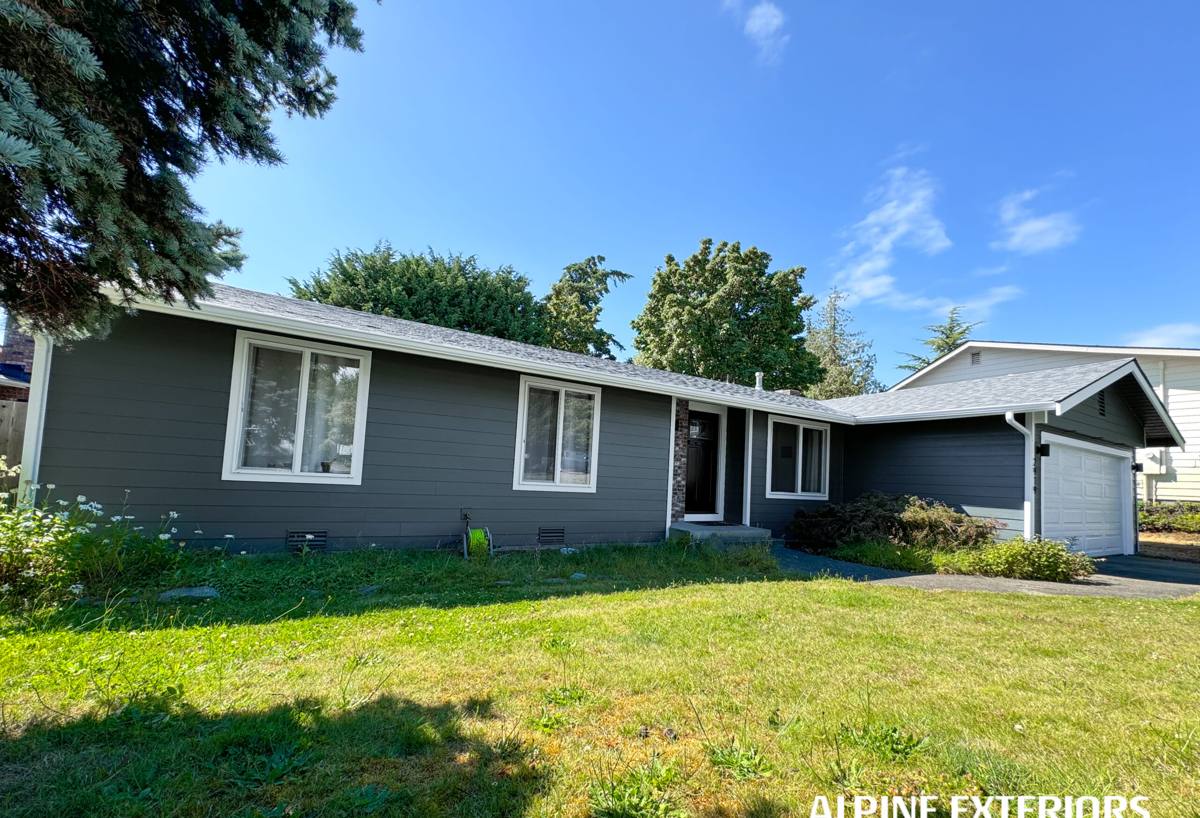
What Fiber Cement Actually Solves for This Neighborhood
Fiber cement siding is a mix of Portland cement, sand, and cellulose fiber, pressed and cured into planks that are dimensionally stable in a way wood and most engineered wood products simply aren't. It doesn't swell when it absorbs moisture, it doesn't delaminate the way OSB-core products can when water gets behind a seam, and it's non-combustible — a real consideration anywhere near dry summer conditions and wildfire smoke seasons, even on the wet side of the Cascades. For a shaded, damp South Hill lot, the properties that matter most are moisture stability and resistance to the kind of surface growth — moss, algae, mildew — that thrives where siding doesn't get enough sun to dry between rain events.
None of that means fiber cement is maintenance-free. It still needs correct clearances, correct flashing, and periodic cleaning to keep moss from taking hold in shaded corners and under eaves. What it means is that when it's installed correctly, the material itself isn't the weak link — the installation is.
Why We Only Install James Hardie, Not Other Fiber Cement or Engineered Wood Brands
We install James Hardie exclusively — we don't put up LP SmartSide, vinyl, Cemplank, Allura, or primed wood siding, even though homeowners ask about all of them. Vinyl expands and contracts more than fiber cement in temperature swings and can crack in cold snaps; engineered wood products rely on a resin-treated wood core that performs well when detailing is perfect but is less forgiving of the moisture exposure a shaded, rainy hillside lot delivers. Hardie's fiber cement formulation is engineered specifically for regional moisture and temperature conditions through its HZ5 product line, backed by a factory-applied ColorPlus finish and a transferable limited warranty. We standardized on it because, installed to spec, it holds up the way this neighborhood's climate demands — and because we'd rather install one product extremely well than several products adequately.
What a Correct Fiber Cement Installation Actually Involves
The material only performs as well as the install. On a South Hill home, the details that separate a job that lasts decades from one that fails early are almost all about water management:
- Clearance from grade and hard surfaces — Hardie panels need a minimum gap above soil, decking, and paved surfaces so splash-back and standing moisture don't wick into the bottom edge.
- Weather-resistive barrier and flashing — a correctly lapped water-resistive barrier behind the siding, with proper flashing at every window, door, and roofline transition, so wind-driven rain off the bay has nowhere to get behind the cladding.
- Fastener pattern and depth — Hardie specifies fastener placement and drive depth precisely; over-driven or misplaced fasteners crack the board or leave gaps that let water track in.
- Joint and seam treatment — factory edges and field-cut edges are treated differently, and butt joints need to be caulked or flashed per Hardie's published details, not left to the installer's judgment.
- Ventilation gap where called for — allowing the wall assembly to dry outward matters even more on a shaded lot where sun-drying time is limited.
Skip any one of these and the siding can still look right for a year or two before the underlying problem shows up as staining, soft trim, or paint failure at the seams.
Signs a South Hill Home's Existing Siding Is Past Its Service Life
Before we talk replacement, it's worth knowing what to actually look for, since not every discolored wall needs a full re-side:
- Persistent green or black staining in shaded corners and under eaves that pressure washing only removes temporarily
- Soft or spongy spots at the bottom courses, especially near grade or below downspouts
- Paint that's peeling or bubbling in sheets rather than just fading, which usually points to moisture trapped behind the surface, not just UV wear
- Visible gaps or separation at butt joints and corner boards
- Warping, cupping, or delamination on the face of the boards themselves
Any one of these on its own might be a repair. Several together, especially on a wall that gets little direct sun, usually means the siding and the water-management details behind it both need to be redone.
How the Material Options Actually Compare
Homeowners on South Hill often ask us to explain, plainly, why we steer toward fiber cement over the alternatives. Here's the honest comparison, without exaggerating any option's weaknesses:
| Material | Moisture/Moss Resistance | Maintenance | Typical Lifespan | Notes for This Climate |
|---|---|---|---|---|
| Vinyl | Sheds water well but seams can trap moisture | Low, but can crack in cold snaps | 20–30 years | Can warp near heat sources; color fades over time |
| Cedar / primed wood | Absorbs moisture readily | High — regular repainting, sealing | 10–20 years without diligent upkeep | Attractive but demanding in a shaded, damp setting |
| Engineered wood (LP-type) | Good if perfectly detailed; vulnerable if water reaches the core | Moderate | 20–30 years with correct maintenance | Resin-treated wood core is less forgiving of installation gaps |
| James Hardie fiber cement | High — dimensionally stable, resists moisture-driven swelling | Low — periodic cleaning to control moss/algae | 30+ years with correct install | Non-combustible; factory ColorPlus finish holds color longer than field paint |
Our Process for South Hill Jobs
Every South Hill property we work on gets treated as its own case, not a template. We walk the exterior first and look specifically at sun exposure, tree cover, drainage patterns, and any existing moisture damage before we talk product or price. From there:
- On-site assessment — we check the sheathing condition once old siding starts coming off, not just the surface appearance beforehand.
- Water-resistive barrier and flashing plan — mapped to the specific roof lines, windows, and grade conditions on that lot.
- Hardie panel installation — to manufacturer fastening and clearance specs, with attention to the shaded and high-exposure walls differently where needed.
- Trim, joint, and caulk detailing — the step most often rushed on lower-quality installs, and the one that determines how the job ages.
- Final walkthrough — so the homeowner sees exactly what was done and why, before we consider the job finished.
Because we work Bellingham and Whatcom County regularly, we already know what wind-driven rain and moss growth do to siding on shaded hillside lots — we're not learning that on your house.
What to Check Before You Hire Anyone for This Job
Whether you go with us or someone else, these are the questions worth asking any crew before they touch a South Hill home's siding:
- Are the installers factory-trained or certified on the specific Hardie product line being used?
- Will they show you the flashing and water-resistive barrier plan before panels go up, not just after?
- Do they follow Hardie's published fastener schedule and clearance specs, or "what's worked before"?
- Is the finish factory-applied ColorPlus, or field-painted — and what warranty applies to each?
- Do they have experience specifically with shaded, tree-covered lots where moss and slow-drying walls are the norm?
- What's the plan for disposal of old siding, and are permits pulled where required?
What Affects the Cost
We don't quote pricing without seeing the house, but the factors that move the number on a South Hill re-side are consistent: total wall square footage, how much of the existing siding and sheathing needs to come off versus what can be built over, the number of window and door openings (each one is a flashing detail), trim and corner complexity, and whether the home needs additional moisture remediation once old siding is removed. Homes with more shaded, moss-prone walls sometimes need extra attention to ventilation detailing, which is a labor consideration more than a material one.
If you're weighing a re-side on South Hill, we're glad to take a look, walk the exterior with you, and give you a straight answer on condition and options — no pressure, no upsell script. A free estimate is the easiest way to find out what your home actually needs.