 Bellingham
 Two Boards That Look Alike on a Spec Sheet
If you've gotten a few siding quotes in Whatcom County, you've probably heard both names: James Hardie and Cemplank. Both are fiber cement. Both come primed or factory-finished. Both show up on paper with similar thickness, similar fire ratings, and similar talking points from whoever's selling them. On a spec sheet, they can look almost interchangeable.
They aren't, and the differences matter more here than they would in a mild, dry climate. Bellingham sits on Bellingham Bay with salt-laden air rolling off the water, driving rain off the Pacific for months at a time, and shaded, north-facing walls that grow moss almost as reliably as the grass does. Siding here doesn't just have to look good on installation day — it has to hold a factory finish and shed water correctly for decades under conditions that are genuinely harder on a wall assembly than most of the country deals with.
This page isn't about trashing Cemplank. It's a legitimate fiber cement product from a real manufacturer, and plenty of houses wear it without incident. It's about explaining, honestly, why we made the decision years ago to install James Hardie exclusively and turn down jobs that call for anything else — including Cemplank.
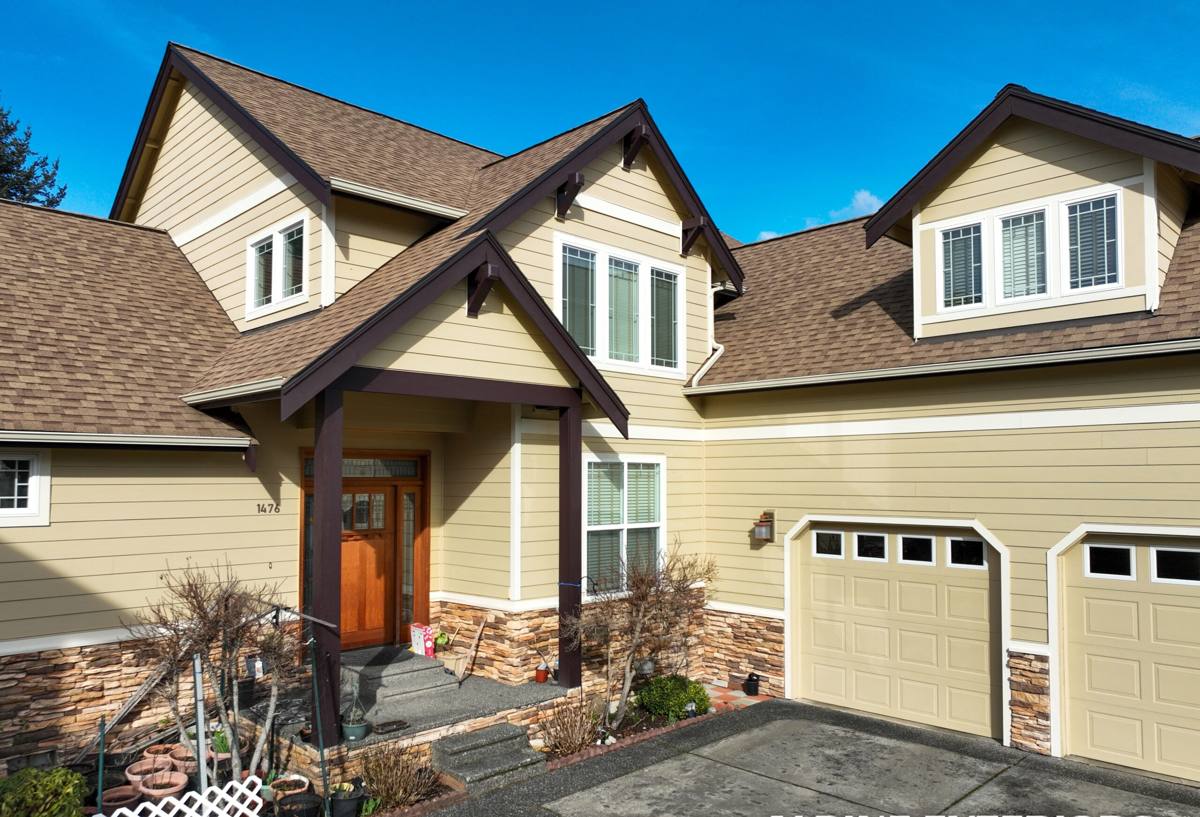
What Cemplank Actually Is
Cemplank is manufactured by Etex Group, the same parent company behind the Allura fiber cement brand. It's a genuine cement-and-cellulose-fiber product, not a vinyl or engineered-wood substitute, and it's sold through many of the same building supply distributors that carry Hardie. Credit where it's due: it's fire-resistant, it doesn't rot the way wood trim does, and it takes paint reasonably well. For a contractor who installs a lot of different brands, it's a workable material.
Where it starts to diverge from Hardie isn't in the raw ingredients — it's in the engineering behind those ingredients, the finish system on top of them, and the warranty structure standing behind the whole install. Those are the parts that matter most once the siding is on a wall in a wet marine climate for the next 30-plus years.
Climate-Specific Engineering: The Part Most Homeowners Never Hear About
HardieZone vs. a One-Size-Fits-All Formula
James Hardie engineers its siding differently depending on where in the country it's going to be installed, through what it calls the HardieZone system. Homes in wet, humid, or coastal regions — which describes Whatcom County almost exactly — get HZ5 formulations, engineered specifically to resist the moisture cycling that comes with driving rain, high humidity, and long stretches of overcast, damp weather. It's a direct response to the fact that fiber cement performs differently in Seattle than it does in Phoenix.
Cemplank doesn't offer a regionally engineered product line in the same way. That doesn't mean it fails in wet climates, but it does mean the moisture-management engineering wasn't built around the specific weather pattern your house sits in — onshore flow, salt air off the bay, and a rainy season that runs most of the year.
Why That Matters More in Bellingham Than It Would Inland
Fiber cement is far more moisture-tolerant than wood or OSB-based products, but it's not moisture-proof, and no fiber cement product is immune to what constant dampness does to a finish, a fastener, or a poorly flashed joint. In a climate with a real moss season and salt-air exposure near the water, the margin for error in both product formulation and installation detail is smaller than it is in a drier region.
The Finish System: ColorPlus vs. Standard Coatings
This is where the visible difference shows up first — usually five to ten years in, which is exactly when it's too late to do anything but repaint.
Factory-Applied, Baked-On Color
James Hardie's ColorPlus finish is applied and cured in a controlled factory environment, in multiple coats, before the boards ever leave the plant. It's backed by its own dedicated finish warranty, separate from the substrate warranty, specifically because Hardie treats the finish as a system component, not an afterthought.
What This Means for Maintenance
A factory-cured finish resists fading, chalking, and moisture-driven peeling far better than field-applied paint, and it holds up better under salt air and constant damp cycling than standard primer-and-paint coatings tend to. Cemplank is typically sold primed, meaning the homeowner or contractor's paint job — not a factory-engineered coating — becomes the long-term line of defense against weather. That paint job is only as good as the primer, the paint, the applicator, and the number of coats, and it's the homeowner who inherits that maintenance schedule, not the manufacturer.
Warranty Structure and What's Actually Backing the Product
| Factor | James Hardie | Cemplank |
|---|---|---|
| Substrate warranty | Non-prorated, long-term, transferable | Manufacturer-backed, terms vary by product line |
| Finish warranty | Separate ColorPlus finish warranty, factory-applied | Typically primed; paint/finish warranty depends on field application |
| Climate-specific formulation | HardieZone HZ5 for wet/coastal regions | No regional formulation system |
| Regional brand recognition | Widely recognized by PNW buyers and appraisers | Less commonly specified in this region |
| Installer specification consistency | Single fastener, clearance, and flashing spec across our crews | Would require a second install standard alongside Hardie |
Warranty terms shift over time and by product line, so we'd rather a homeowner read the current published warranty on whatever product they're considering than take a contractor's word for it. What we can speak to firsthand is which one we've built our installation practices, training, and long-term callback experience around — and that's Hardie.
Why We Don't Run Two Installation Systems
This is the least talked-about reason, and it's arguably the most practical one. Fiber cement siding fails or succeeds based on installation details most homeowners never see: fastener placement and spacing, minimum clearances off grade and roof lines, weather-resistive barrier and rain-screen detailing behind the boards, caulking joints correctly, and flashing every horizontal transition so water is shed, not trapped.
Every brand publishes its own installation manual with its own fastener schedules, clearances, and butt-joint treatments. A crew that installs three or four different siding brands is, in effect, juggling three or four different rulebooks. Small details get crossed between systems — a clearance from one manual, a fastener pattern from another — and those small details are exactly what determines whether a wall assembly sheds Bellingham's rain correctly or slowly lets moisture in behind the cladding.
We standardized on one system so our crews install the same product, to the same spec, on every job. That consistency is a bigger factor in long-term performance than most homeowners realize when they're comparing quotes.
What This Means for a House in Whatcom County
None of this means a Cemplank-clad house is doomed. It means the margin for error is thinner here than in a dry climate, and we'd rather put a climate-engineered product with factory-cured color and a single, well-practiced installation standard on a home that's going to sit through salt air, driving rain, and a long moss season year after year. That's a decision about risk management on our end, not a verdict on every fiber cement product other than the one we install.
If you're evaluating quotes and different contractors are proposing different fiber cement brands, it's worth asking pointed questions rather than assuming "fiber cement is fiber cement."
- Ask which fiber cement brand and product line is being quoted, by name — not just "fiber cement."
- Ask whether the finish is factory-applied and cured, or field-primed and painted.
- Ask to see the manufacturer's current written warranty, not a verbal summary.
- Ask whether the crew installing your job specializes in that one brand or rotates between several.
- Ask how clearances and flashing will be handled at grade, around windows, and at roof-to-wall transitions.
- Ask whether the product has any climate-specific formulation for wet, coastal regions like ours.
Why We Put Hardie on Every Job
We install James Hardie exclusively because it's the one product where we can vouch for the whole system — the HZ5 formulation built for wet coastal climates like Bellingham's, the factory-cured ColorPlus finish that doesn't leave the homeowner responsible for a paint schedule from day one, a warranty structure we can point to in writing, and an installation standard our crews know cold because it's the only one they run. That combination is what we've found holds up best against salt air off the bay, driving winter rain, and the moss that comes with a lot of shade and a lot of moisture.
If you're weighing siding options for a home in Bellingham or anywhere in Whatcom County, we're glad to walk through what we see on real houses in this climate and give you a straight answer — including when a full re-side isn't even the right call yet. Reach out for a free, no-pressure estimate using the form below.