 Bellingham
 Bellingham sits in a tough spot for exterior materials. You've got salt air rolling in off Bellingham Bay, driving rain that comes in sideways for months at a stretch, and a moss season that seems to run from October through June some years. Add in the freeze-thaw cycles Whatcom County gets a few times most winters, and your siding is working harder than most homeowners realize. The good news is that siding almost never fails overnight. It sends signals first — usually months or years before a small problem turns into rot, mold, or a full re-side. This guide walks through what those signals look like, what causes them, and how to tell the difference between something you can watch and something you need to act on now.
Why Siding Fails Faster Here Than in Drier Climates
Siding is a system, not just a decorative skin. Its whole job is to keep water moving down and away from the wall assembly behind it. In Bellingham, that system gets tested constantly. Wind-driven rain off the Sound pushes moisture into seams and laps that would stay dry in a calmer climate. Salt air accelerates corrosion on fasteners, flashing, and metal trim. And because our summers rarely give siding a long, hot, dry stretch to fully evaporate trapped moisture, any water that does get behind the material has more time to do damage before it dries out.
Moss and algae compound the problem. They hold moisture against the surface, and on wood-based products they can feed rot organisms directly. None of this means siding is doomed here — plenty of well-installed, well-maintained siding lasts decades in this climate. But it does mean small issues get less benefit of the doubt than they would in Spokane or Sacramento. What looks cosmetic in July can be a moisture problem by the following spring.
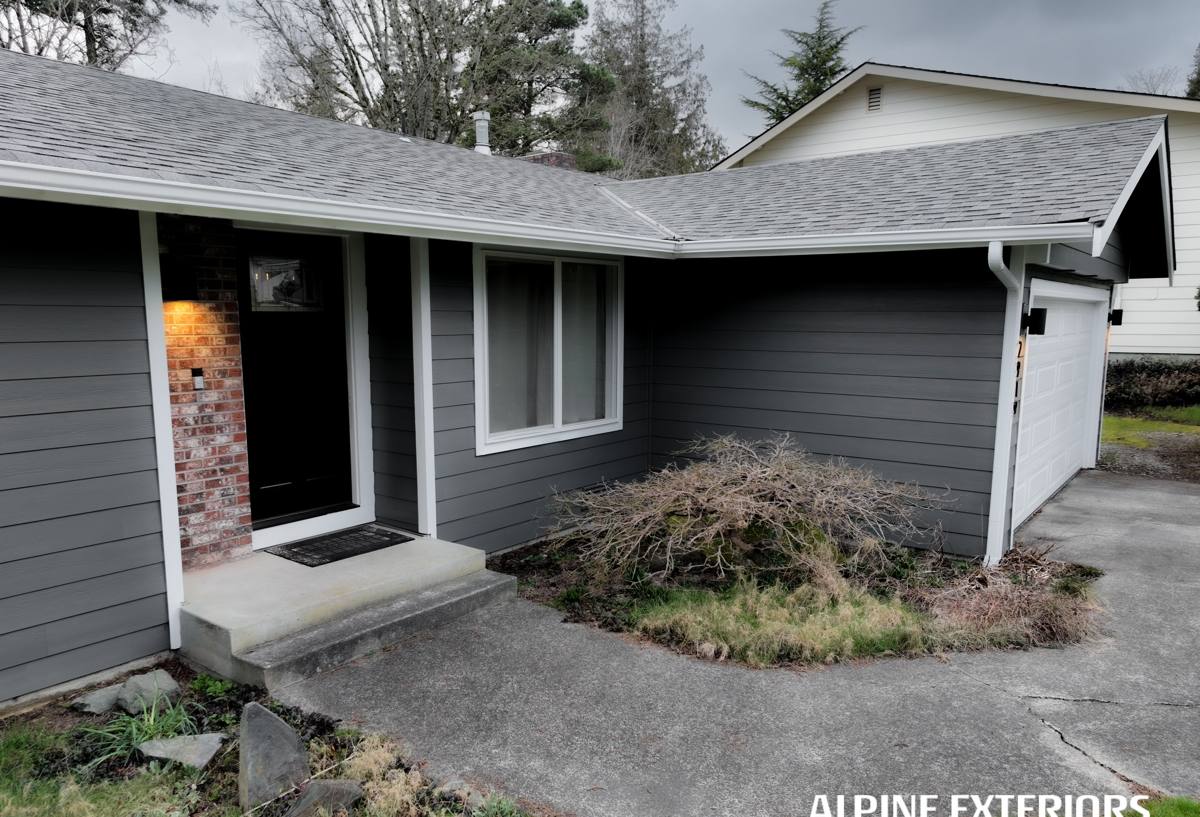
Visual Warning Signs You Can Check From the Ground
Cracking, Splitting, and Warping
Hairline cracks in wood or composite siding widen over time and become water entry points. Warping or buckling boards usually mean moisture has already gotten behind the material and it's expanding and contracting unevenly. On lap siding, watch for boards that no longer sit flat against the wall — a wave or cup shape is a clear sign of moisture cycling.
Peeling or Bubbling Paint
Paint failure on siding almost always traces back to moisture, not just age. If paint is peeling in sheets or bubbling rather than just chalking and fading evenly, water is moving through the material from behind. This is especially common on the north and west-facing walls of Bellingham homes, which take the brunt of driving rain and get the least sun to dry out between storms.
Discoloration and Dark Streaking
Dark streaks running down from seams, nail heads, or trim joints usually indicate water is tracking along a path it shouldn't be. Rust-colored streaks point to corroding fasteners — a bigger deal near the water where salt air speeds up the process. Greenish or black staining that won't power-wash off is often moss, algae, or early mold growth rather than dirt.
Soft or Spongy Spots
Press gently on suspect areas, especially near the bottom of walls, around window and door trim, and near roof-to-wall transitions. Wood-based siding that gives or feels soft has active rot underneath. This is one of the clearest signs that repair windows have already closed on that section.
Signs You'll Notice From Inside the House
- Musty or mildew smell in a room along an exterior wall, especially after rain
- Peeling paint or bubbling drywall on interior walls near windows or the bottom of exterior walls
- Visible mold on interior trim or baseboards along exterior walls
- Unexplained increases in heating bills, which can mean wet, compressed insulation has lost its R-value
- Warped baseboards or trim on exterior walls
These interior signs matter because by the time moisture shows up inside, it's usually been working on the wall assembly from the outside for a while. Interior symptoms are a good reason to get an exterior inspection quickly rather than waiting.
Signs at Seams, Trim, and Penetrations
Most siding failures don't start in the middle of a flat wall — they start at the details. Check these areas specifically:
- Butt joints and seams — gaps, cracking caulk, or visible daylight between boards
- Window and door trim — separation between the trim and siding, or soft wood at the bottom corners
- Corner boards — rot commonly starts here because water sheets off two directions at once
- Roof-to-wall intersections and dormers — flashing problems here can mimic siding failure but require a different fix
- Deck ledger and porch attachment points — frequently under-flashed on older Bellingham homes and prone to hidden rot
What Causes These Problems in the First Place
Product-Level Issues
Some siding materials are more moisture-sensitive by nature. Untreated or primed wood products absorb water at cut ends and fastener penetrations unless every edge is sealed and maintained on schedule. Engineered wood products depend heavily on an intact factory coating — once that's compromised at a scratch or cut edge, the substrate underneath can wick moisture and swell. This is a big part of why we standardized on James Hardie fiber cement: it's not organic material, so it doesn't feed rot or support the kind of moisture-driven decay wood-based products are prone to.
Installation-Level Issues
Even a good product fails early if it's installed wrong. Common culprits we see on inspections include missing or undersized flashing above windows and doors, siding installed too close to grade or a roofline (trapping moisture against the bottom edge), caulk used in place of proper flashing, and fasteners driven too tight or at the wrong spacing, which restricts the material's ability to expand and contract.
Maintenance Gaps
Every siding product has a maintenance schedule, whether or not the homeowner was told about it. Repainting intervals, caulk inspection, gutter cleaning to keep water off the wall, and moss removal all extend siding life. Skipping these doesn't cause instant failure, but it shortens the runway between "early warning sign" and "structural problem."
Repair, Monitor, or Replace: A Practical Framework
| Situation | Typical Response | Why |
|---|---|---|
| Isolated caulk failure or single cracked board, no soft wood found | Spot repair | Localized issue, substrate still sound |
| Peeling paint with no soft spots, on a wall under 10-15 years old | Monitor + repaint on schedule | Likely coating age, not active moisture intrusion |
| Soft spots at multiple corners or seams | Full inspection, likely partial re-side | Suggests a systemic flashing or moisture issue, not a one-off |
| Interior moisture symptoms with matching exterior signs | Prioritize inspection soon | Wall assembly moisture is already established |
| Siding is 20+ years old with widespread warping or rot | Full replacement | Cumulative wear outweighs the cost of repeated repairs |
A straight repair-versus-replace call should always follow a hands-on inspection, not a guess from the curb. But this table gives a general sense of how the decision usually shakes out.
A Quick Self-Check Before You Call Anyone
- Walk the full perimeter of the house, including areas hidden by landscaping or fencing
- Press on siding near the bottom of walls and at corners, especially north and west-facing sides
- Look up at trim above windows and doors for staining or gaps
- Check inside on exterior walls for smell, staining, or soft trim
- Note the age of the siding and when it was last painted or resealed, if applicable
When It's Time to Replace, Not Just Repair
Once rot, warping, or moisture intrusion shows up in multiple areas rather than one isolated spot, patch repairs tend to become a repeating expense rather than a fix. That's usually the point where a full or partial re-side makes more financial sense than chasing individual problem areas year after year. When homeowners in Bellingham get to that decision point, we install James Hardie fiber cement exclusively — it's non-combustible, engineered for wet coastal climates, holds its factory ColorPlus finish far longer than field-applied paint, and comes with a strong transferable warranty. We don't install vinyl, LP SmartSide, or other wood-based composite products, because we've seen how this specific climate — the rain, the salt air, the moss — tends to expose their weak points over time. Hardie isn't the cheapest option on day one, but it's the one we're willing to stand behind for the long haul in this environment.
Get a Second Set of Eyes
If you're seeing any of the signs above — or you're just not sure how your siding is holding up after another wet Whatcom County winter — it's worth getting an honest, no-pressure look before small problems turn expensive. Request a free estimate below and we'll walk the exterior with you, point out what we find, and give you a straight answer on repair versus replacement.