 Bellingham
 Siding Built for the Way Sudden Valley Actually Weathers
Sudden Valley sits in a different microclimate than a lot of the rest of Whatcom County. The community wraps around Lake Whatcom under heavy tree cover, and that combination of water, shade, and forest changes how a house ages compared to a home out in the open on a windswept lot. Homes here don't necessarily take the hardest wind-driven rain in the county, but they take something arguably tougher on siding over time: near-constant shade, elevated humidity off the lake, and long stretches where a wall simply never fully dries out between rain events.
Add in the broader reality of living in Whatcom County — close enough to the Salish Sea and Bellingham Bay that the regional air carries a faint salt influence even well inland — and you get an exterior environment that rewards materials chosen deliberately, not generically. We install siding, roofing, windows, and decks across the Bellingham area, and Sudden Valley is one of the neighborhoods where the material choice matters more than the average buyer expects going in.
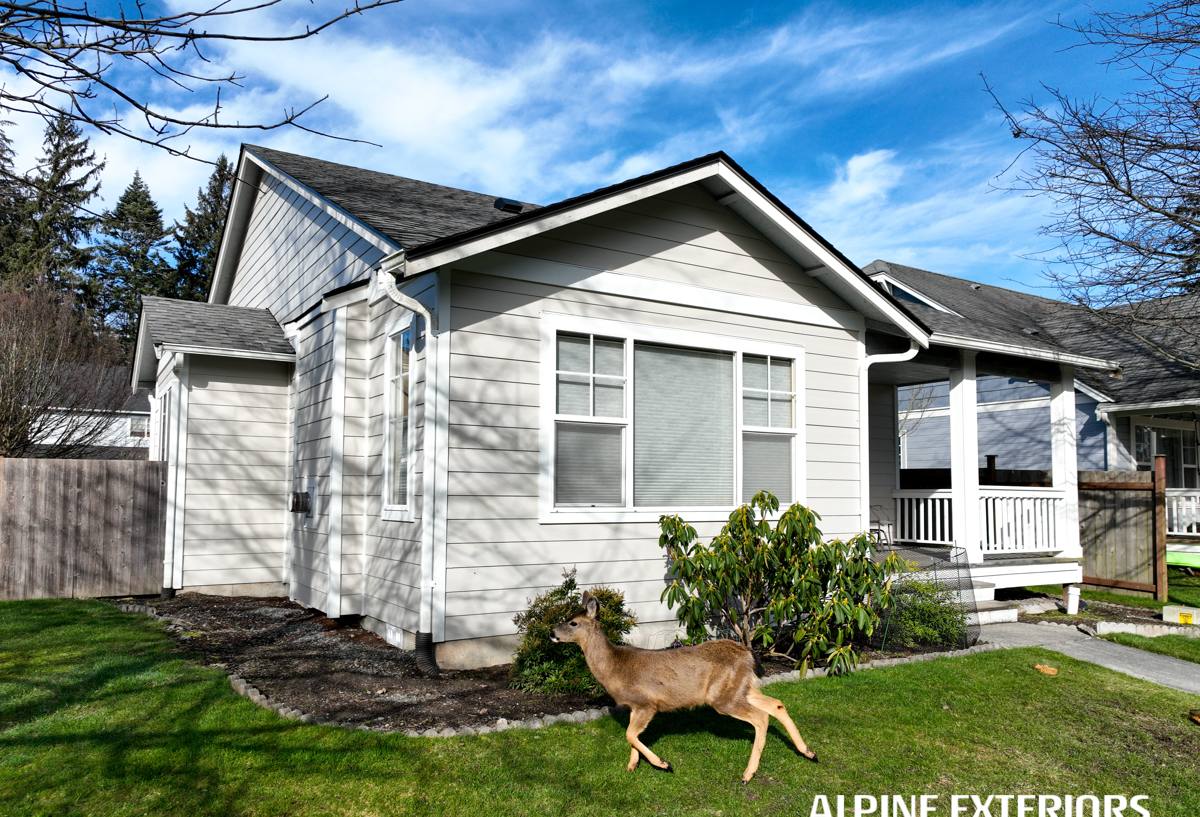
What the Lake Whatcom Microclimate Does to a House
Shade that never fully lets a wall dry
Mature conifers and a lot of tree canopy are part of what makes Sudden Valley desirable, but they also mean many homes have entire wall sections that see limited direct sun for most of the day. Sunlight is one of the cheapest, most effective drying mechanisms a house has. Without it, moisture that lands on a wall — from rain, dew, or lake-driven humidity — sits there longer. That extended damp window is exactly the condition that lets mold, algae, and moss get a foothold on siding, trim, and roofing.
Moss and organic growth as a long-season problem
In a lot of Western Washington, moss is a fall-and-winter concern. Around Lake Whatcom, with the added shade and humidity, the moss season runs longer and starts earlier. It shows up first on north-facing walls, under eaves, and anywhere siding sits close to landscaping or overhanging branches. Left unaddressed, moss and algae hold moisture directly against the surface of the siding — which is a much bigger problem for some materials than others.
Lake-effect humidity and driving rain
Lake Whatcom generates its own localized humidity and morning mist, on top of the rain that moves through the broader Bellingham area. Wind off the water can drive rain sideways into exposed gable ends and upper stories, pushing moisture into seams, laps, and trim joints that a calmer site wouldn't stress nearly as hard.
How These Conditions Show Up on Different Siding Materials
Not every siding product responds to shade and moisture the same way, and this is where a lot of homeowners get surprised a few years after installation.
- Wood-based composite siding (OSB-core products) can swell, delaminate at the edges, or lose its factory finish faster when it stays damp for extended periods — exactly the pattern a heavily shaded Sudden Valley lot creates.
- Vinyl siding doesn't rot, but it doesn't fight moss and algae growth either, and it can trap moisture behind it against the wall sheathing if installed or flashed poorly.
- Cedar and other wood siding looks great new, but it needs active maintenance — re-staining, caulking, spot repairs — to keep ahead of moisture in a shaded environment, and that maintenance burden only grows over time.
- Fiber cement siding is inorganic — there's no wood fiber for moisture to feed on, so it doesn't swell, delaminate, or rot the way wood-based products can.
That last point is the whole reason we standardized the way we did.
Why We Install Only James Hardie Fiber Cement
We made a deliberate call some time ago to stop installing LP SmartSide, vinyl, Cemplank, Allura, and primed wood siding, and to install James Hardie fiber cement exclusively. It's not that every one of those products is a bad product in every application — it's that for the climate we work in, and for homes in conditions like Sudden Valley's, Hardie's engineering and track record hold up better over the life of the siding.
Non-combustible by composition
James Hardie siding is fiber cement — sand, cement, and cellulose fiber — which means it's non-combustible. That's a meaningful difference from wood-based and vinyl products, and it's one factor insurers and homeowners increasingly weigh when comparing exterior materials.
Engineered for the Pacific Northwest specifically
Hardie's HZ5 product line is engineered for climates like ours — the freeze-thaw cycles, prolonged damp seasons, and moisture exposure that define Western Washington. It's not a one-size-fits-all product pulled from a national catalog; it's built with this region's weather in mind.
ColorPlus factory finish
Rather than field-painting siding after installation, Hardie's ColorPlus finish is baked on at the factory under controlled conditions, which gives it stronger fade and wear resistance than most site-applied paint jobs — a real advantage in a shaded environment where surfaces stay damp longer and finishes get pushed harder.
A warranty that reflects confidence in the product
James Hardie backs its siding with a strong, transferable warranty. That transferability matters in a community like Sudden Valley where homes do change hands — it's a selling point for the current owner and a reassurance for the next one.
None of this means fiber cement is maintenance-free or bulletproof against bad installation. It means that when it's installed to spec — correct clearances, proper flashing, correct fastening — it holds up to shade, moisture, and a long moss season better than the alternatives we chose to stop installing.
It's Not Just Siding — The Whole Exterior Envelope Matters
Siding doesn't work in isolation. On a shaded, moisture-heavy lot like a lot of Sudden Valley properties, the roof, windows, and any exterior structures like decks all interact with the same conditions, and neglecting one undermines the others.
Roofing
A roof that's holding moss, has failing flashing, or is shedding water poorly will send that water straight down onto your siding and trim. We look at roof condition as part of any siding conversation on a shaded lot, because the two systems are connected whether homeowners think about it that way or not.
Windows
Window flashing and trim are common failure points where wind-driven rain finds its way behind the siding plane. When we replace siding, we pay close attention to how it integrates with existing or new window flashing rather than just working around what's there.
Decks
Decks on shaded, lake-adjacent lots deal with the same slow-drying conditions as siding — algae on decking boards, ledger board rot where the deck meets the house, and fastener corrosion. A deck built or maintained without that in mind becomes a moisture entry point for the house itself.
What a Siding Project Looks Like for a Sudden Valley Home
Every home is different, but a few things tend to come up consistently on shaded, lake-proximity properties:
| Factor | Why it matters here |
|---|---|
| Wall inspection before tear-off | Shaded walls often hide sheathing damage behind moss-covered or delaminated siding that isn't visible from the ground. |
| Flashing and moisture barrier detail | With less natural drying from sun exposure, correct house wrap and flashing sequencing matters more than on an open, sunny lot. |
| Clearances at grade and landscaping | Shaded lots often have siding sitting close to shrubs, ferns, or mulch beds that hold moisture against the wall — proper clearance is part of the install, not an afterthought. |
| Trim and caulking | Trim boards are usually the first failure point in a long moss season; getting these details right up front reduces callbacks for years. |
| Color and finish selection | Darker ColorPlus tones can look great against heavy tree cover, but heat and fade behavior differ by color — worth discussing before ordering material. |
Why a Local Crew Matters for This Kind of Property
Sudden Valley sits far enough from the center of Bellingham that some contractors treat it as an afterthought — a longer drive that gets squeezed in when convenient. That shows up in scheduling, in how carefully punch-list items get handled, and in whether anyone comes back promptly if something needs adjusting after the fact. A crew that works Whatcom County regularly, including communities like Sudden Valley, understands the tree cover, the moisture patterns, and the access considerations that come with wooded, lake-adjacent lots — narrower driveways, limited staging space, and the need to protect landscaping during tear-off and disposal.
Here's a short list worth going through with any contractor bidding your siding project, whether that's us or someone else:
- Are they installing manufacturer-certified per James Hardie's fastening and clearance specifications, or just "similar to" the spec?
- Do they inspect and address sheathing condition before installing new siding, not just cover over what's there?
- Will they coordinate roofing, window, and siding work so flashing details tie together instead of being handled by separate crews with no communication?
- Do they carry proper licensing and insurance for work in Washington State, and will they put that in writing?
- Do they give a written estimate that specifies the actual Hardie product line, not just "fiber cement" generically?
- Are they upfront about lead times, since Hardie product availability can vary by color and profile?
Maintaining Siding in a Shaded, Moisture-Heavy Environment
Fiber cement siding needs less maintenance than wood-based alternatives, but "less" isn't "none," especially in a spot like Sudden Valley. A few habits go a long way:
- Trim back branches and shrubs that keep siding shaded and damp against the wall — airflow is your friend here.
- Rinse moss and algae growth off with a garden hose and soft brush rather than a pressure washer, which can drive water behind laps and trim if used too aggressively.
- Check caulking at trim joints and penetrations annually — this is usually the first thing to fail, well before the siding panels themselves show any wear.
- Keep gutters clear so overflow isn't running down the face of the siding during heavy rain.
- Watch north-facing and heavily shaded walls specifically — that's where moss and staining will show up first.
Get a Straightforward Look at Your Home
If you're noticing moss buildup, paint failure, soft spots, or siding that just looks tired despite not being that old, it's worth having someone take a real look rather than guessing from the ground. We'll walk the exterior, talk through what we're seeing, and give you a straightforward, no-pressure estimate for siding — and if roofing, windows, or a deck are part of the picture, we can look at those too. Fill out the form below to get started.