 Bellingham
 Why Ferndale Roofs Wear Differently Than Roofs Inland
Ferndale sits close enough to the water and open farmland that its roofs take a different kind of beating than a roof twenty miles inland. Homes here deal with a steady mix of salt-laden air off the Strait, wind-driven rain that comes in sideways instead of straight down, and long stretches of damp, shaded weather that keep roof surfaces wet for days at a time. None of that is dramatic on any single day, but it adds up year after year in ways that shorten the life of a shingle roof that wasn't installed with those conditions in mind.
The three biggest local stressors we plan around on every Ferndale roofing job are salt exposure, wind-driven rain, and moss and algae growth. Each one attacks a roof differently, and each one calls for a specific detail in the install — not just "a good shingle."
Salt Air and Metal Components
Salt in the air accelerates corrosion on anything metal on the roof: flashing, vent caps, fasteners, and gutter hardware. A roof that looks fine from the ground can have flashing or nail heads corroding underneath the shingles years before the shingles themselves are due for replacement. We spec corrosion-resistant metals and fasteners on every roof we install in and around Ferndale for this reason, not as an upsell but because it's the difference between flashing that lasts the life of the roof and flashing that needs attention in year eight or nine.
Wind-Driven Rain
Rain that comes in at an angle finds every weak point in a roof system — lap seams, nail placement, valley details, and the transitions around chimneys, skylights, and dormers. A roof that would perform fine under straight-down rain can leak under driving rain if those transition points aren't detailed correctly. This is one of the most common causes of "mystery leaks" we get called out for on older Ferndale roofs, and it's almost always a detailing issue rather than a shingle failure.
Moss and Algae Season
Whatcom County's long wet season, combined with tree cover and north-facing roof slopes that don't get much sun, creates ideal conditions for moss and black algae streaking. Moss holds moisture against the shingle surface and can work its way under shingle edges over time, while algae staining is mostly cosmetic but signals a roof surface that's staying damp longer than it should. Both are manageable with the right shingle choice and a little routine maintenance, which we cover below.
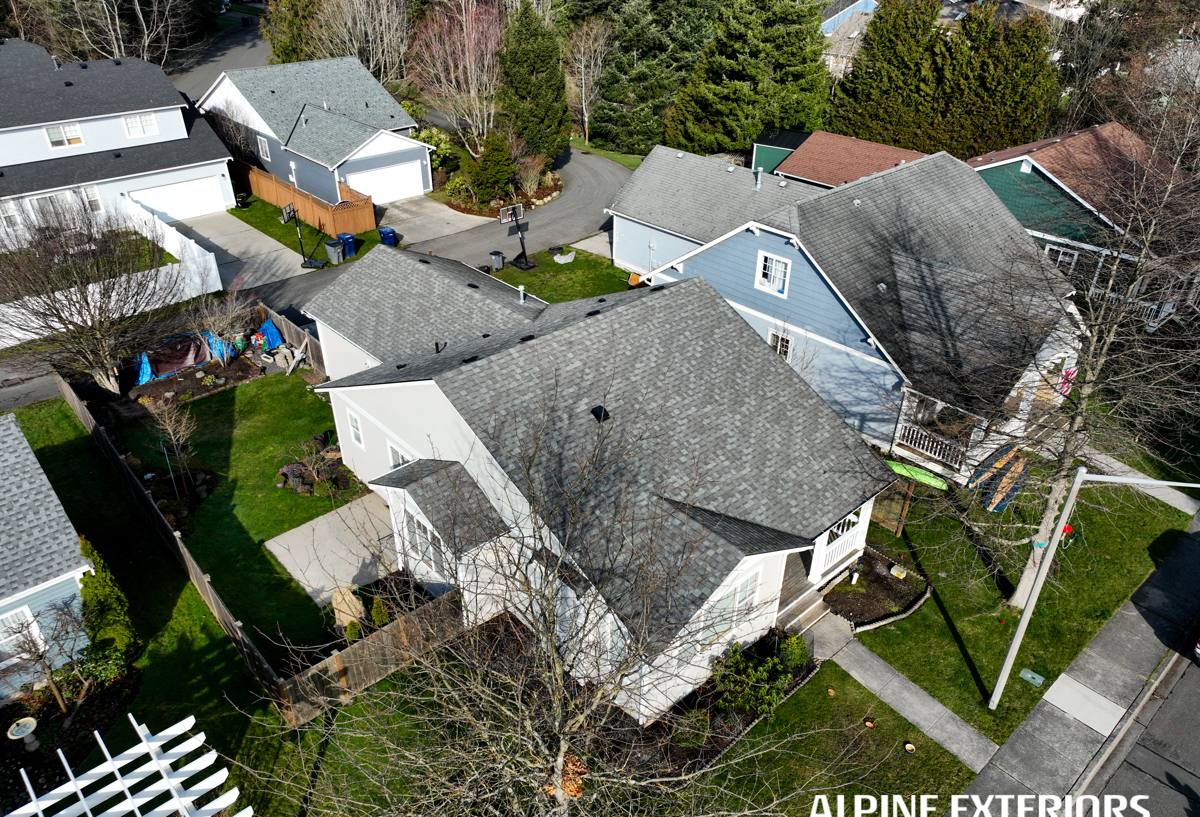
What a Correctly Installed Shingle Roof Includes Here
A roof that's built to hold up in this climate isn't just shingles nailed to plywood. There are several layers and details that matter more here than they would in a drier, calmer climate.
- Ice and water shield at vulnerable points — eaves, valleys, and roof-to-wall transitions get a self-adhering waterproof membrane underneath the shingles, not just felt paper.
- Synthetic underlayment across the full roof — more tear-resistant and more water-resistant than old-style felt, especially useful during the install itself when a roof deck can sit exposed for a day or two.
- Corrosion-resistant flashing and fasteners — at chimneys, skylights, sidewalls, and valleys, matched to the salt exposure in this area.
- Balanced attic ventilation — intake at the eaves and exhaust at the ridge, sized to the attic volume, so moisture doesn't get trapped under the deck.
- Proper nailing pattern and shingle exposure — set to the manufacturer's high-wind specification, not just the minimum code nailing pattern.
- Algae-resistant shingle granules where the roof has shade or north-facing exposure prone to moss and streaking.
Skip any one of these and the roof will likely still look fine on installation day — the problems that show up from cutting corners on wind-driven-rain climates tend to surface two, five, or ten years later, which is exactly why they're worth getting right the first time.
How Our Ferndale Roofing Process Works
1. Inspection and Honest Assessment
We start by getting on the roof (or using a drone when access or safety calls for it) to look at the deck, the flashing, the ventilation, and the general condition of the roof — not just the shingles. Sometimes a roof that looks rough from the ground has a lot of life left; sometimes a roof that looks fine has a soft spot or a flashing problem that needs attention. We tell you what we actually find.
2. A Written, Itemized Quote
You get a quote that spells out the shingle line, the underlayment and ice-and-water-shield coverage, flashing work, ventilation changes if needed, and disposal — not a single lump number. That way you know exactly what you're paying for and can compare it against any other bid apples-to-apples.
3. Tear-Off and Deck Inspection
We remove the old roofing down to the deck rather than layering over it. This lets us actually see and repair any soft or water-damaged sheathing before it gets covered up again — a step that gets skipped by contractors trying to install fast and cheap, and one that matters a lot in a climate where hidden moisture is common.
4. Install to Manufacturer and Local-Condition Specs
Underlayment, ice and water shield, flashing, shingles, and ventilation go in following both the manufacturer's installation requirements and the extra detailing this climate calls for, as outlined above.
5. Cleanup and Final Walkthrough
We magnet-sweep for nails, haul away the old material, and walk the finished roof with you so you know what was done and what to expect going forward.
Choosing a Shingle Line for Coastal Whatcom Weather
Not every asphalt shingle line is built the same way, and the differences matter more here than in a mild inland climate. The table below is a general guide to how shingle tiers typically compare — your best choice depends on your roof's slope, sun exposure, and budget, which we'll walk through together during your estimate.
| Shingle Tier | Wind Rating | Algae Resistance | Typical Lifespan |
|---|---|---|---|
| Standard 3-tab | Lower | Limited or none | Shorter — often the first to show wear in this climate |
| Architectural / dimensional | Moderate to high | Usually available as an upgrade option | Mid-to-long, with better wind and impact performance |
| Premium algae-resistant architectural | High | Built-in algae-resistant granules | Longest-performing option for shaded, damp roof sections |
For most Ferndale homes, we recommend at least an architectural-grade shingle with algae-resistant granules on north-facing or tree-shaded slopes. The upfront cost difference over a basic 3-tab shingle is modest compared to the cost of dealing with moss and streaking a few years down the road.
Moss, Algae, and Ongoing Roof Health
Even a well-installed roof benefits from a little seasonal attention in a moss-prone climate like ours. None of this is complicated, but it's easy to let slide until moss has gotten a foothold.
- Keep gutters and valleys clear of needles and leaf debris, which hold moisture against the shingle surface.
- Trim back overhanging branches to let more sun and airflow reach shaded roof sections.
- Have visible moss removed by a professional using proper technique — scraping or pressure-washing incorrectly can strip granules and shorten shingle life faster than the moss itself.
- Watch for algae streaking as an early signal, not an emergency — it's mostly cosmetic but worth mentioning at your next inspection.
- Schedule a roof check every year or two, especially after a hard windstorm, rather than waiting for a visible leak.
Attic Ventilation: The Detail Homeowners Rarely Think About
A shingle roof doesn't just get attacked from the outside — poor attic ventilation traps warm, moist air underneath the deck, which can lead to premature shingle aging from below, condensation issues, and even ice damming during a cold snap. Balanced ventilation (intake low at the eaves, exhaust high at the ridge) keeps that attic air moving and dry. When we replace a roof, we check existing ventilation and will flag it if it's undersized or unbalanced — this is a case where a small correction during the roofing job saves a much bigger headache later.
What Affects the Cost of a Ferndale Roofing Project
| Factor | Why It Matters |
|---|---|
| Roof size and pitch | More material and more complex safety setup on steep roofs increases labor time. |
| Number of layers to remove | Roofs with multiple old layers take longer to tear off and may reveal more deck repair needs. |
| Deck condition | Soft or water-damaged sheathing found during tear-off needs to be replaced before shingles go on. |
| Shingle tier chosen | Standard, architectural, and premium algae-resistant lines carry different material costs. |
| Flashing and ventilation work | Chimneys, skylights, and ventilation upgrades add material and labor beyond a basic reshingle. |
| Access and roof complexity | Steep pitches, multiple valleys, and tight access all add time and safety equipment needs. |
We won't give a number here that means nothing without seeing your roof — instead, our estimate breaks down exactly which of these factors apply to your project so you can see where your money is going.
Why a Crew That Already Works Ferndale Roofs Matters
Roofing crews that mostly work drier, calmer parts of the state can do a technically fine install and still miss the details that matter for coastal Whatcom County — the extra ice-and-water-shield coverage, the corrosion-resistant fastener choice, the algae-resistant shingle recommendation for a shaded slope. Those aren't exotic upgrades; they're standard practice for anyone who roofs here regularly and has seen what five or ten years of salt air and driving rain actually does to a roof that wasn't detailed for it.
Working locally also means we're not guessing at permitting requirements, disposal logistics, or how a given roof's orientation and tree cover will affect moss growth. It's the difference between a contractor solving your roof in the abstract and one solving your specific roof, on your specific lot, in Whatcom County weather.
Get a Straightforward Estimate
If your Ferndale roof is showing moss, algae streaking, granule loss, or you're just past due for a look, we're happy to come take a look and give you an honest read on where it stands. There's no pressure and no obligation — just a clear assessment and a written quote you can take your time with. Use the form below to request your free estimate.