 Bellingham
 Why Decks in the Birchwood Area Wear Out Faster
Bellingham sits in a marine climate, and Whatcom County homes pay for it in a few specific ways when it comes to outdoor structures. Salt-laden air drifting in off the Salish Sea accelerates corrosion on any exposed metal fastener, bracket, or hinge. Driving rain off Bellingham Bay doesn't just fall straight down — wind-driven moisture gets pushed sideways into gaps, seams, and end grain that a dry-climate deck would never have to deal with. And because so much of Birchwood and the surrounding neighborhoods sit under mature tree canopy, decks here go through a long moss and algae season that can run eight or nine months a year in a shaded yard.
None of that means a deck can't last in this area. It means a deck built without those three things in mind — corrosion, wind-driven wet, and prolonged shade moisture — will show problems years before it should. We see it constantly: decks that look fine from the yard but have soft ledger boards, rusted-through joist hangers, or a slick green film that never fully dries between rains.
Salt Air and Fastener Corrosion
Standard electro-galvanized fasteners and hardware are not built for a coastal-influenced climate like Bellingham's. Over a decade or so, galvanic coatings on cheaper fasteners break down, and once that happens, corrosion moves fast on treated lumber because the copper compounds in modern pressure-treated wood accelerate corrosion on the wrong metal. A deck that used mismatched hardware often fails at the connections — the joist hangers, the ledger bolts — long before the boards themselves are unusable.
Moss, Mildew, and Trapped Moisture
Moss itself doesn't rot wood, but it holds water against the surface for weeks at a time, and that constant dampness is exactly what wood decay fungi need. Decks in shaded Birchwood yards with tight board spacing or poor airflow underneath tend to develop soft spots at butt joints and around fasteners well before decks in full sun, even when both were built the same year with the same materials.
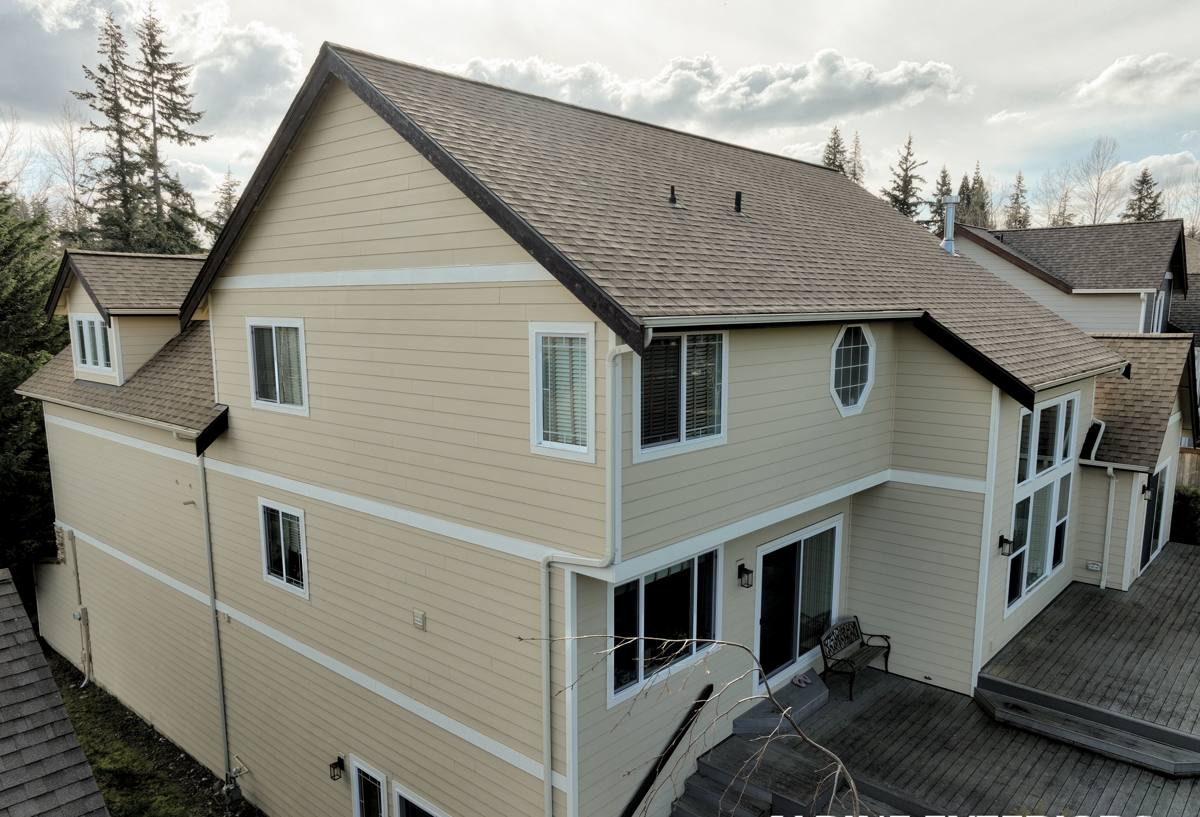
Signs Your Deck Needs Replacing, Not Just Patching
A lot of decks get repaired board by board for years past the point where that's the economical choice. Here's what tells us a full replacement is the honest recommendation instead of another round of patching:
- Soft or spongy spots anywhere in the decking, especially near the house or around posts
- Visible rot, rust streaking, or crumbling at the ledger board where the deck attaches to the house
- Joist hangers or structural fasteners that are rusted, loose, or missing entirely
- Posts that wobble at the base, which usually points to footing or post-base failure, not just a cosmetic fix
- Railings that flex noticeably when leaned on — this is a safety issue, not a maintenance one
- A deck more than 20-25 years old that has never had the substructure inspected or updated
- Persistent moss or algae that returns within weeks of cleaning, signaling the wood underneath is staying wet
If what you're seeing is limited to a handful of surface boards and the framing underneath is sound, repair can make sense. Once the ledger, joists, or footings are compromised, patching the decking on top of a failing structure is just delaying a bigger problem — and a more expensive one, since by then it's often attached to a rot issue on the house itself.
What Goes Into a Correct Deck Replacement
Tearing off old boards and screwing down new ones is the easy 20% of a deck replacement. The parts that determine whether it lasts 10 years or 30 happen underneath.
Ledger Board and Flashing
This is the single most important connection on the entire deck, and it's the one most likely to be done wrong on older builds. The ledger board bolts directly to the house framing, and if the flashing behind it isn't properly integrated with the home's water-resistive barrier, rain gets channeled directly into the house's rim joist and wall framing instead of running off. In a climate with as much sideways-driven rain as Bellingham gets, a poorly flashed ledger is one of the more common causes of hidden structural rot we find once we open a deck up.
Framing, Footings, and Fasteners
Footings need to be sized and set to current code for our frost depth and soil conditions, not just poured to match whatever was there before. We use fasteners and structural hardware rated for the corrosive combination of coastal air and modern treated lumber — stainless steel or heavy-duty coated hardware at every structural connection, not standard-grade screws that will start rusting within a few winters.
Decking Material Choices
The decking surface itself is where most homeowners spend their attention, and it's worth getting right for this specific climate — some materials handle Bellingham's wet-shade cycle better than others.
| Material | Upfront Cost | How It Handles PNW Moisture | Maintenance |
|---|---|---|---|
| Cedar | Moderate | Naturally rot- and insect-resistant, but still needs to breathe and dry between rains; performs poorly with tight board spacing or heavy shade | Annual cleaning and periodic sealing or staining |
| Pressure-treated pine/fir | Lowest | Resists rot with proper installation, but end cuts and fastener holes need field treatment or they become weak points for moisture | Regular sealing; moss and mildew show up faster than on composite |
| Composite decking | Highest | Doesn't absorb water or rot, but can develop surface mold/mildew in constant shade if not cleaned; check for a moisture-resistant core in wet-climate applications | Occasional washing, no sealing or staining ever needed |
We don't push one material on every job. A sunny, open backyard and a shaded, tree-covered lot in the same neighborhood can have very different outcomes with the same product. Part of a correct estimate is looking at your specific site conditions before recommending a decking material, not just defaulting to whatever's cheapest or most popular that season.
Permits, Code, and What's Non-Negotiable
Most deck replacements in Bellingham and unincorporated Whatcom County require a permit, especially when the structure is being rebuilt down to the framing or footings rather than just having boards swapped. Guardrail height, baluster spacing, and stair geometry are all governed by code and inspected for a reason — these are the parts of a deck that fail dangerously, not just cosmetically, when built wrong. We handle the permitting and inspection process as part of the job rather than treating it as optional paperwork, because a deck built to current code is also simply a better-built deck.
Our Deck Replacement Process
- On-site assessment — we check the ledger, framing, footings, and any moisture damage at the house connection before quoting anything, not just the visible decking
- Written estimate — scope, materials, and a straightforward price, with options if you're deciding between decking materials
- Permit and code review — pulled and handled before demolition starts
- Tear-off and structural inspection — this is when we confirm what's actually happening under the old decking and flag anything that changes the plan, like hidden ledger rot
- Rebuild — footings, framing, ledger flashing, and structural hardware installed to current code with corrosion-appropriate fasteners
- Decking, railing, and finish work — installed per manufacturer spec if composite, or properly sealed if wood
- Final walkthrough and inspection sign-off
Why Local Experience in Birchwood Matters
A deck built by a crew that only builds in dry-climate regions will get the visible parts right and miss the details that matter here — the flashing detail behind the ledger, the fastener grade, the drainage gap between boards that keeps moss from taking hold. A crew that regularly works in and around Birchwood and the rest of Bellingham already knows how the tree cover, the rainfall pattern, and the housing stock in this area tend to interact with a deck over time. That shows up in small decisions: how tight to space composite boards for airflow, which side of the yard actually needs a wider footing due to soil conditions, and where on a given lot moss is going to be a persistent problem versus a minor one.
It also means faster, more accurate estimates. We're not learning the local permit process or guessing at Whatcom County frost depth requirements on your job — that's already known before we show up.
Keeping Your New Deck Ahead of the Moss and Rain
A correctly built deck still needs some seasonal attention in this climate. A few habits make a real difference in how long a replacement lasts:
- Sweep debris out of board gaps before fall rains start — trapped leaves hold moisture against the wood
- Clean moss and algae off the surface at least once a year, more often in heavily shaded yards
- Check and re-seal wood decking on the manufacturer's recommended schedule, not just when it looks dry
- Inspect fastener heads and railing connections annually for early rust or looseness
- Keep gutters and downspouts near the deck clear so runoff isn't dumping extra water onto or under the structure
None of this is complicated, but skipping it is how a well-built deck ends up with the same problems as a poorly built one, just a few years later.
If your deck in Birchwood is showing soft spots, rust, or moss that won't quit, we're happy to take a look and give you a straight answer on repair versus replacement. Fill out the form below for a free, no-pressure estimate.