 Bellingham
 Decks in Birch Bay Take a Different Kind of Beating
Birch Bay sits right on the water, and that changes what a deck goes through compared to a deck a few miles inland in Bellingham or Ferndale. The salt air off the bay gets into everything metal — fasteners, joist hangers, railing brackets — and speeds up corrosion in ways that just don't happen the same way further from shore. Add in driving rain that comes sideways off the water during winter storms, and a deck here is fighting moisture intrusion from more angles than a typical Whatcom County build.
Then there's the moss and algae season, which in this part of Washington runs a lot longer than most homeowners realize — often from early fall through late spring. Shaded decks, north-facing decks, and anything under fir or cedar canopy stays damp for days after a storm rolls through, and that damp surface is exactly what moss needs to take hold. Once moss and algae get established on a deck surface, they hold moisture against the wood or composite and make the boards slick and dangerous underfoot, especially on stairs.
None of this means a deck in Birch Bay can't last — it means the materials, fasteners, and drainage details have to be chosen with the bay's climate in mind from the start, not treated the same as a deck build anywhere else in Whatcom County.
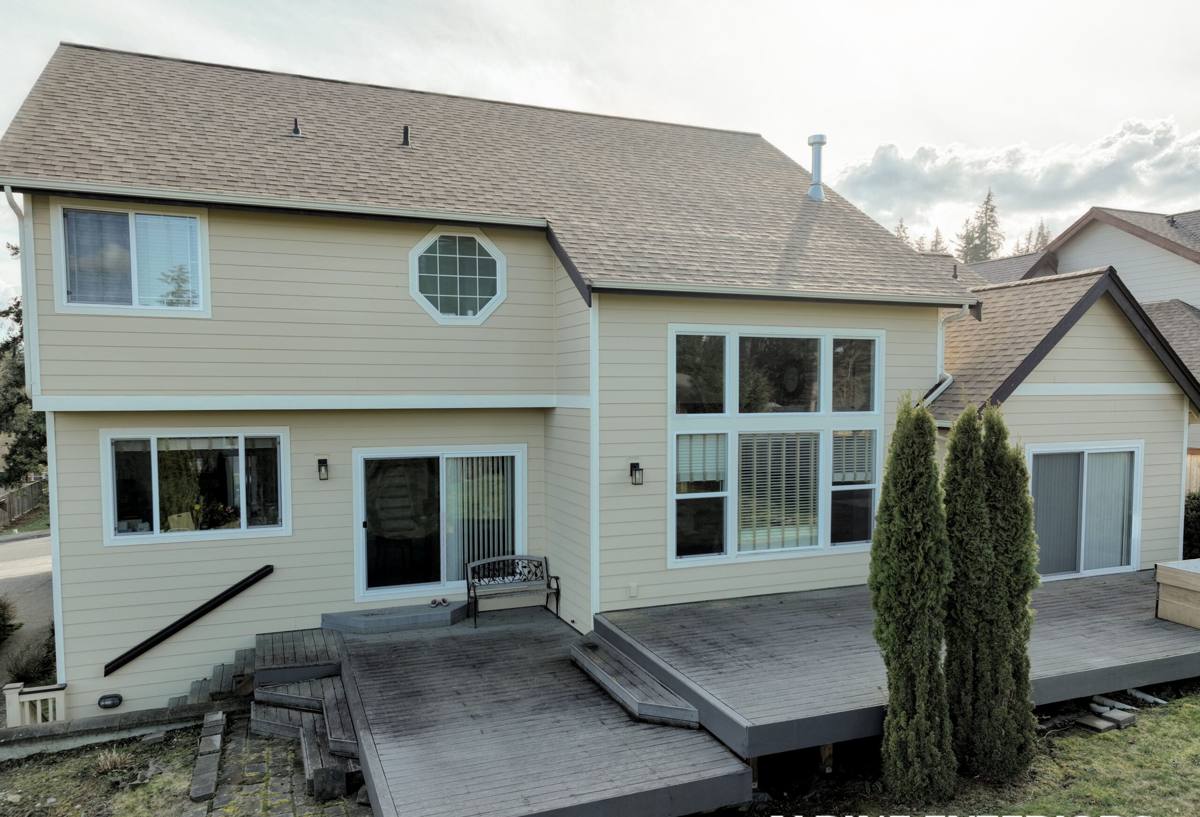
Signs Your Birch Bay Deck Is Due for Replacement
Repairs make sense for isolated problems — a cracked board, a loose rail, a squeaky spot. Replacement becomes the honest answer once the damage is in the structure itself or spread across enough of the deck that patching it would just be delaying the same failure in another spot next season.
- Soft or spongy spots in the decking, especially near the house or around post bases — a sign moisture has been sitting in the wood
- Rust staining running down from fasteners or hardware, which points to corroding connectors underneath
- Ledger board separation or gaps where the deck meets the house — a serious structural concern, not cosmetic
- Persistent moss or algae growth that comes back within weeks of cleaning, no matter how often it's scrubbed
- Railings that flex or feel loose when leaned on — a safety issue that shouldn't wait
- Boards that are cupping, splitting, or delaminating across large sections rather than in a few spots
- A deck built more than 15-20 years ago with untreated or minimally treated framing lumber
If you're only seeing one or two of these, a repair or partial rebuild may be the right call. If you're seeing several at once, especially anything involving the ledger or framing, replacement is usually the more honest and more cost-effective path.
Why "Just Resurface It" Often Isn't Enough Here
Homeowners sometimes ask about simply replacing the surface boards and leaving the substructure alone. In a drier climate that can work. In Birch Bay's salt air and rain exposure, the framing and fasteners underneath are frequently further along in deterioration than the visible boards suggest, because moisture reaches the underside and connections before it shows on top. We check the substructure before recommending a surface-only approach — not to upsell a bigger job, but because a new deck surface on a compromised frame is a short-term fix that costs more in the long run.
What a Correct Deck Replacement Involves
A deck replacement done right in this climate is more than pulling old boards and nailing down new ones. Here's what we actually address on a Birch Bay job:
Structure First
Posts, beams, and joists get inspected and, where needed, replaced with lumber rated for ground contact and moisture exposure. Post bases are set to keep wood off standing water, and we pay close attention to how the deck ties into the house — that ledger connection is the single most common failure point on coastal decks when it's not flashed correctly.
Fasteners and Hardware Matched to Salt Air
Standard galvanized fasteners corrode faster in salt-influenced air than most homeowners expect. For Birch Bay builds we spec stainless steel or marine-grade coated fasteners and connectors at the framing level, particularly anywhere hardware is exposed to weather rather than buried in dry framing.
Drainage and Flashing
Proper flashing at the ledger, sloped surfaces that shed water away from the house, and gaps between boards that let water drain rather than pool are what keep moisture from becoming rot. This is invisible once the deck is finished, but it's the difference between a deck that lasts and one that needs attention again in five years.
Surface Material Suited to Moss Season
We'll walk through the tradeoffs between wood and composite decking honestly — composite costs more upfront but resists moisture and moss growth better and needs less seasonal maintenance, while quality wood decking costs less initially but asks for more regular cleaning and sealing to hold up through the wet season. Neither is wrong; it depends on how much upkeep you want to take on.
Wood vs. Composite for a Bay-Facing Deck
| Factor | Wood (Cedar/Treated) | Composite |
|---|---|---|
| Upfront cost | Lower | Higher |
| Moss/algae resistance | Needs regular cleaning and sealing | More resistant, still needs periodic washing |
| Salt air fastener exposure | Same corrosion risk, needs quality hardware | Same corrosion risk, needs quality hardware |
| Maintenance routine | Annual clean + seal recommended | Occasional wash, no sealing |
| Typical lifespan (Whatcom County coastal) | 15-20 years with upkeep | 20-30+ years |
| Appearance over time | Weathers naturally, graying without upkeep | Holds color longer, consistent look |
Neither material eliminates the need for good framing, drainage, and fastener choices underneath — the surface material only handles part of the job.
How We Approach a Birch Bay Deck Replacement
- On-site assessment. We look at the existing deck's framing, ledger connection, post condition, and drainage — not just the surface — so you know exactly what's driving the need for replacement.
- Honest scope and estimate. You get a clear breakdown of what's structural, what's cosmetic, and what your material options actually cost, with no pressure to upgrade beyond what the job needs.
- Demo and structural rebuild. Old decking, framing, and hardware come out; new framing goes in with fasteners and connectors specified for salt-air exposure.
- Flashing and drainage detail work. This is the step that gets skipped on cut-rate jobs and is the one that determines whether the deck holds up through Birch Bay winters.
- Surface installation. Decking, railings, and stairs go in per your chosen material, with attention to board spacing and slope for proper drainage.
- Final walkthrough. We go over the finished deck with you, including basic maintenance expectations for the material you chose.
Maintenance That Actually Matters Here
Whatever material you choose, a few habits go a long way toward getting the full lifespan out of a Birch Bay deck:
- Sweep debris off the surface regularly, especially fir needles and leaves that trap moisture against the boards
- Clean moss and algae buildup at the first sign of it rather than letting it establish — it's far easier to remove early
- Check railings and stair connections once a year for looseness, which can signal hardware corrosion underneath
- Keep gutters and downspouts near the deck clear so runoff isn't draining directly onto or under it
- For wood decks, reseal on the schedule recommended for the product — skipping a year in this climate adds up fast
Why Hire a Crew That Already Works Birch Bay
A contractor who mostly builds decks inland doesn't always think about salt-air fastener corrosion or how long moss season actually runs this close to the water. We work throughout Whatcom County, including Birch Bay and the rest of the Bellingham area, and we spec materials and hardware based on what actually holds up here — not a generic build sheet. That matters more on a bay-facing lot than it does a few miles inland, and it's the kind of detail that shows up in whether your deck is still solid in year twelve instead of needing rework in year six.
We also know the practical side of building close to the water — protecting the work site and finished deck from weather during construction, timing work around the wetter months when possible, and being straightforward about what a coastal environment means for long-term upkeep.
Getting Started
If your deck is showing soft spots, persistent moss, loose railings, or just isn't holding up the way it used to, we're happy to take a look and give you a straight assessment of what it needs. Reach out for a free, no-pressure estimate using the form below — we'll walk the deck with you and lay out your options plainly.