 Bellingham
 Why Sunnyland Decks Wear Differently Than Decks Inland
Sunnyland sits close enough to Bellingham Bay that salt-laden air is a constant factor, not an occasional one. Add in Whatcom County's long wet season, heavy driving rain off the water, and a moss season that can stretch from October well into spring, and you've got a set of conditions that punishes decking materials in specific, predictable ways. Untreated or poorly maintained wood softens and checks. Metal hardware corrodes faster near the water than it does a few miles inland. And any deck surface that holds moisture against itself — instead of shedding it — becomes a moss and algae farm within a season or two.
Composite decking exists specifically to resist most of this, but "composite" isn't a single product with one set of behaviors. Boards vary a lot in how they handle moisture, how they're capped (or not), and how forgiving they are of the kind of standing water and shade that's common on Sunnyland lots with mature trees and close-set homes. A deck built to a generic spec, without accounting for this neighborhood's actual exposure, will show its age faster than it should.
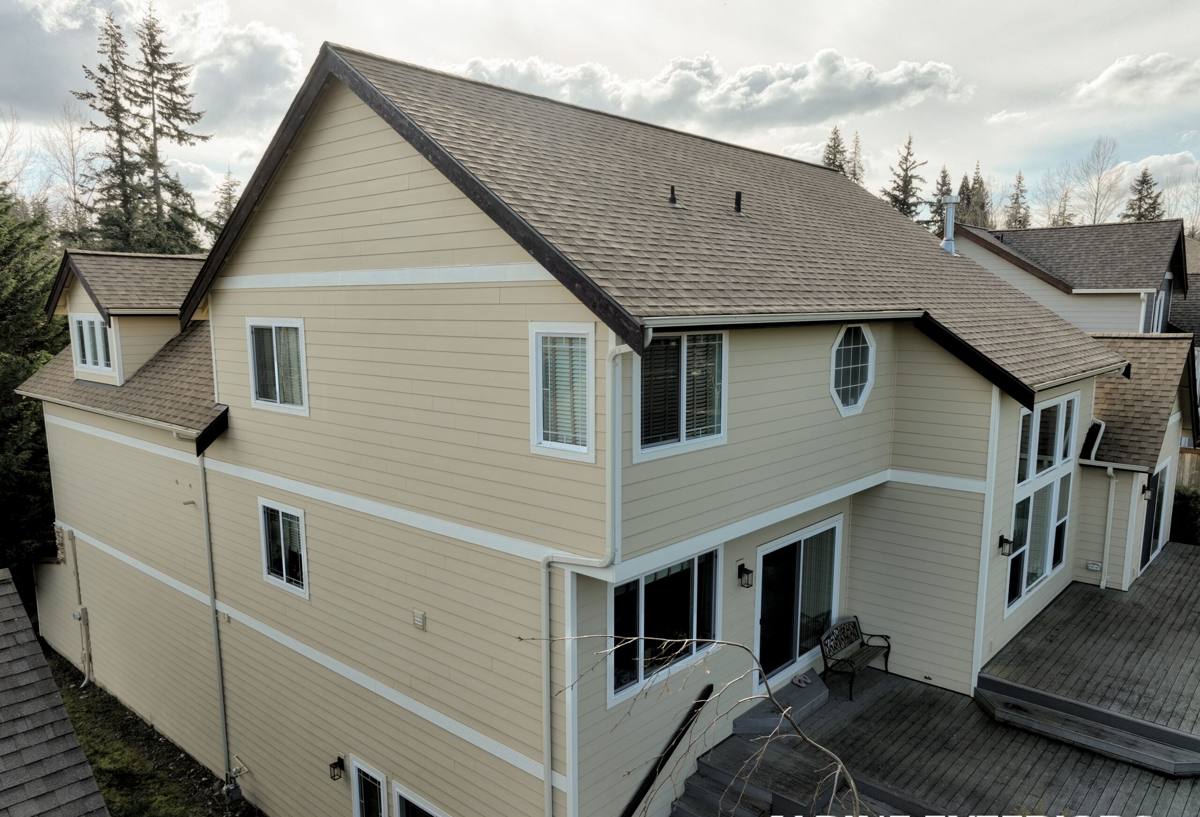
What Local Homes Actually Need From a Composite Deck
Drainage First, Everything Else Second
The single biggest factor in how long a composite deck looks good in this climate isn't the board brand — it's whether water gets off the deck and out from underneath it. Flat grading, tight board spacing, and framing that doesn't allow airflow underneath all combine to trap moisture, which is exactly what feeds moss and mildew growth on the surface and around fasteners.
Corrosion-Resistant Hardware Throughout
Salt air accelerates corrosion on standard fasteners, joist hangers, and ledger hardware. On a deck this close to the bay, we treat stainless steel or coated, marine-rated hardware as the standard, not an upgrade — the framing and fasteners usually fail before the boards do if this is skipped.
A Structure That Can Handle Sustained Wet Weight
Composite boards themselves don't rot, but the substructure underneath almost always is wood, and it has to be protected from the repeated wetting and drying cycle that's normal here for eight or nine months of the year. Joist tape, proper flashing at the ledger, and pressure-treated or naturally durable framing lumber matter as much as the decking material sitting on top.
Composite Decking Compared to the Alternatives
Homeowners in this neighborhood usually ask us to weigh composite against wood or PVC. Here's how they actually compare under Bellingham's conditions, not under ideal ones.
| Material | Moisture Behavior | Maintenance | Typical Lifespan Here |
|---|---|---|---|
| Wood (cedar/fir) | Absorbs water, needs sealing to resist swelling and checking | Annual cleaning and re-sealing/staining | 10–15 years with consistent upkeep |
| Uncapped composite | Some moisture absorption at cut ends and edges | Periodic cleaning; more prone to mold in shaded, damp spots | 15–20 years |
| Capped composite | Fully sealed shell resists moisture intrusion | Occasional washing | 20–30 years |
| PVC | No wood content, essentially moisture-proof | Occasional washing | 25–30+ years |
Capped composite is our default recommendation for Sunnyland lots, especially anything shaded, close to grade, or within a block or two of the water. The moisture resistance directly addresses the moss and mildew problem this area produces, without the sealing and staining cycle that wood decking demands here every single year.
What a Correct Installation Actually Involves
A composite deck is only as good as the framing and detailing underneath it. The board material gets the attention, but most of the failures we get called out to fix started below the surface. A correct job includes:
- Ledger board properly flashed and sealed where it meets the house, so water is directed away from the wall assembly, not into it
- Joist tape over all framing lumber to slow moisture absorption at the most vulnerable point in the structure
- Corrosion-resistant fasteners and hardware rated for coastal or marine exposure
- Board spacing set to the manufacturer's spec for expansion, drainage, and airflow — not tightened up for looks
- Hidden or color-matched fastening systems installed per the manufacturer's pattern, since incorrect spacing voids most warranties
- Grading and footing placement that keeps the structure out of standing water during the wet months
- Ventilation gaps maintained around the deck perimeter and any skirting, so air can move underneath
Where Corners Get Cut
The shortcuts that cause problems later are rarely visible at handoff: missing joist tape, standard fasteners instead of coated ones, board spacing tightened for a cleaner look, or skirting installed with no ventilation gaps. All of these pass a walkthrough. All of them cause real problems within a few wet seasons in this climate.
Our Process for Sunnyland Deck Projects
We keep the process straightforward because most of the value is in the details, not in complexity:
- Site visit and assessment — we look at sun exposure, tree cover, grading, and how close the deck footprint is to the house and to grade, since all of these affect moisture exposure and board choice.
- Product selection — we walk through capped composite options and, where it fits the budget or the look, PVC, explaining the real trade-offs rather than pushing one line.
- Permitting — most new decks and significant rebuilds in the City of Bellingham require a permit; we handle that paperwork so it doesn't fall on you.
- Tear-out (if replacing an existing deck) — including an honest look at the framing underneath, since that's often the part that actually needs replacing.
- Framing and structural work — ledger flashing, joist tape, corrosion-resistant hardware, and grading corrections as needed.
- Decking installation — boards, fastening system, and trim installed to manufacturer spec.
- Final walkthrough and cleanup — we go over care and cleaning specifics for your board choice before we leave.
Living With a Composite Deck Here: Realistic Maintenance
Composite is lower-maintenance than wood, not maintenance-free — that distinction matters most in a climate like this one. Moss spores are present in the air here year-round, and any deck with shade or debris buildup will pick some up eventually.
- Sweep leaves and needles off regularly in fall — trapped organic debris is the main food source for moss and mildew on composite surfaces
- Rinse the deck a few times a year with a garden hose and a stiff (non-metal) brush; avoid pressure washers on composite unless the manufacturer specifically rates the boards for it
- Clean the gaps between boards where debris and moss tend to establish first
- Keep gutters and downspouts near the deck clear so runoff isn't landing directly on the surface
- Check under the deck once a year for airflow blockages — stacked storage or dense plantings against skirting can trap moisture underneath
Cost Factors on a Sunnyland Project
Every deck is different, but the line items that actually move the price are consistent. We'll give you real numbers during the site visit — this is meant to help you understand what you're paying for.
| Factor | Why It Matters Here |
|---|---|
| Board tier (uncapped vs. capped composite vs. PVC) | Capped and PVC boards cost more up front but hold up far better against moisture and moss |
| Substructure condition | Older framing near the water often has hidden fastener corrosion or moisture damage that needs addressing before new decking goes down |
| Height and railing requirements | Elevated decks need code-compliant railing and stair systems, which add material and labor |
| Site access and grading | Sloped or tight lots common in this neighborhood can add footing and excavation work |
| Permitting scope | New construction and larger rebuilds typically require permitting through the City of Bellingham |
Why Local Experience on This Specific Job Matters
Composite decking is sold as a low-maintenance, install-anywhere product, and mostly it is — but "anywhere" doesn't account for a neighborhood that sits this close to salt water with this much annual rainfall and this long a moss season. A crew that installs decks across a wide mix of climates will build to a generic spec. A crew that works Sunnyland and the surrounding Bellingham neighborhoods regularly already knows which lots need extra grading attention, which board lines actually perform in shaded, moisture-heavy yards, and which hardware holds up under sustained salt air exposure rather than looking fine for the first year or two.
That local pattern-recognition is the difference between a deck that needs real attention again in eight years and one that holds up for two or three decades with basic upkeep.
Get a Straight Answer for Your Property
If you're weighing a new composite deck or a replacement for a Sunnyland home, we're happy to take a look, walk the site with you, and give you a straightforward estimate — no pressure, no upsell script. Fill out the form below and we'll set up a time to come by.