 Bellingham
 Asphalt Shingle Roofing in Sunnyland: A Neighborhood With Its Own Weather Story
Sunnyland is one of Bellingham's established residential neighborhoods, with a mix of home ages, mature tree canopy, and the kind of lot-to-lot variation in sun and shade exposure that makes a one-size-fits-all approach to roofing a bad idea. What Sunnyland shares with the rest of Bellingham and Whatcom County is the climate: salt-tinged marine air moving in off the water, rain that arrives sideways as often as it falls straight down, and a moss season that can run most of the year on shaded roof planes. Asphalt shingle roofs handle that combination well when they're specified and installed correctly for it. They handle it poorly when they're treated like a generic, drop-in product installed the same way it would be in a drier, calmer climate.
We work asphalt shingle roofs across Sunnyland and the surrounding Bellingham neighborhoods regularly enough to know which details actually matter here versus which ones are just checklist items in a drier region. This page walks through what this specific climate does to a shingle roof, what a correct installation actually requires, and how to think about repair versus replacement on an aging roof.
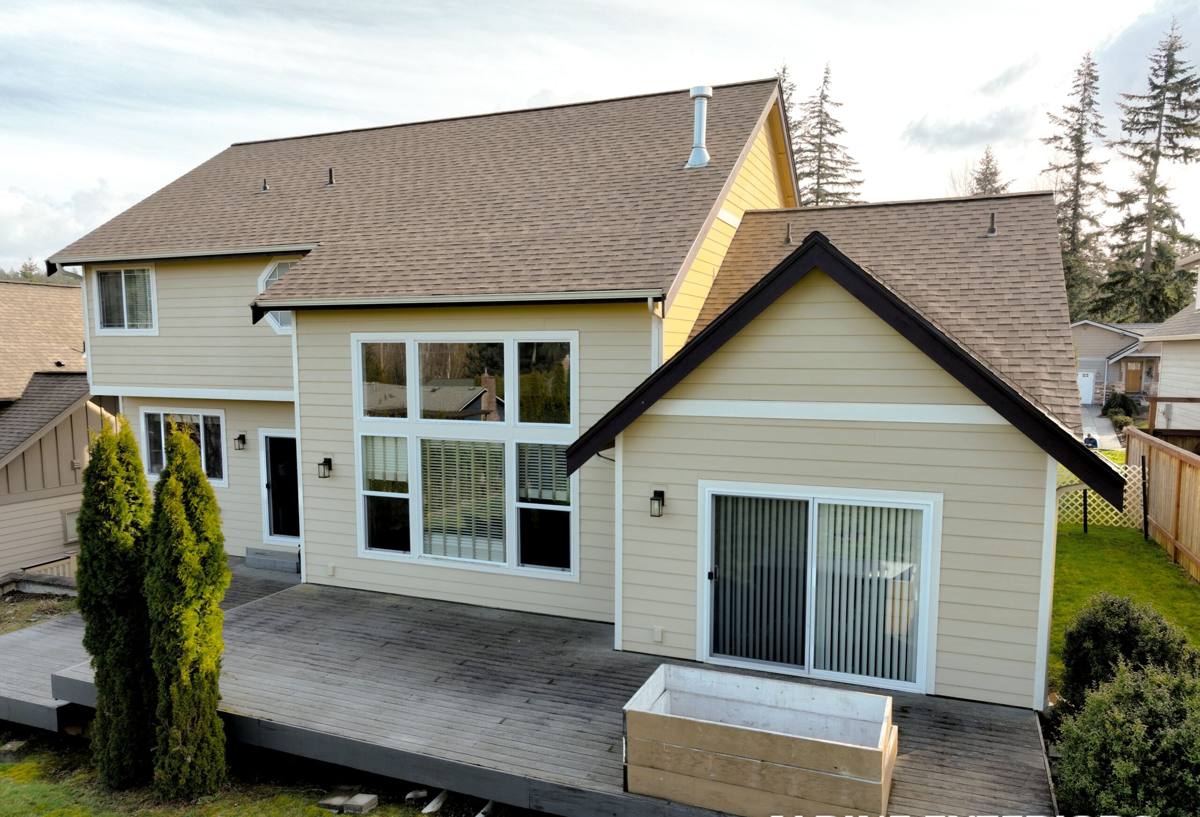
What Salt Air, Driving Rain, and Moss Season Do to a Shingle Roof
Salt Air and Metal Corrosion
Bellingham's proximity to the water means a steady background level of salt-tinged moisture in the air, not just on days with an obvious storm rolling in. That exposure is harder on the metal components of a roofing system, flashing, drip edge, fasteners, and vent housings, than an inland climate would be. Lower-grade or improperly rated metal can start corroding years before the shingles themselves show any wear, and once flashing starts to fail, water finds its way in at the exact points a roof is supposed to be most protected: valleys, chimneys, and roof-to-wall transitions.
Wind-Driven, Sideways Rain
Rain in this part of Whatcom County doesn't just fall, it gets pushed sideways by wind coming off the water. That matters because a shingle roof, underlayment, and flashing detail that would perform fine in a calmer, drier climate can still let water in here specifically because the wind is driving rain up under shingle tabs and into laps and seams from an angle a purely vertical rainfall assumption doesn't account for. Roof edges, low-slope sections, and valleys take the brunt of it.
A Long Moss and Algae Season
Mild year-round temperatures and consistent dampness give moss and algae a long growing season on any roof plane that stays shaded or slow to dry, which describes a good number of roofs under Sunnyland's tree cover. Moss does more than look bad. It holds moisture against the shingle surface, works its way under tab edges as it spreads, and can gradually lift or loosen shingles that were otherwise sound. A roof that never gets real sun exposure on part of its surface needs to be built and maintained with that in mind from day one.
Why Asphalt Shingles Still Make Sense Here, Done Right
Asphalt shingle roofing remains one of the most practical choices for this climate when it's specified correctly. It's not the only roofing material that performs well here, but it offers a strong balance of upfront cost, proven performance, and manufacturer-backed warranty coverage that fits a wide range of budgets and home styles. The trade-off is that asphalt shingle performance in a marine climate depends more heavily on installation quality than some other materials do, which is exactly why we treat the details below as non-negotiable rather than optional upgrades.
Architectural (dimensional) shingles are the better fit for most Sunnyland homes over basic three-tab shingles. They're thicker, rated for higher wind resistance, and generally carry a longer manufacturer warranty, and in a climate with frequent wind-driven rain, that added durability and better sealing tend to earn back their modest cost difference over the life of the roof. Shingle products with algae-resistant granules are also worth the small upcharge on any roof plane that's going to sit in shade for a meaningful part of the day, which is common under Sunnyland's tree cover.
What a Correct Asphalt Shingle Installation Requires in This Climate
The shingle itself is only one part of a roofing system. A lot of the roofs we get called out to repair didn't fail because the shingles were bad, they failed because something underneath or around them was installed as a shortcut. On every job, that means paying real attention to:
Underlayment and Ice-and-Water Shield
A synthetic underlayment rated for sustained moisture exposure, not a bare minimum-code product, gives the roof a real second line of defense if wind-driven rain gets past the shingles. Ice-and-water shield belongs at eaves, valleys, and any low-slope transition where water and debris tend to collect and linger.
Flashing at Every Penetration and Transition
Valleys, chimneys, vent pipes, skylights, and roof-to-wall transitions all need properly lapped, correctly sequenced flashing, not just a bead of sealant covering a gap. This is the single most common point of failure we see on older Sunnyland roofs, and it's rarely visible from the ground.
Ventilation That Actually Works
Balanced intake and exhaust ventilation lets moisture escape from the attic space instead of condensing against the underside of the roof deck. Poor ventilation shortens shingle life from below, quietly, in a way that has nothing to do with the shingle brand or grade chosen.
Corrosion-Resistant Fasteners and Ridge Details
Given the salt exposure this area sees, fasteners and metal ridge and hip components need to be rated for it. It's a small line item on a bid and an easy one to overlook, but it's exactly the kind of detail that determines whether a roof is still tight in fifteen years or starting to show fastener corrosion in five.
- Underlayment rated for sustained wet-climate exposure, not a bare minimum-code product
- Ice-and-water shield at eaves, valleys, and low-slope transitions
- Properly lapped, correctly sequenced flashing at every valley, chimney, and vent pipe
- Balanced attic ventilation sized to the actual roof and attic volume
- Corrosion-resistant fasteners and metal components suited to salt air exposure
- Algae-resistant granules on shaded or tree-covered roof planes
- A written manufacturer warranty that's actually valid because the install followed spec
None of these items add much to the overall cost of a job relative to the shingles themselves, but skipping any of them is what turns a roof rated for two or three decades into one calling for repairs inside of ten years.
Asphalt Shingle Roofing Cost Factors in Sunnyland
| Factor | What It Affects | Why It Matters Here |
|---|---|---|
| Roof size and pitch complexity | Total material and labor | More valleys and hips mean more flashing detail exposed to wind-driven rain |
| Tear-off vs. overlay | Labor scope and deck access | Tear-off exposes hidden moisture or moss damage common under older roofs in this climate |
| Deck condition | Repair costs before new shingles go on | Long-term moisture or moss intrusion can soften decking before it's visible from outside |
| Shingle grade and warranty tier | Material cost and expected lifespan | Higher wind ratings and algae-resistant granules matter more under Sunnyland's tree cover |
| Tree cover and shade exposure | Ventilation and moss-prevention needs | Shaded roof planes need extra ventilation and moss-resistant materials to perform as rated |
Real numbers depend on the specific roof, which is why we walk the property and get on the roof itself before quoting instead of pricing off square footage alone.
Signs a Sunnyland Roof Needs Attention
- Moss buildup on shaded slopes that returns quickly after cleaning
- Granules collecting in gutters or at the base of downspouts
- Curling, cupping, or missing shingles, especially after a windstorm
- Water staining on interior ceilings near exterior walls, chimneys, or skylights
- Flashing that looks lifted, rusted, or missing sealant around penetrations
- Daylight visible through the roof deck from inside the attic
- Sagging rooflines or soft spots underfoot when walked
Any single item on that list is worth a professional look before the next wet season. Several of them together usually mean the roof has already been leaking longer than it's been showing on the ceiling below.
Repair or Full Replacement? How We Help You Decide
Not every roofing issue on a Sunnyland home calls for a full tear-off. A localized leak, storm-damaged section, or a single failed flashing detail on a roof that's otherwise in good shape is usually a straightforward repair. A roof that's nearing the end of its rated life, has moss-related damage spread across multiple planes, or has a deck already showing soft spots from long-term moisture is more honestly addressed with a full replacement than another round of patchwork that just delays the same job. We'll tell you plainly which situation you're actually in and explain the reasoning, not just hand you a number.
Why a Bellingham Crew That Already Works Sunnyland Matters
A crew that regularly works roofs across Sunnyland and the rest of Bellingham sees how salt air, wind-driven rain, and moss actually behave on real houses over full years, not just how a shingle performs on a manufacturer's data sheet. That experience shows up in practical decisions on install day: which roof planes need extra ventilation because of shade, how much ice-and-water shield a given valley actually needs, and which flashing details are worth the extra time so a homeowner isn't dealing with a callback two winters later. It also means understanding that a heavily shaded, tree-lined Sunnyland lot doesn't need the exact same detailing as a more open, sun-exposed property elsewhere in the county, and building the roof accordingly instead of applying one generic spec to every job.
Beyond the Roof: Siding, Windows, and Decks
Roofing problems on a Sunnyland home don't always stay confined to the roof. A leaking valley or failed flashing detail can track water down into siding, trim, or a wall cavity before it's ever obvious from the ceiling below. Because we also handle siding, window, and deck work, we can look at a property as one connected exterior system and trace a moisture problem back to where it actually started, instead of replacing a roof over a leak that's still working its way into the walls underneath.
If your Sunnyland home needs a roof inspection, a repair, or you're weighing a full replacement, we're glad to take an honest look and walk you through exactly what we find. Reach out using the form below to schedule a free, no-pressure estimate.