 Bellingham
 Board & Batten Siding in Sudden Valley
Sudden Valley sits in a pocket of Whatcom County that gets its own version of Bellingham weather — lake humidity, filtered marine air moving up from Bellingham Bay, heavy tree cover, and long stretches of gray, damp months where moss and algae have nothing but time. Board and batten is one of the most popular looks out here, especially on the cabin-style and craftsman homes that line the hillsides around the lake. It's also one of the easiest siding profiles to get wrong if the installer doesn't understand how this specific climate behaves against vertical siding. This page is about what a correct board and batten installation actually requires in Sudden Valley, not just what the style looks like.
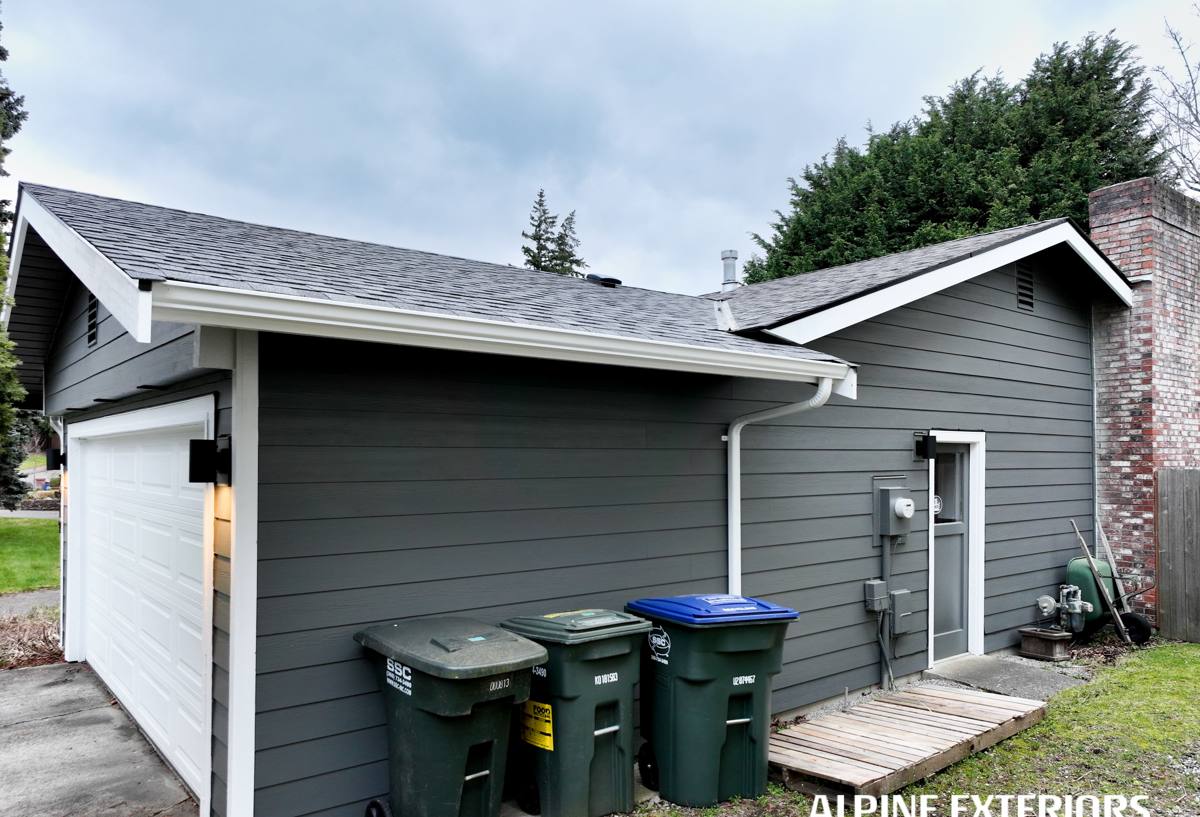
Why Board & Batten Fits Sudden Valley Homes
Board and batten is a vertical siding pattern — wide flat panels or boards with narrow battens covering the seams — that reads as classic Pacific Northwest without looking like every other subdivision in Whatcom County. It pairs naturally with the wooded, cabin-adjacent character of Sudden Valley: gable ends, covered porches, exposed beams. A lot of homeowners here choose it specifically because it doesn't look mass-produced.
But the same vertical lines that make it attractive also change how water moves across the wall. Horizontal lap siding sheds water down and off at every course. Vertical board and batten channels water straight down the face of the board, which means the battens, the seams, and the bottom termination all have to be detailed correctly or that water finds a way behind the cladding instead of off of it.
What the Local Climate Actually Does to This Siding
- Salt-influenced moisture: Air moving off Bellingham Bay and the Sound carries salt content that accelerates corrosion on the wrong fastener or trim metal, and keeps wood-based sidings damp longer than a drier inland climate would.
- Driving rain: Storms here don't just fall straight down — wind-driven rain hits gable ends and upper stories at an angle, which is exactly where vertical siding seams are most exposed.
- Long moss season: Shade from the tree cover around Sudden Valley plus consistent damp air means moss and algae get a long runway, often eight or nine months of the year, on any surface that holds moisture or stays shaded.
- Freeze-thaw cycling: Whatcom County gets enough winter cold snaps that trapped moisture behind siding can freeze, expand, and work joints loose over a few seasons.
What a Correct Board & Batten Job Involves
The style is simple. The execution is not. A board and batten installation that's actually built for this area has to get several things right that don't show up in a driveway walk-through after the crew leaves.
Water Management Behind the Boards
Every board and batten wall needs a drainage plane behind it — a weather-resistant barrier plus a rainscreen gap that lets any water that does get past the cladding drain and dry instead of sitting against the sheathing. In a climate with this much sustained dampness, skipping the rainscreen gap is one of the most common corners cut, and it's the one that causes the most damage later because you can't see it's missing until there's a problem.
Fastening and Batten Spacing
Battens have to be fastened into structural framing, not just through the wide board into sheathing, and fastener spacing has to account for the board width expanding and contracting with seasonal moisture swings. Get the spacing wrong and you get splitting, popped fasteners, or gaps opening up at the seams within a couple of years — right where driving rain is hitting hardest.
Corners, Trim, and Termination Details
Outside corners, window and door trim, and the bottom termination at the foundation are where board and batten fails first if it's going to fail. Each of these needs proper flashing and clearance — siding that terminates too close to grade, a deck, or a roofline holds moisture against the material and gives moss a permanent foothold.
Material Choice
This is where the biggest long-term difference shows up. We install James Hardie fiber cement board and batten exclusively — specifically their HardiePanel vertical siding system with Hardie battens, finished in factory-applied ColorPlus. Fiber cement doesn't absorb water the way wood-based or wood-composite products do, so it doesn't swell, cup, or feed rot at the seams the way an untreated or primed wood product can in a climate this wet. It's also non-combustible, which matters given how much of Sudden Valley sits close to tree cover.
Our Process for Sudden Valley Jobs
| Step | What Happens | Why It Matters Here |
|---|---|---|
| Site walk & assessment | We inspect existing siding, sheathing condition, and moisture exposure at grade, decks, and roof intersections | Sudden Valley homes vary a lot in sun/shade exposure block to block — the assessment is never a template |
| Drainage plane install | Weather-resistant barrier plus rainscreen furring behind every panel | Non-negotiable in a climate with this much sustained humidity |
| Board & batten install | HardiePanel vertical siding with Hardie battens, fastened to framing | Correct spacing prevents seasonal splitting and seam gaps |
| Flashing & trim | Corners, window/door openings, and base termination flashed and gapped properly | These are the failure points in vertical siding under driving rain |
| Final inspection | Walk-through checking fastener pattern, caulking, and clearances | Catches anything that would show up as a callback in year two or three |
Why Hardie Instead of Wood, Vinyl, or LP SmartSide
We get asked regularly why we won't install cedar, primed spruce, LP SmartSide, or vinyl board and batten, especially since some of those options cost less up front. Here's the honest version.
Cedar and primed spruce look good the day they go up, and in a drier climate they can perform fine for years with regular maintenance. In Sudden Valley's combination of shade, humidity, and long moss season, wood-based board and batten needs recoating, caulk maintenance, and moss treatment far more often to avoid rot at the seams — and vertical siding concentrates water exactly at those seams. LP SmartSide is an engineered wood product with real strengths, but it's still wood-based at its core, meaning it depends on an intact factory coating and careful field sealing of every cut edge to keep moisture out over the long run. Vinyl board and batten is low-maintenance and inexpensive, but it can warp or distort in temperature swings and it doesn't hold the crisp, deep shadow lines that make board and batten look right architecturally — the panels tend to read as flat rather than as true boards.
James Hardie fiber cement gets around the core problem with all of those: it isn't a wood product, so it doesn't rot, and it isn't a vinyl product, so it doesn't soften or distort with heat and cold. It holds paint and factory color far longer than wood, it's rated for coastal and marine-influenced climates, and it carries a strong transferable warranty when installed to Hardie's specifications. That's the whole reason we standardized on it — not because every other product is bad, but because Hardie is the one that matches what this climate actually does to a house over ten and twenty years, not just the first two or three.
Signs Your Current Board & Batten Needs Attention
- Dark streaking or moss buildup concentrated at batten seams or panel bottoms
- Soft spots or visible cupping in boards, especially near ground level or under a deck
- Gaps opening up between battens and the panel behind them
- Paint or coating failure that shows bare wood or substrate underneath
- Caulk that's cracked, shrunk, or pulled away from trim and corner boards
Cost Factors for Sudden Valley Board & Batten Projects
| Factor | Why It Affects the Job |
|---|---|
| Home access & site slope | Many Sudden Valley lots are sloped or have limited driveway/staging area, affecting scaffolding and material staging |
| Existing siding removal | Tear-off of old wood, vinyl, or damaged panels adds labor and disposal |
| Sheathing repair | Moisture damage found once old siding comes off can require sheathing replacement before new siding goes on |
| Wall height & gable complexity | Tall gable ends common in Sudden Valley's cabin-style homes require more scaffolding and precise batten layout |
| Trim & corner detail | Custom corner and window trim work adds time but is where long-term water performance is decided |
Why a Crew That Already Works Sudden Valley Matters
Sudden Valley isn't downtown Bellingham. The lot slopes, the tree cover, the lake-adjacent humidity, and the mix of older cabins with newer builds all change how a siding job needs to be planned — from staging equipment on a sloped driveway to knowing which sides of a house are going to hold moss the longest. A crew that's done work in this specific community already knows those variables going in, instead of learning them on your dime. That local familiarity, paired with a single-product standard we can stand behind, is what keeps a board and batten job looking right ten years out instead of just on install day.
If you're considering board and batten siding for a home in Sudden Valley, we're glad to walk the property, look at your current siding condition, and give you a straightforward, no-pressure estimate — no invented urgency, just what the house actually needs.