 Bellingham
 Why Decks in Sehome Wear Differently Than Decks Inland
Sehome sits close enough to the water and the hillside tree canopy that its decks live under a different set of pressures than a deck built twenty miles east in drier country. Bellingham's marine air carries salt and moisture that settles into fasteners, connectors, and end grain long before it's visible on the surface. Add Whatcom County's driving rain — the kind that comes in sideways off a southwest wind rather than falling straight down — and you get water finding its way into joints and ledger connections that a fair-weather build never accounts for.
Then there's moss. Sehome's mix of mature trees and shaded lots means many decks stay damp longer after a storm than a deck out in open sun would. Moss and algae don't just look bad; they hold moisture against the wood surface and turn boards slick and dangerous underfoot for months at a time. A deck designed without that in mind will show it within a couple of seasons — cupped boards, dark staining, and a surface that never quite dries out between rains.
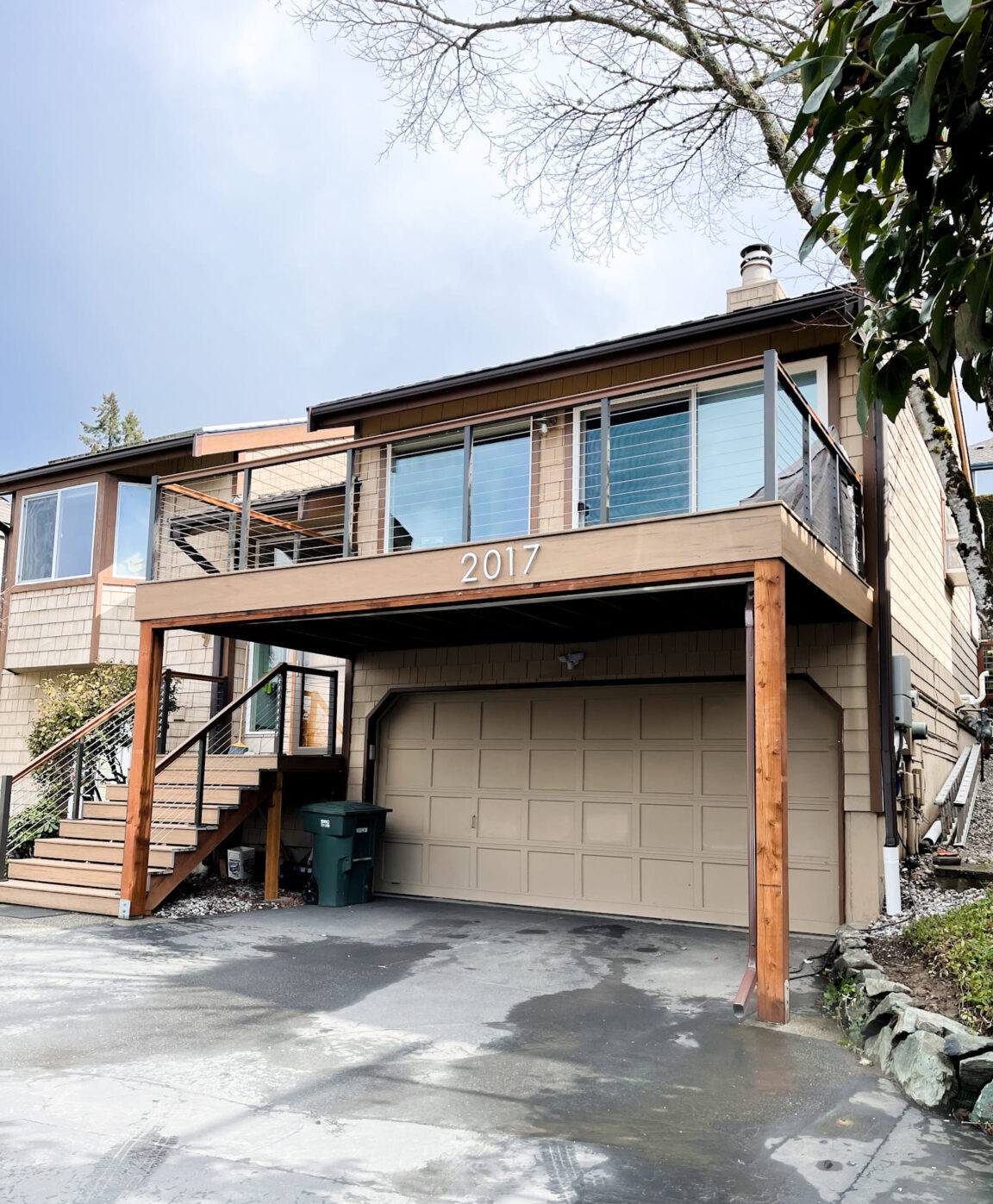
What a Correctly Built Deck Actually Requires Here
"Correct" isn't about upgrading everything to the most expensive option — it's about getting the details right that this climate specifically punishes. Three things matter more here than in a dry-climate build:
- Ledger attachment and flashing. The ledger board (where the deck ties into the house) is the single most common failure point in wet climates. It needs proper flashing that sheds water away from the house band board, not just lag bolts and caulk.
- Fastener and hardware corrosion resistance. Salt-laden air accelerates corrosion on standard fasteners. Structural connectors, joist hangers, and screws need coatings rated for the exposure they'll actually see, not just what's cheapest at the yard.
- Airflow underneath and between boards. A deck that can't dry out between rain events will grow moss and mildew no matter what decking material sits on top. Proper joist spacing, board gapping, and ground clearance all affect how fast a deck dries.
Framing Choices That Hold Up
Pressure-treated framing lumber is the standard here, but the grade and the connectors matter as much as the lumber itself. We use hardware rated for the corrosive, high-moisture exposure Bellingham decks see rather than general-purpose fasteners — it costs a bit more up front and saves a full rebuild later.
Choosing a Decking Material for a Sehome Lot
There's no single "best" decking material — there's the right trade-off for your lot's sun exposure, your maintenance appetite, and your budget. Here's how the common options actually compare in this specific climate:
| Material | Moisture Behavior | Maintenance | Typical Lifespan Here |
|---|---|---|---|
| Pressure-treated wood | Absorbs and releases moisture readily; prone to cupping if not sealed | Annual cleaning/sealing recommended | 10–15 years with upkeep |
| Cedar | Naturally rot-resistant but still needs sealing against constant damp | Sealing every 1–2 years, moss treatment | 15–20 years with upkeep |
| Composite decking | Doesn't absorb water into the board itself, but can trap moisture at fastener points and in shaded, low-airflow spots | Periodic washing to prevent surface moss/mildew | 20–25+ years |
| PVC/capped polymer | Fully moisture-sealed surface; least prone to rot | Lowest — occasional washing | 25+ years |
For shaded Sehome lots under tree cover, we lean toward steering clients away from bare untreated wood left to weather naturally — not because the wood itself is bad, but because in low-airflow, high-shade conditions it holds moisture longer than the material can shed it, and moss takes hold faster than most homeowners want to keep up with. That's a maintenance-burden call, not a knock on wood as a material — a well-sealed, well-maintained wood deck still performs fine on a sunnier lot.
Drainage and Airflow: The Detail That Prevents Callbacks
Most deck problems we get called out to fix in this neighborhood trace back to water that had nowhere to go. A few design choices make the difference between a deck that dries out and one that doesn't:
- Board gapping sized for wood movement and drainage, not just appearance
- Joist tape over framing members to keep water from wicking into end grain
- Adequate clearance between the deck framing and the ground or grade below
- Post bases that keep structural posts off standing water and soil contact
- Grading and gutter routing that keeps roof runoff from dumping onto or under the deck
None of these add much to a project's cost when they're planned from the start. Retrofitting them after the fact — because a deck was built without them — costs considerably more.
Dealing With Existing Moss and Shade
If your lot has heavy tree cover, we'll talk through realistic expectations rather than promise a moss-free deck that shade won't allow. Board spacing, surface texture, and material choice all affect how much moss you'll fight, but on a heavily shaded lot in Whatcom County, some seasonal cleaning is part of deck ownership no matter what you build.
Permits and Local Requirements
Deck projects in the City of Bellingham generally require a building permit once you're past a certain size or height off grade, and inspections check things like footing depth, ledger attachment, guardrail height, and stair geometry. We handle the permit process as part of the job rather than leaving it to the homeowner — it's one less thing to chase down, and it means the deck is signed off as built to code, which matters when you eventually sell the house.
Our Process for a Sehome Deck Project
- On-site assessment. We look at sun exposure, drainage patterns, existing structure (for replacements), and how the space will actually be used.
- Design and material selection. We walk through the material comparison honestly, including what each option will look like in year five and year ten, not just on install day.
- Permit submission. We prepare and submit the permit package to the City of Bellingham and handle the inspection scheduling.
- Demolition and framing (if replacing). Old structures are removed and the substructure — ledger, posts, footings, joists — is rebuilt to current standards even if only the surface decking is changing.
- Decking, railing, and finish work. Boards, railings, and any built-in features go in last, with fastener patterns and gapping set for this climate.
- Final walk-through. We go over care and maintenance specific to the material you chose before we call the job done.
Cost Factors to Expect
Every deck is different, but the line items that move the price on a Sehome project are consistent:
| Factor | Why It Affects Cost |
|---|---|
| Height off grade | Taller decks need engineered footings, more bracing, and often stairs and guardrails |
| Decking material | Composite and PVC cost more per board than wood but reduce long-term maintenance spend |
| Ledger and flashing complexity | Difficult house-to-deck connections (siding type, existing water damage) add labor |
| Site access | Sloped or tight lots common in hillside neighborhoods can add equipment and labor time |
| Permit and inspection scope | Larger or taller structures trigger more inspection steps |
We give straightforward, itemized estimates rather than a single lump number, so you can see exactly where the money is going and where there's room to adjust if needed.
Maintenance Checklist for Sehome Homeowners
Whatever material you choose, a few habits keep a deck performing well through Bellingham's wet season:
- Sweep debris (leaves, needles, moss growth) off the surface regularly, especially in fall
- Clean and re-seal wood decking on the schedule appropriate to that species
- Check that gaps between boards haven't clogged with debris that traps moisture
- Inspect the ledger board area annually for signs of water staining or soft wood
- Keep gutters and downspouts clear so roof water isn't draining onto the deck
- Address moss growth early with appropriate cleaning rather than letting it establish
Why Hiring a Crew That Already Works Sehome Matters
A deck built by a crew unfamiliar with this specific stretch of Whatcom County tends to look right on the day it's finished and then reveal its shortcuts two or three winters in — that's when driving rain and a long moss season expose whatever wasn't done right the first time. A crew that already works this neighborhood knows which lots hold shade and moisture longest, which house siding types make ledger flashing trickier, and what the city inspectors here actually check for. That local pattern-recognition doesn't show up on a quote — it shows up in a deck that's still solid a decade later.
If you're planning a new deck or replacing one that's showing its age, we're happy to come take a look and talk through what makes sense for your specific lot. The estimate is free, there's no pressure to commit on the spot, and you'll leave the conversation with a clear, honest picture of your options — just use the form below to get started.