 Bellingham
 Building Decks for Silver Beach Homes
Silver Beach sits close enough to the water that it earns its own set of building problems. A deck built to a generic spec — the kind you'd use inland, away from Bellingham Bay — tends to disappoint here within a few seasons. Fasteners bleed rust, ledger boards trap moisture against the house, and any flat or shaded section of decking turns green before the first anniversary. We build decks for this neighborhood specifically, not decks that happen to end up here, and that distinction shows up in the materials list, the fastener spec, and the way we frame the substructure.
This page covers what a deck actually needs to hold up in Silver Beach's conditions, what our process looks like from first visit to final walkthrough, and the honest trade-offs between the material options homeowners in this part of Whatcom County ask us about most.
What This Climate Does to a Deck
Three things drive nearly every deck failure we get called out to inspect in this area, and all three are present right here in Silver Beach.
Salt-Laden Air
Proximity to the bay means the air carries salt, even a mile or two inland. Salt accelerates corrosion on anything metal — screws, joist hangers, structural bolts, railing hardware. A fastener rated for general exterior use will start showing surface rust in a season or two near the water; a fastener rated for coastal or marine exposure is built to shrug that off for the life of the deck.
Driving Rain
Bellingham doesn't just get a lot of rain — a good share of it comes in sideways off the water, driven by wind. That matters for a deck because it means water finds its way into joints, under flashing, and behind ledger boards that a calmer climate would leave alone. Every connection point on a deck built here needs to assume water will reach it and needs a way to shed that water rather than trap it.
The Long Moss Season
Whatcom County's moss season runs long — realistically much of the year in shaded or north-facing spots. Moss and algae hold moisture against decking boards, which accelerates rot in wood and can stain composite surfaces if left unaddressed. Deck orientation, gap spacing between boards, and how much shade a site gets from trees or the house itself all factor into how much moss pressure a given deck will face.
What a Correctly Built Deck Involves
A deck that's going to hold up in Silver Beach conditions gets built differently in a few specific places, not just "built well" in a general sense.
The Ledger Connection
Where the deck attaches to the house is the single most important — and most commonly botched — connection on the whole structure. It needs proper flashing that directs water out and away from the house's sheathing, not just a bead of caulk and a hope. We flash every ledger connection with the assumption that wind-driven rain will hit it directly, because in this neighborhood it will.
Fastener and Hardware Spec
We use coastal-rated, corrosion-resistant fasteners and structural hardware throughout — not because code requires the upgrade everywhere, but because standard hardware doesn't hold up long-term this close to the water. This is the single easiest thing to under-spec on a deck, and it's the thing that fails first when it's under-spec.
Framing and Ventilation
Joists and beams need airflow underneath to dry out between rain events. Decks built low to the ground, or with skirting that seals off airflow, stay damp longer and invite rot and moss growth. We frame with clearance and drainage in mind, not just load capacity.
Decking Surface Choice and Layout
Board spacing, orientation relative to the sun, and drainage slope all affect how fast moss and standing water become a problem. A deck oriented to get some afternoon sun, with consistent gapping for drainage, will fight moss far better than one shoehorned into a fully shaded corner with tight-butted boards.
Quick Reference: What We Check Before We Frame Anything
- Ledger flashing detail and house wall condition behind the attachment point
- Soil drainage and grade under and around the deck footprint
- Sun exposure and shade pattern across the seasons, not just today
- Existing moss or algae growth on nearby hardscape as an indicator of site conditions
- Fastener and hardware corrosion rating appropriate to the distance from the water
- Local permit and setback requirements for the specific lot
Decking Material Options: An Honest Comparison
There's no single right answer for every Silver Beach home — the right choice depends on budget, how much upkeep the homeowner wants to take on, and how shaded the site is. Here's how the common options actually compare in this climate.
| Material | Moss & Moisture Behavior | Maintenance | Typical Lifespan Here |
|---|---|---|---|
| Pressure-treated wood | Absorbs moisture readily; needs sealing to resist moss and rot | Annual cleaning and periodic sealing/staining | 10-15 years with upkeep, less if neglected |
| Cedar | Naturally rot-resistant but still needs finish maintenance in wet shade | Regular cleaning; refinish every few years | 15-20 years with upkeep |
| Capped composite | Doesn't absorb water like wood; still needs surface cleaning where moss spores land | Occasional wash; no staining or sealing | 25+ years, backed by manufacturer warranty |
| PVC decking | Fully moisture-resistant surface; best performance in constant-shade, high-moss areas | Occasional wash | 25+ years, backed by manufacturer warranty |
We steer homeowners away from uncapped composite in heavily shaded Silver Beach lots specifically — the exposed core on older-generation composite products can hold moisture and stain in a way that capped composite or PVC won't. That's a maintenance and appearance trade-off we're upfront about before you buy, not a defect we discover after installation.
Railings and Hardware: Where Corrosion Shows First
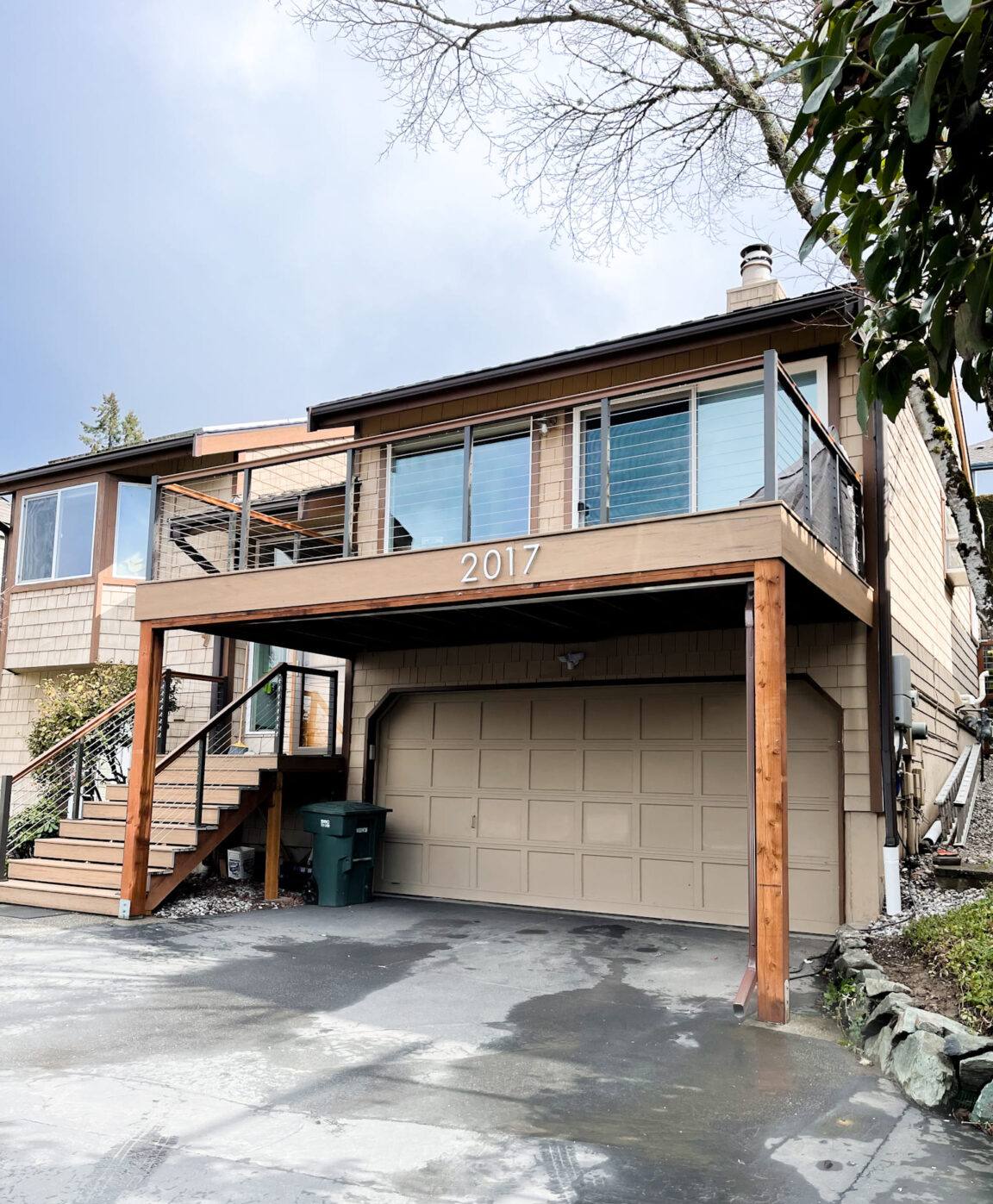
Railings are usually the first place a homeowner near the water notices a problem, because they're the most visible metal on the deck. Cable railing systems and aluminum balusters both perform well here if they're rated for coastal exposure — the failures we see are almost always with mismatched or bargain-grade hardware substituted in somewhere along the way. We spec railing hardware to match the rest of the structure's corrosion resistance, not just the parts that are easy to see.
Our Process, Start to Finish
- Site visit and assessment — we walk the lot, check sun exposure, drainage, and the condition of the house wall where the deck will attach.
- Design and material selection — we talk through decking material, railing style, and layout based on your site's specific moss and moisture exposure, not a generic recommendation.
- Permitting — we handle the paperwork for the applicable local permit and setback requirements before any work starts.
- Framing — ledger flashing, coastal-rated fasteners, and proper ventilation clearance get built in from the first board, not added as an afterthought.
- Decking and railing installation — surface material and railing go on with attention to drainage gaps and consistent fastening.
- Final walkthrough — we go over care and cleaning expectations specific to the material you chose, so moss and moisture don't catch you off guard the following winter.
Maintenance Expectations by Material
Every deck in Silver Beach needs some seasonal attention — the question is how much. Wood decks need the most: an annual wash to clear moss buildup before it takes hold, plus periodic sealing or staining to keep the wood from absorbing rain. Composite and PVC decking cut that down substantially, generally needing just an occasional wash with a soft brush and mild cleaner to keep moss spores from getting a foothold in shaded corners. We walk through the specific maintenance schedule for whatever material you choose at the final walkthrough, so there are no surprises come the next wet season.
A Simple Seasonal Checklist for Any Silver Beach Deck
- Clear leaves and debris from board gaps before fall rains set in
- Wash down shaded areas where moss tends to establish first
- Check railing hardware for early rust spots and address them before they spread
- Confirm drainage under the deck isn't blocked by planting beds or stored items
- Reseal or restain wood decking on the schedule recommended for the specific product used
Why a Local Crew Matters Here
A contractor who mostly works inland, drier parts of Whatcom County can build a technically sound deck that still underperforms on a Silver Beach lot, because the spec that's "good enough" fifteen minutes from the water isn't good enough here. Working this neighborhood regularly means we've seen which corners fail first in this specific microclimate — the ledger flashing, the bargain-grade fasteners, the decking left unsealed in full shade — and we build around those failure points as standard practice, not as an upgrade you have to ask for.
If you're planning a new deck or replacing one that's showing its age, we're happy to take a look and put together a straightforward estimate — no pressure, no hard sell. Use the form below to get in touch and we'll set up a time to walk the site with you.