 Bellingham
 Why South Hill's Climate Is Hard on Siding
South Hill sits up above downtown Bellingham on a wooded slope close enough to the water to catch weather straight off Bellingham Bay. That combination — elevation, mature tree cover, and salt-tinged marine air — makes it one of the tougher spots in Whatcom County to keep siding looking and performing the way it should. Homes here don't fail because owners neglect them. They fail because the exterior envelope is being tested year-round by moisture in ways a drier inland home never sees.
Moss, Shade, and Standing Moisture
Many South Hill lots carry heavy fir and cedar canopy that keeps north and side walls shaded for most of the day. Shaded siding dries slowly after rain, and slow-drying siding grows moss and algae. Moss isn't just a cosmetic problem — its root structure holds water against the surface, and on materials with any wood content, that sustained dampness is exactly what starts rot at seams, butt joints, and the bottom courses near grade.
Salt Air and Wind-Driven Rain
Storms coming off the Strait of Georgia and Bellingham Bay bring driving, horizontal rain that pushes water into laps, joints, and fastener heads that would stay dry in a straight-down rain. Add the mild salt content in the coastal air and you get accelerated corrosion on exposed fasteners and faster breakdown of paint films — both of which shorten the useful life of siding that isn't engineered or installed for this kind of exposure.
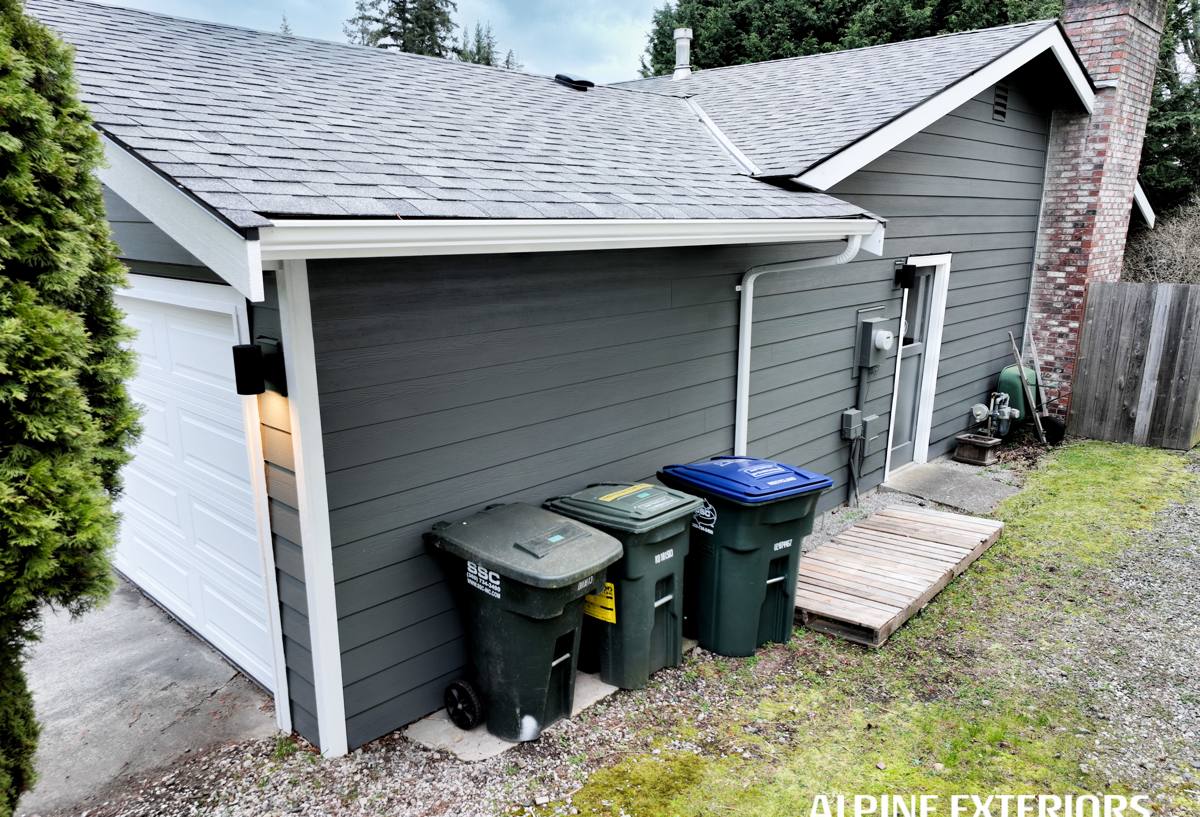
Signs a South Hill Home Needs Siding Replacement, Not Just Repair
Not every siding problem calls for a full replacement, but on hillside, shade-heavy properties the window for a simple patch closes faster than homeowners expect. Watch for these signs:
- Soft or spongy spots when you press on the siding, especially near the bottom courses or under windows
- Paint that's peeling, bubbling, or alligatoring rather than just fading
- Persistent moss or dark algae streaking that comes right back after cleaning
- Boards that are cupping, warping, or visibly separating at the joints
- A musty smell near exterior walls or unexplained interior drafts
- Rot or crumbling material at corners, trim, or anywhere siding meets the ground
- Siding that's original to a home built more than 20–25 years ago and has never been replaced
If you're seeing two or more of these, it's worth having someone look at the sheathing underneath, not just the surface — that's where the real damage usually is.
What a Correct Siding Replacement Actually Involves
A siding replacement is only as good as what happens underneath it. On a wet, shaded property like this, the details that don't show once the job is finished are the ones that determine whether it lasts.
Tear-Off and Sheathing Inspection
A full tear-off pulls the old siding completely off so the sheathing can actually be inspected, not guessed at. Any soft, delaminated, or rotted sheathing needs to be cut out and replaced before anything new goes back up — covering damaged sheathing with new siding just hides a problem that keeps growing behind the wall.
Moisture Management Behind the Siding
Correct installation means a continuous weather-resistive barrier, properly lapped and taped, with flashing integrated at every window, door, and penetration so water is directed out and down rather than trapped behind the cladding. In a climate with this much seasonal rain, a drainage gap behind the siding also matters — it lets any moisture that does get past the surface actually dry out instead of sitting against the wall.
How Siding Materials Compare in This Climate
Homeowners often ask why product choice matters as much as installation. In a marine climate with heavy moss pressure, it matters a lot — some materials simply handle sustained moisture better than others over a 20-, 30-, or 50-year timeline.
| Material | Moisture Behavior | Typical Maintenance | Realistic Lifespan Here |
|---|---|---|---|
| Vinyl | Doesn't rot, but seams and J-channels trap moisture and moss; can warp or crack in temperature swings | Periodic cleaning; panels are hard to color-match if damaged | 15–25 years before fading, warping, or seam failure |
| Engineered wood (LP SmartSide) / primed wood | Wood-based core is vulnerable to swelling and edge rot if any moisture gets past the coating or caulking | Repainting and caulk maintenance every few years; failed caulk joints need prompt attention | Highly dependent on maintenance; edge rot is common in wet, shaded exposures |
| James Hardie fiber cement | Fiber cement doesn't absorb and swell the way wood-based products do; factory finish sheds water at the surface | Occasional washing; ColorPlus finish is not meant to need repainting | Decades, when installed to spec with proper flashing and gapping |
Why We Install Only James Hardie Fiber Cement
We don't install vinyl, LP SmartSide, primed spruce, or cedar siding, and we're upfront about why. Each of those products has legitimate strengths — vinyl is inexpensive and low-maintenance in the right climate, engineered wood and cedar look great and are easy to work with — but every one of them asks something of the homeowner or the installer that we've watched cause problems in exactly this kind of wet, shaded, salt-air environment: seams that trap moisture, coatings and caulk joints that need to be maintained on schedule, or a wood-based core that swells and rots once water finds a way in.
James Hardie fiber cement is a cement, sand, and cellulose fiber composite — it doesn't have the wood-swelling problem, and it's non-combustible. Hardie also engineers its board for climate zone: its HZ5 product line is built for colder, wetter regions like ours, where freeze-thaw cycling and prolonged moisture are the norm rather than the exception. The ColorPlus factory finish is baked on under controlled conditions, which gives more consistent, longer-lasting color than field-applied paint and cuts down on the repainting cycle homeowners are used to with wood siding. Hardie also backs the product with a strong, transferable warranty — useful if you sell the home before the siding's functional life is up.
None of this means Hardie is maintenance-free or that installation quality doesn't matter — it's a heavier product that demands correct fastening, flashing, and clearances to perform the way it's designed to. That's precisely why we standardized on it: when it's installed to spec, it holds up to this climate better than the alternatives we used to install.
Our Siding Replacement Process
- On-site evaluation. We walk the exterior, check for soft sheathing and moisture entry points, and look specifically at shaded and north-facing walls where moss and slow drying are usually worst.
- Written scope and product selection. You get a clear scope of work and help choosing the Hardie plank profile and ColorPlus color that fits the home.
- Tear-off and sheathing repair. Old siding comes off completely; any compromised sheathing is cut back to sound material and replaced.
- Weather barrier and flashing. A continuous weather-resistive barrier goes on, with flashing detailed at every window, door, and penetration.
- Hardie installation. Siding is installed to manufacturer specifications and local code — correct fastener type and spacing, proper clearances at grade and trim, and drainage space where called for.
- Trim, caulking, and final finish. Trim and joints are finished and caulked at the manufacturer-specified points, not everywhere, since over-caulking can trap moisture rather than shed it.
- Walkthrough and warranty registration. We review the finished work with you and get the manufacturer warranty registered in your name.
Why It Matters to Hire a Crew That Already Works This Neighborhood
South Hill's terrain creates practical challenges a crew unfamiliar with the area will run into cold: steep driveways and lots that complicate material staging and dumpster placement, mature landscaping that has to be protected during tear-off, and older homes with framing and sheathing quirks that don't always match what's common in newer Bellingham subdivisions. A crew that's done this work up here before knows to expect those things and plans around them instead of discovering them mid-job.
Local experience also means familiarity with City of Bellingham and Whatcom County permitting and inspection expectations, and a working sense of which wall orientations and lot conditions are most likely to be hiding moisture damage before the tear-off even starts. That translates into fewer surprises and a more accurate estimate up front.
What Drives the Cost of a South Hill Siding Replacement
Every home is different, so we don't quote pricing sight unseen — but these are the factors that most often move the number up or down:
| Cost Factor | Why It Matters |
|---|---|
| Home size and number of stories | More wall area and taller walls mean more material, labor, and equipment (lifts or staging) |
| Extent of hidden rot or sheathing damage | Found only after tear-off; shaded, moss-prone walls are more likely to need repair |
| Site access | Steep driveways, narrow lots, and heavy landscaping on hillside properties can slow material staging and disposal |
| Trim and window wrap complexity | Older homes with detailed trim or original wood window casings take more time to detail correctly |
| Siding profile and color selection | Plank width, texture, and custom ColorPlus colors carry different material costs |
Broad ranges exist for siding replacement, but the only accurate number for your home comes from an on-site look at the walls, the sheathing condition, and the access — which is exactly what a free estimate is for.
If your South Hill home is showing any of the signs above, or you just want an honest read on how much life is left in your current siding, we're happy to take a look. The estimate is free, there's no pressure to move forward, and you'll walk away with a clear picture of what your home actually needs.