 Bellingham
 Happy Valley's Climate Is Harder on Siding Than It Looks
Happy Valley sits close enough to Bellingham Bay to catch salt-laden air off the water, and far enough into the trees on many lots to stay shaded and damp for long stretches of the year. That combination — salt air, driving rain off the Sound, and a moss season that can run from fall through spring — is exactly the mix that wears out the wrong siding material faster than homeowners expect. It's not dramatic weather. There's no hurricane risk here. It's slow, steady, year-round moisture exposure, and siding either sheds it or it doesn't.
Homes in this part of Bellingham also skew older, and a lot of the original siding on them was never built for this. Wood siding absorbs moisture and needs repainting on a cycle. Vinyl expands and contracts with temperature swings and can't stop moisture that gets behind it. Engineered wood products are sensitive to any breach in their factory coating. Whatcom County's damp, mild, tree-shaded microclimates are where those weaknesses show up first — usually as soft trim, moss staining, or paint failure well before a siding job should need attention.
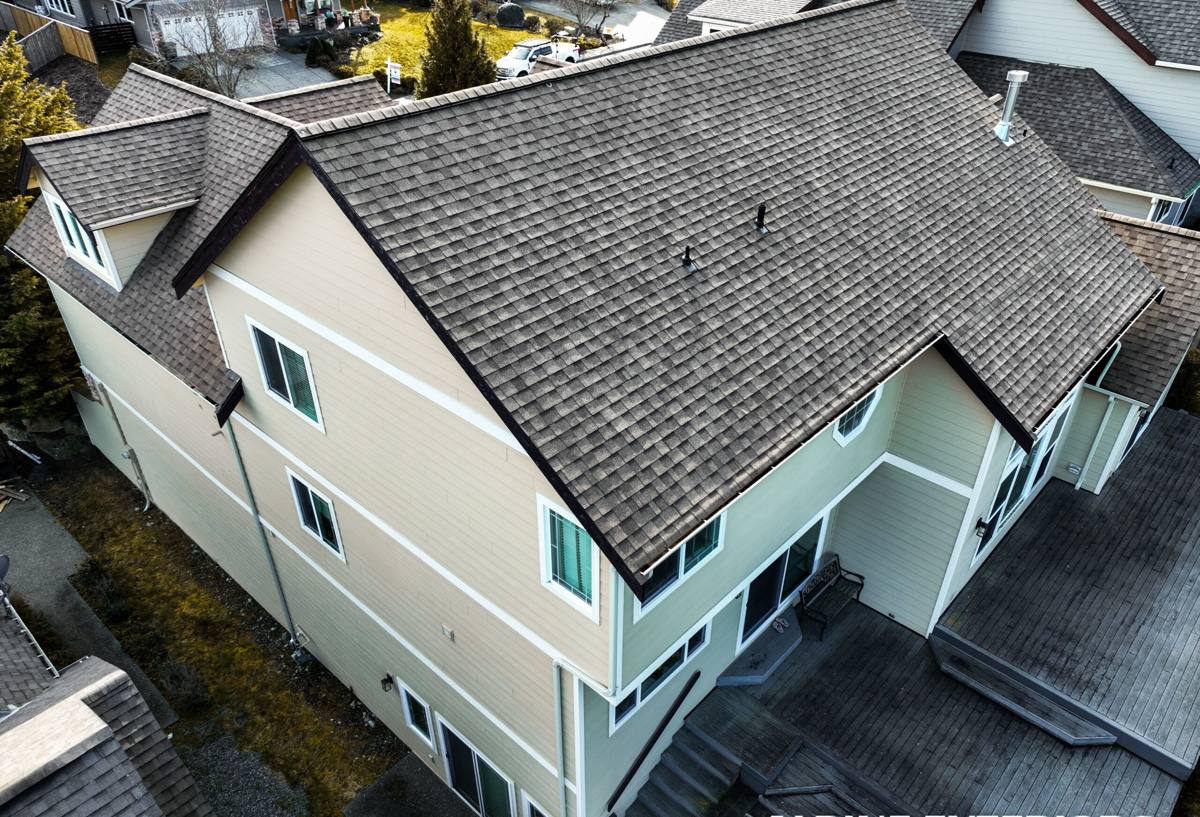
What a Correct Siding Installation Actually Involves
Siding installation is not just fastening new panels over the old wall. Done right, it's a system, and every layer of that system has to work with the others to keep water out and let the wall dry if moisture ever does get in.
Weather-Resistive Barrier and Flashing
Before a single piece of siding goes up, the wall needs a continuous weather-resistive barrier, properly lapped so water sheds downward and out, never inward. Every window, door, and penetration needs flashing that integrates with that barrier — not just caulk applied after the fact. This is the step that determines whether a wall stays dry for decades or develops a hidden rot problem behind siding that looks fine from the driveway.
Clearances and Ventilation
Siding needs proper clearance from grade, roofing, decks, and hardscape so water can't wick up into it or pool against the bottom edge. It also needs to be installed with the gaps and fastening pattern the manufacturer specifies, so the wall assembly can breathe and expand and contract without buckling.
Fastening and Manufacturer Spec
Fiber cement, in particular, has specific fastener type, spacing, and penetration requirements. Installing it like wood siding — wrong nails, wrong spacing, face-nailing where it isn't called for — is one of the most common ways a good product gets a bad reputation. The material isn't the problem in most failed installations; the installation is.
Why We Install Only James Hardie Fiber Cement
We made a decision a while back to stop installing anything other than James Hardie fiber cement siding, and Happy Valley's climate is a good example of why. Hardie siding is non-combustible, doesn't absorb water the way wood-based products do, and comes with a factory-applied ColorPlus finish that's baked on and UV-cured rather than field-painted — which matters directly for moss and mildew resistance, since a factory finish gives algae and moss far less to grip onto than a field-painted or raw wood surface.
We're not going to tell you every other siding product is junk — that's not honest, and it's not our call to make about a manufacturer's product line. What we will say is that after years of doing this work in wet, coastal, moss-prone conditions like Whatcom County's, we stopped installing vinyl, engineered wood, and raw wood siding because we were tired of watching homeowners deal with the maintenance burden, moisture callbacks, or premature repainting those products created here. Hardie, installed correctly, holds up to this specific climate better than anything else we've worked with, and it's backed by a strong transferable warranty that reflects the manufacturer's own confidence in it.
Matching the Right Hardie Line to This Neighborhood
James Hardie engineers its siding by climate zone, and the Pacific Northwest falls into the HZ5 formulation — built specifically for wetter, more temperate conditions than the HZ10 product sold in hot, dry markets. That's not a marketing distinction; it affects how the product handles moisture cycling over time, which is the exact stress Happy Valley's rain and shade put on a wall.
Style-wise, Happy Valley has a real mix of housing stock — older Craftsman and bungalow-style homes alongside newer infill construction. HardiePlank lap siding in a traditional reveal covers most of that older stock well, while HardiePanel or a mixed lap-and-panel approach with trim accents works for more contemporary builds. Color selection matters too: darker ColorPlus finishes read well against the area's tree cover, while lighter and mid-tone finishes tend to show less staining between our wetter months. We'll talk through what fits your specific house rather than pushing one look.
How the Main Siding Options Compare in This Climate
| Material | Moisture behavior in wet coastal climate | Moss/algae resistance | Ongoing maintenance | Fire rating | Relative cost tier |
|---|---|---|---|---|---|
| Vinyl | Doesn't absorb water itself, but can't stop water that gets behind it, and seams/laps are common entry points | Moderate — smooth surface, but grime and algae still build in shaded, damp spots | Low, but cracks and fades over time and can't be repainted easily | Combustible | Lower |
| Engineered wood (LP-style) | Sensitive to any coating breach; moisture intrusion at cuts or damage can spread quickly under the surface | Moderate to low depending on coating condition | Moderate — coating touch-ups matter over time | Combustible | Mid |
| Cedar / primed wood | Absorbs moisture readily; performance depends heavily on upkeep | Low — natural wood is a good substrate for moss and mildew | High — regular repainting or staining cycle required | Combustible | Mid to higher |
| James Hardie fiber cement | Dimensionally stable, engineered for moisture cycling in wet climates (HZ5) | Higher — factory ColorPlus finish resists staining better than field-applied coatings | Low — no repainting cycle needed with ColorPlus | Non-combustible | Mid to higher |
No material is maintenance-free forever, and cost is only one part of the decision. But in a climate that stays wet and shaded for much of the year, the categories that matter most — moisture behavior and moss resistance — are where fiber cement consistently separates itself from the alternatives.
Our Process for a Happy Valley Siding Installation
- On-site assessment. We look at the existing siding, check for soft spots or hidden moisture damage at trim, corners, and penetrations, and assess what the sheathing underneath looks like once the old siding comes off.
- Tear-off and sheathing check. Removing the old siding is also when we find out whether there's rot, damaged sheathing, or old flashing that needs to be corrected before anything new goes up — we don't cover up problems.
- Weather barrier and flashing. A new, continuous weather-resistive barrier goes on, with flashing detailed at every window, door, and penetration.
- Installation to Hardie spec. Panels or planks go up with the manufacturer-specified fasteners, spacing, and clearances — not shortcuts that happen to look fine on install day.
- Trim, caulking, and touch-up. Joints and trim get sealed correctly, and any factory-finish touch-up is done with Hardie's own matched product.
- Cleanup and walkthrough. We clean up the site and walk the finished job with you before we consider it done.
Signs Your Current Siding Is Already Struggling
A lot of homeowners in Happy Valley call us after noticing something during a wet fall or after power-washing a mossy wall for the second year in a row. Here's what tends to signal the siding — not just the paint — needs attention:
- Soft or spongy spots when you press on the siding, especially near the bottom courses or under windows
- Persistent moss or algae staining that comes back within a season of cleaning
- Paint that's peeling, bubbling, or failing faster than it used to
- Visible gaps, warping, or buckling panels
- Interior signs like musty smells, staining, or soft drywall near exterior walls
- Siding that's original to a home built decades ago and has never been replaced
Any one of these on its own might just mean a repair. Several together, especially on an older home, usually means it's time to have the whole wall assembly looked at, not just the visible surface.
Why a Bellingham Crew That Already Works This Neighborhood Matters
Happy Valley's lots vary a lot — some are open and exposed to weather off the bay, others are shaded and hemmed in by mature trees that keep walls damp longer after a storm. A crew that already works this part of Bellingham has a feel for which houses need extra attention to drainage and ventilation and which don't, before we even start tearing anything off. We're also familiar with the City of Bellingham's permitting expectations for exterior work, which keeps a project moving instead of stalling on paperwork. That local familiarity, paired with installing one product system correctly rather than several products inconsistently, is what actually protects a home here long-term — not a sales pitch about a specific neighborhood, but experience with the conditions that neighborhood actually creates.
If your siding is showing its age or you're planning ahead of a wetter season, we're happy to take a look and give you a straightforward, no-pressure estimate — just fill out the form below.