 Bellingham
 Why Sunnyland Decks Wear Out Faster Than the Manual Says
Sunnyland is one of Bellingham's older, more established neighborhoods, with mature tree canopy over a lot of the lots and homes that range from mid-century builds to newer additions tacked onto them — including a lot of decks that were never built to today's code or never flashed correctly against the ledger in the first place. That matters here more than in drier climates, because Whatcom County doesn't give wood or fasteners much of a break. Salt-tinged air off Bellingham Bay accelerates corrosion on anything metal — nails, screws, joist hangers, bolts. Driving rain off the water pushes moisture sideways into joints and end grain that a vertical-only rain design never accounts for. And the long, mild, damp stretch from fall through spring is exactly the window moss and algae need to colonize any horizontal wood surface that doesn't get direct sun or good airflow.
Add in the shade from mature trees on a lot of Sunnyland lots, and you get decks that simply never fully dry out between storms. Wood that stays damp for weeks at a time is wood that rots from the inside before it ever looks bad on top. We've based this page on what we actually find when we pull boards on decks in this part of Bellingham — not a generic list of deck problems.
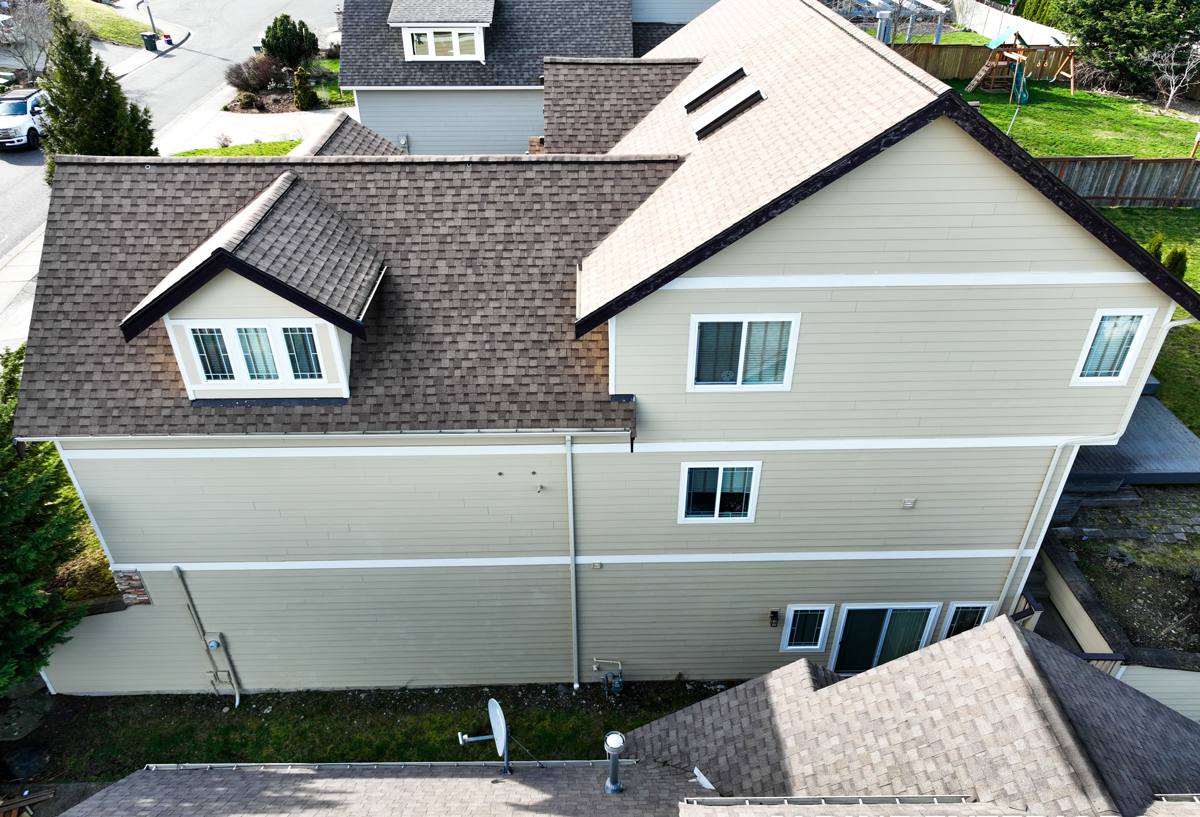
Signs Your Deck Needs Repair, Not Just a Cleaning
A lot of deck damage hides under a coat of dirt and moss, and homeowners understandably assume a pressure wash will fix what's actually a structural problem. Here's what we check for on every Sunnyland deck call:
- Soft, spongy, or bouncy spots underfoot, especially near the house or at board ends
- Rust streaks bleeding out from nail or screw heads onto the wood
- Any gap, dark staining, or daylight visible where the deck meets the house (ledger board)
- Wobble or give in the railing when you push on it — not just cosmetic looseness
- Cracked, splitting, or spongy stair stringers
- Persistent green or black film on boards that comes back within weeks of cleaning
- Standing water that doesn't drain within an hour or two after rain stops
- Fasteners backing out or heads sheared off when you try to reset them
Any one of these on its own might be minor. Two or three together, especially the ledger gap or the soft framing, usually mean the repair needs to start below the decking, not on top of it.
What a Correct Deck Repair Actually Involves
The Ledger Board and Flashing
This is the single most common failure point we find on older Bellingham decks, and it's the one that matters most for safety. The ledger board bolts the deck to the house, and if the flashing behind it was skipped or installed wrong — extremely common on decks built before local code tightened up — water has been getting behind that board for years. We check ledger attachment and flashing on every job, even when the homeowner called about something else entirely, because a failed ledger is how decks collapse, not how they sag.
Framing, Joists, and Posts
Once we know the ledger is sound, we probe the joists, beams, and post bases for rot, usually where they sit closest to grade or against the house. Post bases sitting in dirt or old concrete without proper standoff hardware are a repeat problem in older Sunnyland yards. Any joist with soft or crumbling wood gets sistered or replaced — we don't just cap over it.
Decking Boards
Cupped, splintering, or rotted boards get replaced individually where the framing underneath is still sound. This is where matching existing wood species and dimension matters, both for how the repair looks and how it weathers next to the original boards.
Railings and Stairs
Railing repairs aren't just cosmetic — Washington building code has specific requirements for guardrail height and baluster spacing, and a lot of older Sunnyland decks predate those requirements. When we're already repairing a railing, we bring it up to current code rather than just patching the same undersized system back together.
Fasteners
We don't reuse corroded fasteners, and we don't mix metals that cause galvanic corrosion with treated lumber. Given the salt air off the bay, this is one area where cutting corners shows up as rust streaks and loosening hardware within a couple of seasons.
Repair vs. Replace: How We Help You Decide
| Situation | Right Call | Rough Cost Factor | What It Buys You |
|---|---|---|---|
| Ledger and framing sound, a few bad boards | Board replacement | Lower — priced per board/section | 5-10+ years if maintained |
| Ledger flashing failed but framing mostly sound | Ledger rebuild + targeted framing repair | Moderate — labor-heavy, material-light | Resets the deck's weak point; framing life extended |
| Widespread joist/post rot, deck over 20-25 years old | Full rebuild | Highest — but often close to major-repair cost | New code-compliant structure, predictable lifespan |
| Structure sound, just weathered/gray | Clean, sand, reseal or stain | Lowest | Protects existing wood, buys time |
Our honest default is to repair whatever is structurally sound and replace only what isn't. On decks over about 20-25 years old, though, we'll tell you plainly if the repair math starts approaching rebuild cost — patching failing framing piece by piece can cost more over time than doing it right once.
Our Process for Sunnyland Deck Repairs
1. On-Site Inspection
We walk the deck, probe suspect boards and framing with an awl, check the ledger flashing, and look at post bases and stair stringers. This is where most of the real findings happen — problems you can't see from the top.
2. Scope and Written Quote
You get a clear breakdown of what's structural versus cosmetic, what we recommend fixing now versus monitoring, and a real number — not a range so wide it's meaningless.
3. Permits and Code Check
Structural deck repair — ledger work, framing replacement, railing changes — can trigger permit requirements with the City of Bellingham or Whatcom County depending on scope and location. We handle that conversation so you're not guessing whether your project needs a permit.
4. The Repair Itself
We work from the structure out: ledger and flashing first, then framing, then decking, then rails and stairs. We don't cover up wood we haven't confirmed is sound.
5. Cleanup and Walkthrough
We walk the finished repair with you, point out what we did and why, and flag anything worth watching going forward — a shaded corner that'll need more frequent moss treatment, for example.
Materials: Matching What's There, or Talking You Through Options
Most Sunnyland deck repairs are on wood decks — pressure-treated framing with cedar or treated decking boards. Our standard is to match existing material where the deck is otherwise in good shape, since mixing wood species or profiles on a partial repair usually looks patched rather than restored. For larger repairs or full rebuilds, composite decking is worth discussing: it resists moss and rot better than wood, but it comes with real trade-offs — higher upfront material cost, specific fastening systems that aren't interchangeable with wood-decking hardware, and its own installation sensitivities around spacing and substructure ventilation. We'll walk you through both honestly rather than pushing whichever costs more.
Keeping a Repaired Deck Ahead of the Moss Season
A repair is only as good as what happens after it. In Whatcom County's damp stretch, that mostly comes down to two things:
- Airflow and drainage: keeping planters, rugs, and furniture from creating permanently damp spots on the decking
- Periodic cleaning and resealing: a wood deck in a shaded Sunnyland yard typically needs cleaning and re-sealing more often than one in full sun — moss regrowth is the tell that it's due
We can talk through a realistic maintenance interval for your specific lot when we're on site, since shade, tree cover, and drainage vary a lot street to street even within the neighborhood.
Why It Matters That We Already Work in Sunnyland
A crew that already works this neighborhood knows what a Sunnyland-era deck was typically built to, where the recurring problem spots are (ledger flashing on additions, post bases set too close to grade, undersized older railings), and how shade and drainage patterns differ block to block. That's the difference between a repair that guesses at what might be wrong and one that knows what to check first. It also means faster response if you find a soft spot before hosting people, and a contractor who's still around locally if something needs a follow-up look next season.
If you're seeing any of the warning signs above, or just want an honest read on whether your deck needs a few boards or a real structural fix, we're glad to come take a look. Estimates are free and there's no pressure — use the form below to get started.