 Bellingham
 Barkley is one of Bellingham's newer, well-established neighborhoods, and most of its homes are still young enough that siding problems catch owners off guard. The assumption is usually "it's only fifteen or twenty years old, it should be fine" — but siding age isn't the whole story in Whatcom County. What matters just as much is how that siding has spent those years standing up to marine air off Bellingham Bay, long stretches of driving rain, and a moss season that can run from fall through spring. A repair crew that understands that local pattern of wear fixes the actual problem instead of just patching the symptom.
Why Siding Fails Faster in a Neighborhood Like Barkley
Bellingham's climate is hard on exterior building materials in three specific ways, and Barkley homes get all three at once. Understanding which one is doing the damage changes how the repair should be done.
Salt Air
Proximity to Bellingham Bay means a steady low-level exposure to salt-laden air, even for homes set back from the water. Salt accelerates corrosion on fasteners, flashing, and any exposed metal trim. When a nail or staple starts to rust before the siding around it fails, you get streaking, loosened boards, and small cracks that let water in behind the material — long before the siding itself is actually worn out.
Driving Rain
Whatcom County doesn't just get a lot of rain — a good share of it comes in sideways off wind driven up the Sound and the Nooksack valley. Wind-driven rain finds every gap in flashing, every unsealed joint, and every spot where caulking has shrunk or failed. It pushes moisture into places that a light vertical rain never would reach, which is why so many repair calls in this area turn out to be water damage behind the siding rather than damage to the siding face itself.
Moss and Sustained Moisture
Bellingham's moss season is long, and moss doesn't just grow on roofs. It establishes on north-facing siding, in corner boards, and anywhere shade and moisture linger — holding water against the surface for weeks at a time. On the wrong material, that sustained dampness leads to swelling, delamination, or rot. On correctly installed fiber cement, it's mostly a cosmetic and maintenance issue, but it still needs to be cleared before a repair, or new growth will hide the very damage you're trying to fix.
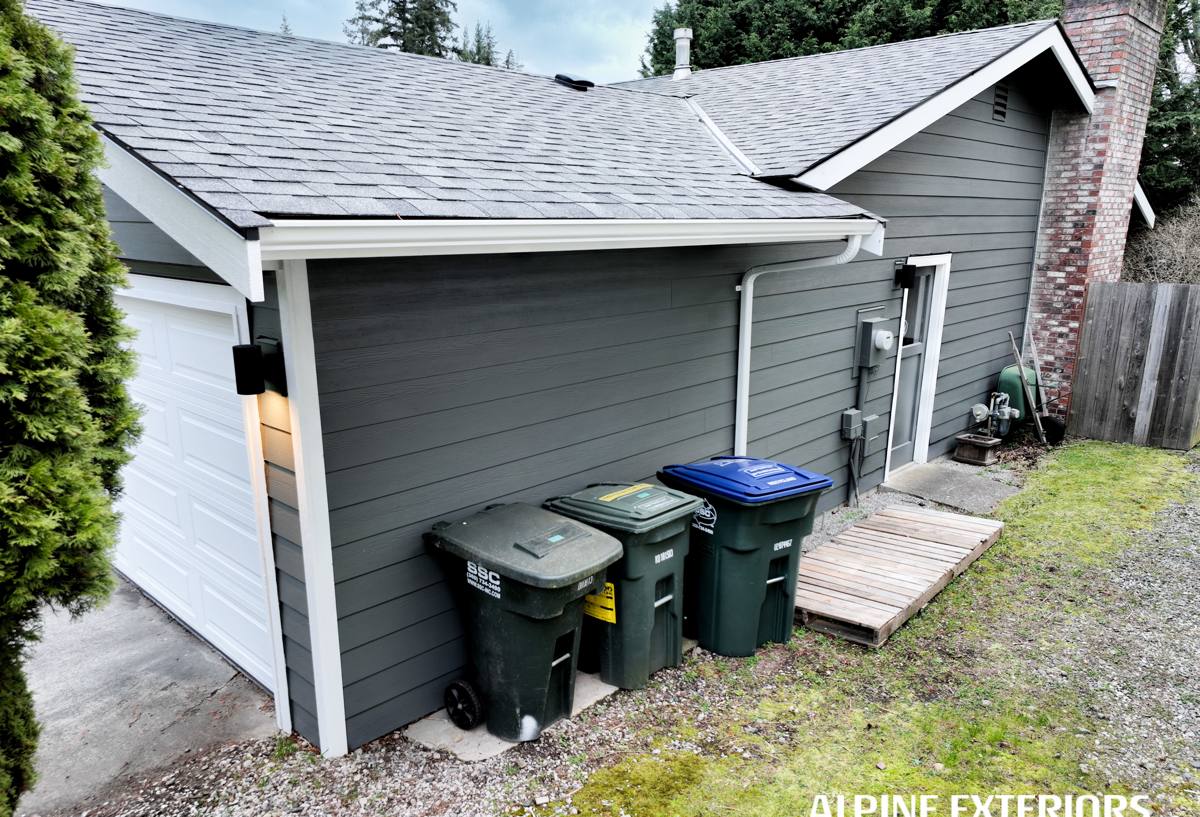
Signs a Barkley Home Needs Siding Repair, Not Just a Wash
Some damage is obvious. Some hides behind trim, under eaves, or behind healthy-looking moss. Here's what we actually check for on a service call in this neighborhood:
- Soft or spongy spots when you press on the siding, especially near the bottom courses and around window and door trim
- Visible cracking or chipping at butt joints, corners, or anywhere boards meet trim
- Dark staining or streaking running down from nail heads or seams — often a sign of rusting fasteners
- Bulging, bowing, or separation where boards have pulled away from the wall
- Persistent moss or algae in the same spots year after year, even after cleaning
- Paint or ColorPlus finish that's peeling, bubbling, or wearing unevenly in patches rather than uniformly with age
- Soft trim boards, window casings, or corner boards, which usually means water has been getting behind the siding for a while
- A musty smell or visible staining on interior walls that share an exterior wall with damaged siding
Any one of these on its own might be minor. Several together, especially clustered on one wall or corner, usually points to a moisture path that's been active for a season or more.
What a Correct Siding Repair Actually Involves
A quick patch — caulk over a crack, a fresh coat of paint over a stain — buys a homeowner a season, maybe two, before the same spot fails again. A correct repair addresses why that section failed in the first place. That means:
Finding the Water Path, Not Just the Symptom
Before any board is replaced, we trace how water is getting in. That usually means pulling the damaged section, checking the house wrap or weather-resistive barrier behind it, and inspecting flashing at windows, doors, and any penetrations nearby. Replacing siding over a still-active leak just hides the problem for another year.
Matching Material and Fastening Correctly
Repairs need to be done with the right product, the right fasteners for a marine climate, and installation that matches manufacturer spec — proper nail placement, correct gapping at joints, and flashing details that shed water rather than trap it. Mismatched materials or shortcuts here are exactly what causes repeat failures a few years down the line.
Addressing Moss and Drainage, Not Just Replacing Boards
If moss or standing moisture caused the original failure, a repair that doesn't also address drainage, gutter overflow, or shaded, poorly-ventilated wall sections will fail again in the same spot. Sometimes the fix includes small changes — a kickout flashing, better gutter discharge, trimming back vegetation — alongside the siding work itself.
Finishing to Match
Especially on a home with factory-finished siding, a repair should come as close as possible to a seamless color and texture match, not an obvious patch. This is easier with a factory-finish product than with a field-painted one, since the original finish doesn't fade the way site-applied paint does.
Repair or Replace: How We Help You Decide
Not every damaged section needs a full re-side, and not every repair is worth doing on its own. The right call depends on how much of the wall is affected and what's causing the damage.
| Factor | Favors Repair | Favors Full Replacement |
|---|---|---|
| Extent of damage | Isolated to one or two sections or walls | Spread across most elevations of the home |
| Cause | One-time event: impact damage, a single failed flashing detail | Systemic moisture intrusion or aging original material throughout |
| Age of existing siding | Newer siding, otherwise sound | Original siding is near or past its expected service life |
| Material match | Matching product is still available (ColorPlus lines are especially consistent over time) | Discontinued color or product line, or non-Hardie material that can't be matched |
| Underlying structure | Sheathing and framing behind the damage are dry and sound | Rot has spread into sheathing or framing in multiple areas |
We'll tell you honestly which side of that table your home falls on. If a targeted repair solves the problem, that's what we'll recommend — a repair-focused crew that only pushes full replacements would lose trust in a neighborhood like Barkley fast, and repeat and referral business is how a local crew actually stays busy.
Our Process for a Barkley Repair Call
- Inspection. We walk the exterior, check the damaged area and its surroundings, and look for related trouble spots you might not have noticed yet.
- Diagnosis. We identify the actual cause — fastener corrosion, flashing failure, moss-driven moisture, impact damage — before recommending a fix.
- Written scope and estimate. You get a clear explanation of what needs to happen and why, with an honest cost range, before any work starts.
- Repair. Damaged material comes out, the water path gets corrected, and new material goes in matched to spec — fastening, gapping, and flashing done to hold up in this climate.
- Finish and walkthrough. We match color and texture as closely as the product allows and walk the repair with you before we call it done.
Straightforward repairs on a single section are often a one-day job. More involved repairs — especially any that uncover sheathing damage — take longer, and we'll tell you that up front rather than discover it mid-job and surprise you with it.
Why We Only Repair and Install James Hardie Fiber Cement
We don't install vinyl, LP SmartSide, primed spruce, cedar, or other fiber cement brands, and that standard applies to repairs too, not just new installs. In a climate like Bellingham's — salt air, driving rain, months of dampness — the material matters as much as the workmanship.
James Hardie fiber cement doesn't absorb and swell with moisture the way wood-based products can, and it's non-combustible, which matters more each year with regional wildfire smoke seasons even this far north and west. The ColorPlus factory finish holds its color far longer than field-applied paint, which is a real advantage on a repair: a factory-finished patch matches the surrounding wall in a way that a freshly painted patch on faded paint never quite does. Hardie's HZ product lines are also engineered specifically for wetter climate zones like ours, and the warranty is transferable if you sell the home — worth something to a buyer's inspector who knows what to look for.
When we repair a wall that has other manufacturers' siding on it, we'll say so plainly and explain the trade-offs of matching versus upgrading that section. We won't tell you your existing product is garbage just to sell a bigger job — but we also won't install something we don't stand behind, which is why our own work is Hardie, start to finish.
Why a Crew That Already Works Barkley Matters
Siding repair done wrong in this climate doesn't fail quietly — it fails in the same spot again, usually within a year or two, and usually worse than the first time because water's had another season to work on the sheathing behind it. A crew that repairs siding across Whatcom County regularly has already seen how salt air, wind-driven rain, and moss behave on homes in this specific area, on this specific mix of ages and construction styles. That's less guesswork than a crew driving in from outside the region for a one-off job, and it shows in the diagnosis — spotting a flashing detail that's failing at the source instead of just patching the visible crack downstream of it.
It also means we're a known, findable local business if a repair ever needs a follow-up visit — not a name from an out-of-town ad that's hard to track down eighteen months later.
If you're seeing cracking, staining, soft spots, or persistent moss on your Barkley home's siding, we're happy to take a look. The estimate is free, there's no pressure to do more work than the home actually needs, and you'll get a straight answer about whether it's a repair or something bigger.