 Bellingham
 Building Decks for Sehome's Specific Conditions
Sehome sits close enough to the water and high enough in elevation that homes here deal with a mix of conditions that don't show up the same way everywhere in Bellingham. You get salt-laden air drifting in off the bay, long stretches of driving rain through fall and winter, and a moss season that can run from October well into spring. None of that is unusual for Whatcom County, but it adds up differently on an outdoor deck than it does on a roof or on siding, because a deck is horizontal, walked on, and exposed to standing water in a way vertical surfaces simply aren't.
A deck that's built without accounting for this combination doesn't usually fail dramatically. It fails slowly — a soft board here, a rusting fastener there, moss creeping into a joint that never quite dries out. By the time it's obvious, you're often looking at a full rebuild instead of a repair. This page is about what it actually takes to build a deck in Sehome that holds up, and how we approach that job when your address is here.
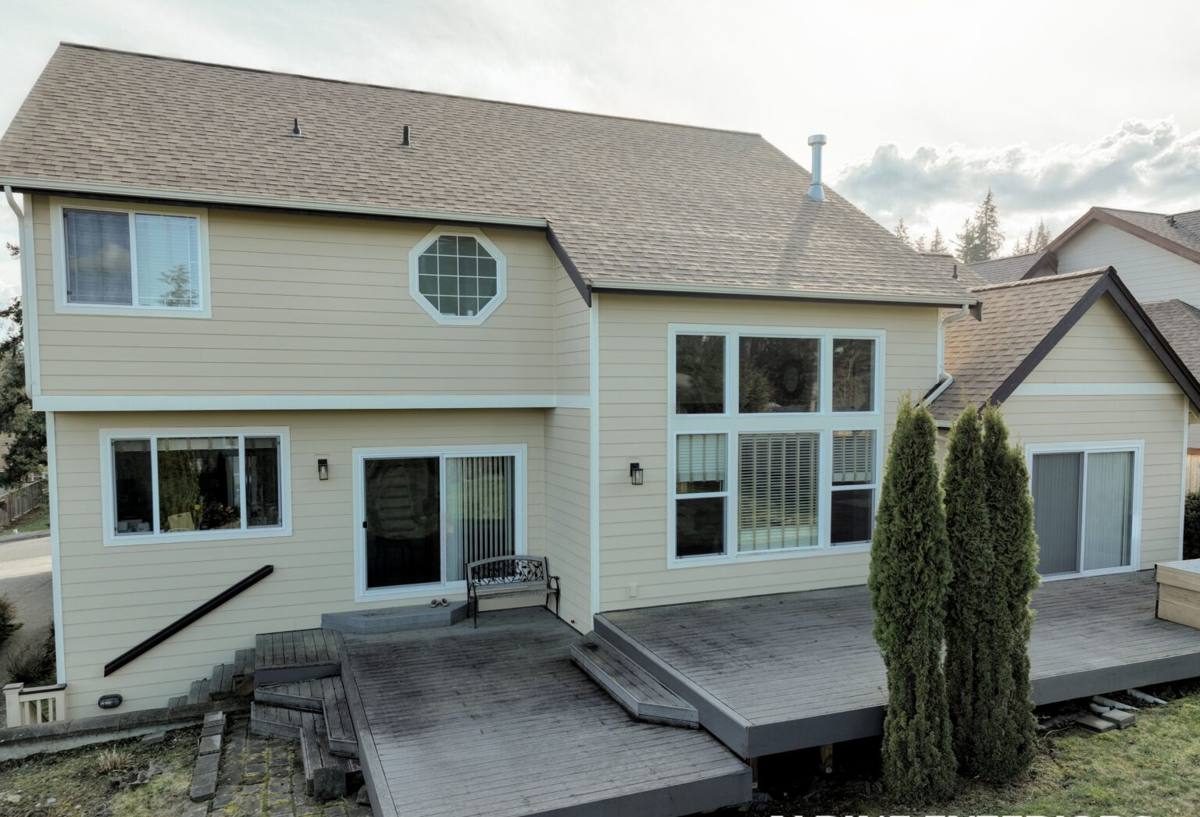
What Salt Air, Rain, and Moss Actually Do to a Deck
Salt Air and Metal Hardware
Salt in the air accelerates corrosion on anything metal — screws, joist hangers, bolts, and structural connectors. A fastener that would last decades further inland can start showing rust streaks and weakening well ahead of schedule near the water. This matters most where you can't see it: inside a joist hanger, at a ledger board connection, or wherever two pieces of framing meet.
Driving Rain and Water Path
Bellingham rain doesn't fall straight down very often. Wind-driven rain gets pushed sideways into railings, under fascia boards, and into any gap where a builder assumed water would just run off. Decks need an intentional path for water to leave — proper board spacing, correct slope away from the house, and flashing where the deck meets siding — or that water finds its way into framing and stays there.
Moss and Prolonged Dampness
Moss doesn't just grow on roofs. On a deck, it takes hold in shaded corners, between boards that sit too tight together, and on any surface that doesn't get enough sun or airflow to dry out between rain events. Moss holds moisture against wood and decking material far longer than bare surfaces do, which is exactly the condition that leads to rot in wood decking and premature wear in composite products.
What a Correctly Built Deck for This Area Involves
A deck built to hold up under Sehome's conditions isn't a different product than a deck built anywhere else — it's the same job done with more attention to the details that this climate punishes. That means:
- Corrosion-resistant fasteners and structural hardware rated for coastal or wet exposure, not standard interior-grade hardware
- Proper flashing at the ledger board where the deck attaches to the house, so water can't work its way behind siding
- Consistent board spacing that lets water drain instead of pooling or wicking sideways
- Slight slope built into the deck surface, away from the house, so water has somewhere to go
- Airflow underneath the deck through correct joist spacing and skirting design, so framing can actually dry out between storms
- Material choices matched to sun exposure — shaded decks need different consideration than ones that get more direct light
None of this is exotic. It's standard good practice applied consistently, which is where a lot of decks fall short — not because the materials were wrong, but because one connection point or one drainage detail got rushed.
Framing and Structure: Where Most Deck Problems Start
The part of a deck people notice is the surface — the boards you walk on and the railing you lean against. But the part that determines whether a deck lasts fifteen years or thirty is underneath: the ledger, the posts, the joists, and the footings. In a climate with this much rain and moisture exposure, we treat the structural layer as the priority, not an afterthought to the visible finish.
That includes using framing lumber rated for ground contact or exterior exposure where it's called for, sizing footings to local frost and load requirements, and making sure post bases keep wood off standing water rather than sitting directly on grade. A deck can look finished and still have a structural weak point that only shows up years later as sponginess, sagging, or a railing that's gone loose. Getting the frame right the first time is cheaper than fixing it after the surface is already built.
Choosing Decking Material for Sehome's Climate
There's no single "correct" decking material — the right choice depends on your budget, how much sun the deck gets, and how much maintenance you're willing to keep up with. Here's how the common options actually compare under local conditions:
| Material | Moisture Behavior | Maintenance | Typical Lifespan Here |
|---|---|---|---|
| Pressure-treated wood | Resists rot when sealed regularly; can trap moisture if finish is neglected | Annual cleaning and periodic re-sealing | 10–15 years with upkeep |
| Cedar | Naturally moisture-resistant, ages gracefully if maintained | Regular cleaning, periodic oil or sealant | 15–20 years with upkeep |
| Composite decking | Doesn't absorb water like wood, but can still trap moss on the surface if not cleaned | Occasional washing, no sealing needed | 25+ years, varies by product |
| PVC decking | Fully water-resistant surface, best resistance to moss staining | Lowest maintenance of the group | 25+ years, varies by product |
We'll walk through these trade-offs honestly during your estimate rather than steering you toward whatever's easiest for us to install. Wood costs less up front but asks more of you every year. Composite and PVC cost more initially but ask less of you over time. The right answer depends on how you actually want to spend your maintenance weekends.
Railings, Fasteners, and the Hardware You Don't See
Railings take direct hits from wind-driven rain, so the connection points matter as much as the material itself. We use fasteners and brackets rated for exterior and coastal exposure, and we pay close attention to any spot where a railing post meets the deck frame — that's a common place for water to collect and for corrosion to start if the wrong hardware was used.
Our Process, Start to Finish
Every deck project follows the same basic sequence, though the details shift based on your yard, your home's layout, and what you're trying to get out of the space.
- On-site assessment. We look at sun exposure, drainage, how the deck will attach to your home, and any existing structure if this is a replacement or rebuild.
- Design and material discussion. We talk through decking material, railing style, and layout based on your budget and how you'll use the space.
- Permitting. Most deck projects in Bellingham require a permit depending on size and height — we handle that process as part of the job.
- Framing and structural work. This is where we build in the drainage, flashing, and hardware details that determine long-term durability.
- Decking, railing, and finish work. The visible layer goes on last, once the structure underneath is solid.
- Final walkthrough. We go over the finished deck with you, including basic care so you know what to expect going forward.
Keeping a Sehome Deck in Good Shape Long-Term
A well-built deck still needs some seasonal attention in this climate, especially with moss season running as long as it does here. A short, consistent maintenance routine goes a long way toward protecting the investment:
- Sweep debris and leaves off the deck regularly, especially in fall, so moisture doesn't get trapped underneath organic matter
- Rinse off moss and algae buildup before it has a chance to establish, particularly in shaded corners
- Check railing connections once a year for looseness or early corrosion
- Keep gutters and downspouts near the deck clear so runoff isn't dumping extra water onto the structure
- Re-seal or re-stain wood decking on the schedule appropriate to that product — don't wait until it looks obviously weathered
- Look underneath the deck occasionally for standing water, moss, or soft framing, since problems there are easiest to catch early
Why It Matters That We Already Work in Sehome
Building codes, permitting expectations, and the specific mix of weather a deck has to survive don't look identical from one part of Whatcom County to another. A crew that regularly works in and around Sehome has already seen how the local conditions play out over the first few years of a deck's life — which details are worth the extra time and which shortcuts show up as callbacks. That's not a substitute for good craftsmanship, but it does mean fewer surprises and a deck that's built for the actual conditions it'll face, not a generic set of assumptions.
If you're considering a new deck, a replacement, or you're not sure whether your current deck is holding up the way it should, we're happy to take a look and give you a straightforward assessment. Reach out for a free, no-pressure estimate using the form below.