 Bellingham
 New Roof Installation for York-Area Homes
York sits close enough to Bellingham Bay that salt-laden air is a constant factor in how a roof ages here, and the neighborhood's mix of older post-war homes and newer infill means we see a wide range of roof conditions on any given street. Some houses still carry their original roof decking from decades back; others have had one or two re-roofs already. Whatever the starting point, a new roof installation in this part of Whatcom County has to be built for the specific way weather works here — not just installed to a generic manufacturer spec.
Bellingham's climate isn't dramatic, but it's relentless. Long stretches of driving rain, short winter days that keep roofs damp for weeks at a time, and a moss season that can run from fall through spring all add up to steady, cumulative wear. A roof that's installed correctly for this environment holds up. One that's installed to a lowest-bid spec starts showing problems in year five or six instead of year twenty.
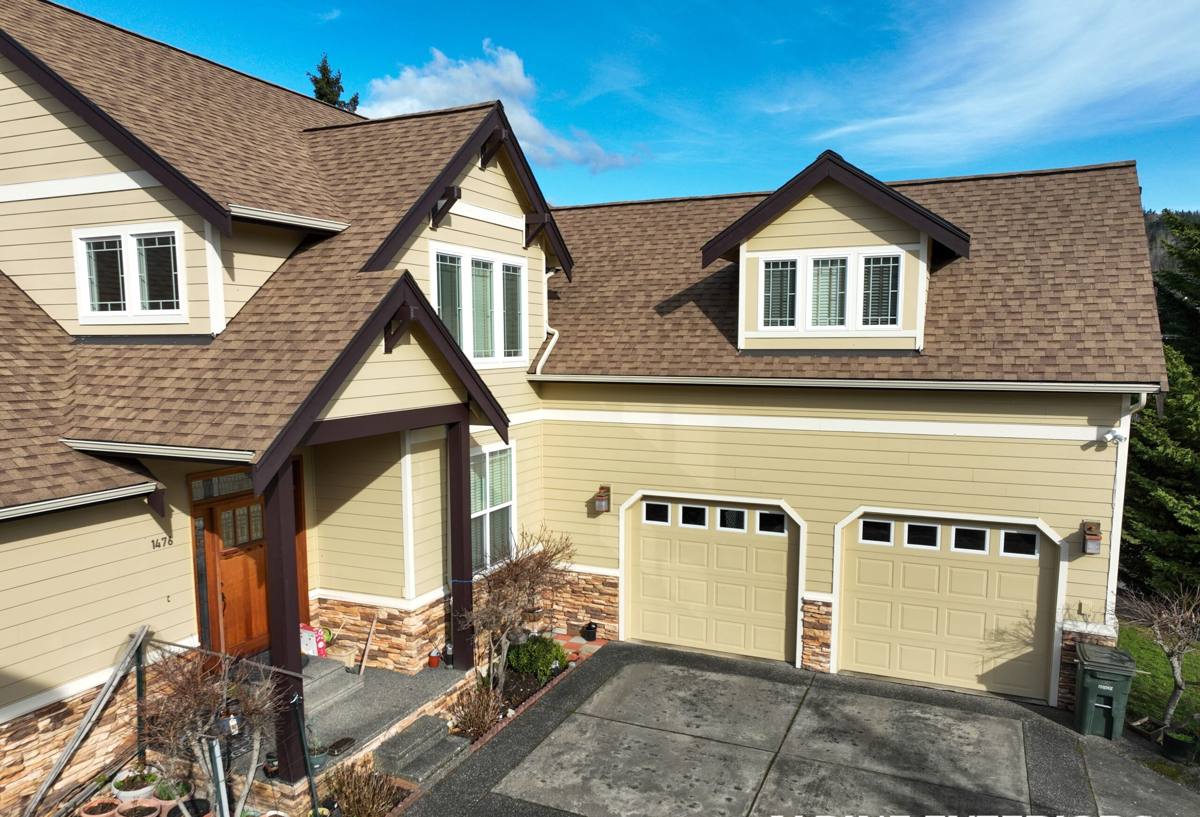
What York's Climate Actually Does to a Roof
Salt Air and Metal Fasteners
Proximity to the bay means airborne salt settles on roofing surfaces and, more importantly, on exposed metal — flashing, fasteners, vent caps, and gutter hardware. Standard galvanized fasteners corrode faster here than they would twenty miles inland. We spec corrosion-resistant fasteners and flashing metals as standard on York jobs, not as an upsell, because replacing a roof over corroded flashing in ten years costs far more than doing it right the first time.
Driving Rain and Wind-Driven Moisture
Storms off the water often come in sideways rather than straight down. That matters for roofing because it pushes water up under shingle tabs, into ridge vents, and along valley lines in ways that a calm-weather installation might not anticipate. Proper underlayment coverage, correctly lapped valley metal, and sealed ridge details aren't optional extras in this part of Whatcom County — they're the difference between a roof that sheds wind-driven rain and one that eventually leaks into the attic.
Moss, Shade, and Slow Drying
Many York lots have mature trees, and shaded roof sections stay damp long after sunnier areas have dried out. That's exactly where moss and algae take hold first. Moss isn't just cosmetic — as it grows, it lifts shingle edges, holds moisture against the roofing material, and accelerates granule loss. A new roof installed with moss-resistant shingles (or copper/zinc control strips near the ridge) and adequate attic ventilation to help sections dry out faster will noticeably outlast one installed without those details.
What a Correct New Roof Installation Involves
A new roof is more than shingles. The parts homeowners don't see are usually what determine whether the roof lasts fifteen years or thirty-five.
- Full tear-off and deck inspection — we remove the old roofing down to the deck and check for soft spots, rot, or delamination before anything new goes down
- Deck repair or replacement — any compromised sheathing gets replaced; nailing new shingles over a weak deck is a shortcut that fails early
- Ice-and-water barrier at vulnerable points — eaves, valleys, and roof penetrations get self-adhering underlayment for a sealed layer against wind-driven rain
- Synthetic underlayment across the field — a consistent moisture barrier under the whole roof, not just the high-risk areas
- Corrosion-resistant flashing and fasteners — sized and installed for coastal air exposure
- Balanced attic ventilation — intake at the eaves and exhaust at the ridge, sized to the attic's actual volume, so moisture and heat don't get trapped
- Proper valley and penetration detailing — woven, closed-cut, or metal valleys installed to shed water rather than channel it under the shingles
- Manufacturer-compliant nailing pattern — the single most common cause of premature wind damage is under-nailing or mis-nailing, and it's invisible until a storm finds it
Choosing Materials for a York Roof
Most homes in this neighborhood do well with a quality architectural asphalt shingle rated for high wind and algae resistance — it balances upfront cost, lifespan, and low maintenance for the Bellingham climate. Some homeowners ask about metal roofing given the rain volume, and it's a legitimate option where budget and roof style support it; we'll walk through the real trade-offs rather than push one product because it's easier to install or higher margin.
| Material | Typical Lifespan Here | Moss/Algae Behavior | Best Fit |
|---|---|---|---|
| Architectural asphalt (algae-resistant) | 25–30 years | Good with copper/zinc strips and airflow | Most York homes; best value |
| Standard 3-tab asphalt | 15–20 years | More prone to moss without added protection | Budget-limited re-roofs, lower-slope garages |
| Standing seam metal | 40–50+ years | Sheds moisture fast, minimal moss | Steeper rooflines, longer-term owners |
| Cedar shake | 20–25 years with upkeep | High maintenance burden in wet shade | Only where owner commits to regular maintenance |
We don't install every product on that list on every job. Cedar shake, for instance, looks great, but in a shaded, damp lot it demands more upkeep than most owners want to sign up for — we'll say so plainly rather than sell a product that doesn't suit the site.
Signs a York Home Needs a New Roof (Not a Repair)
- Granule loss heavy enough that shingles look bald or gutters are full of grit
- Multiple layers already on the roof from past re-roofs — a new layer isn't an option, and tear-off is required
- Soft or spongy decking felt underfoot in the attic or from the ground
- Persistent moss growth that keeps returning after cleaning
- Daylight visible through the roof deck from inside the attic
- Curling, cracked, or missing shingles across more than one section of the roof
- Recurring leaks in the same spot despite prior patch repairs
If a roof is showing one or two of these signs and is under fifteen years old, a repair may still make sense. Past that point, or with several signs present at once, a full replacement is usually the more honest recommendation — patching an aging roof repeatedly ends up costing more than a properly sequenced replacement.
Our Process for a York Re-Roof
- On-site assessment — we walk the roof, check the attic, and look at ventilation and decking condition, not just the shingles
- Written scope and estimate — materials, tear-off scope, ventilation changes, and timeline spelled out before any work starts
- Material selection — we go over the options above and help match the choice to the home's exposure, slope, and budget
- Scheduling around weather — we plan tear-off and dry-in for dry weather windows whenever the forecast allows, so the deck isn't left exposed longer than necessary
- Tear-off, deck repair, dry-in — old roofing removed, deck inspected and repaired, underlayment installed the same day where possible
- Installation — shingles, flashing, and ventilation components installed to manufacturer spec
- Cleanup and magnetic sweep — job site and yard cleared of debris and stray fasteners
- Final walkthrough — we go over the finished roof and warranty paperwork together
Why a Local Crew Matters for This Job
A crew that already works in York and the rest of Bellingham knows which streets sit in heavier shade, which lots catch the worst of the wind off the bay, and which roof ages are common for the housing stock in this part of Whatcom County. That's not abstract — it changes what we look for during the assessment and what we recommend for ventilation and material choice. It also means we're a short drive away if a question comes up after the job is done, not a crew that packed up and left the county.
We're also familiar with the local permitting process and inspection expectations for the City of Bellingham and Whatcom County, which keeps a re-roof project moving instead of stalling on paperwork.
What Drives the Cost of a New Roof
Every roof is priced on its own specifics, but a few factors consistently move the number more than homeowners expect:
| Factor | Why It Matters |
|---|---|
| Roof size and number of layers to remove | More tear-off labor and disposal, especially with multiple existing layers |
| Deck condition | Rotted or soft sheathing has to be replaced before new roofing goes down |
| Roof pitch and complexity | Steep slopes, multiple valleys, and dormers all add labor time |
| Material choice | Standard asphalt, algae-resistant asphalt, and metal carry different material costs |
| Ventilation upgrades | Adding or correcting intake/exhaust venting is often worth the added cost long-term |
| Access and site conditions | Steep driveways, tight lots, or limited staging area can add time |
We'd rather walk a homeowner through these factors on-site than quote a number over the phone with no context — it's the only way the estimate actually reflects the roof in front of us.
If you're in York or anywhere else in the Bellingham area and thinking about a roof replacement, we're happy to come take a look and give you a straight, no-pressure estimate. There's a form below — send us a bit about your home and we'll get back to you to schedule a visit.