 Bellingham
 Why Ferndale Roofs Wear Differently Than Roofs Inland
Ferndale sits close enough to the water that salt-laden air is a real factor, not a theoretical one. Combine that with the driving rain that comes off Bellingham Bay and the Strait during fall and winter storms, and you've got a roof system that's under more sustained stress than a similar home twenty miles inland. Add the shaded, moisture-heavy lots common around Whatcom County — full of fir and cedar cover — and you get a moss season that can run eight or nine months out of the year on a north-facing slope.
None of this means a Ferndale roof needs to be exotic or overbuilt. It means the details that are optional in a dry climate — the underlayment spec, the flashing at every penetration, the ventilation balance, the material's moss resistance — stop being optional here. A roof installed to a generic national standard will survive in Ferndale. A roof installed with this specific climate in mind will last longer, leak less, and cost less to maintain.
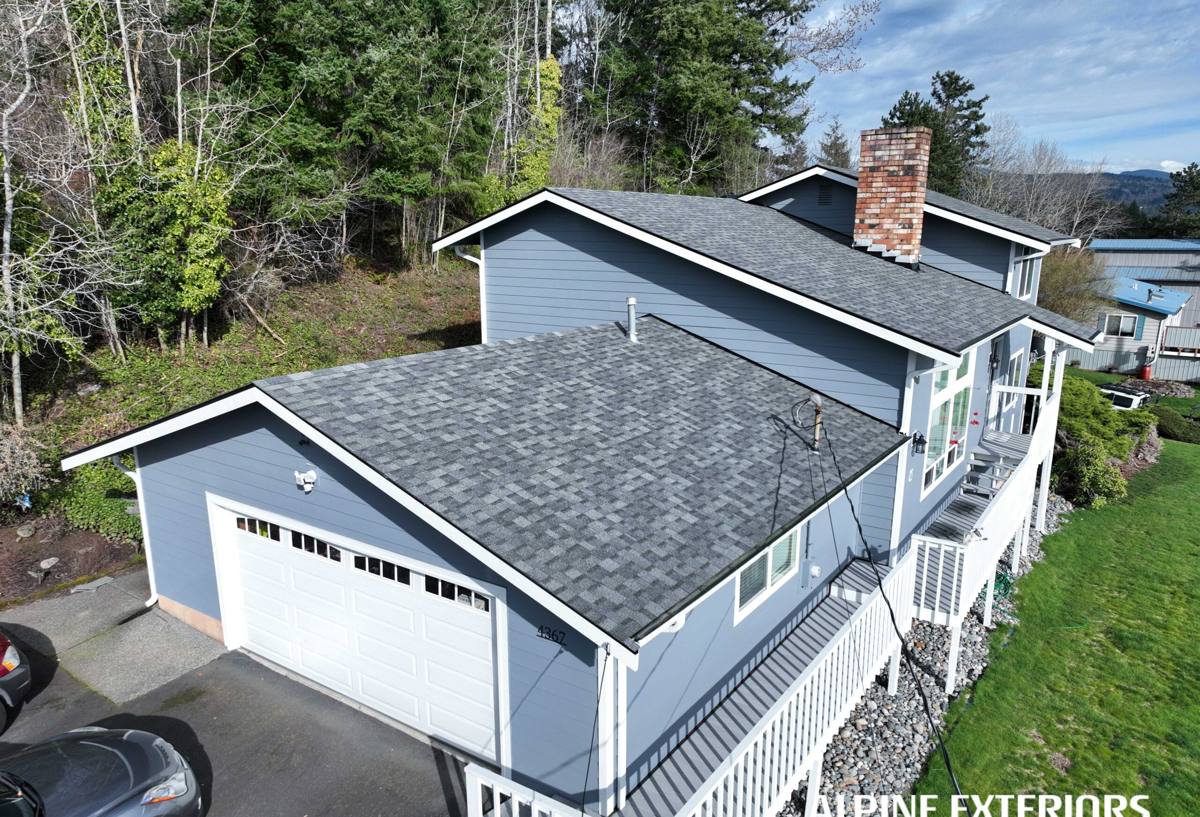
Signs You're Looking at Replacement, Not Repair
Not every roof problem in Ferndale calls for a full tear-off. But there's a point where patching stops making financial sense. Some of the clearer signals:
- Shingles are curling, cupping, or losing granules in patches rather than just at one flashing detail
- The roof is past 20-25 years old (asphalt shingle) and has had more than one repair in the last few years
- Moss has been growing thick enough, long enough, that it's lifted shingle edges or you can feel soft spots when you walk the roof
- You're seeing daylight or water staining in the attic near valleys, chimneys, or where two roof planes meet
- Multiple layers of shingles were installed over each other in the past — a second tear-off is usually the point where it's time to go down to the deck
If you're only dealing with one bad valley or a single failed boot flashing, a repair is the honest answer and we'll say so. This page is for when the roof itself, not just one detail on it, has reached the end of its service life.
What a Correct Installation Actually Involves
Tear-Off and Deck Inspection
Every job starts with removing the old roofing down to the deck — never installing over an existing layer. That's the only way to actually see the plywood or plank sheathing underneath. In this climate, deck rot around old flashing points, chimneys, and low-slope valleys is common enough that we plan for some sheathing replacement rather than treating it as a surprise change order.
Underlayment and Ice-and-Water Protection
Given how much driving rain Whatcom County sees, we run self-adhered ice-and-water membrane at all valleys, eaves, and roof-to-wall transitions — not just the code minimum. Synthetic underlayment covers the rest of the field. This is the layer that keeps wind-driven rain from working its way under the shingles during a real storm, which matters more here than in places that get straight-down rain.
Flashing Details
Chimneys, skylights, vent pipes, and any wall-to-roof intersection are where roofs actually fail — the field shingles rarely are the problem. New step flashing, counter-flashing, and pipe boots go in with every replacement; reusing old flashing to save time is exactly how a new roof ends up with an old leak.
Ventilation
A roof that traps moist attic air rots from the inside regardless of how good the shingles are. We balance intake (soffit vents) with exhaust (ridge or box vents) so the attic can actually dry out between rain events — a real issue on the shaded, wet lots common in and around Ferndale.
Material Options for This Climate
There's no single "best" roofing material — there's a best fit for your home, budget, and how much moss and moisture exposure the site actually gets. Here's how the common options stack up for a Ferndale property:
| Material | Moss/moisture resistance | Typical lifespan | Relative cost |
|---|---|---|---|
| Architectural asphalt shingle | Good with algae-resistant granules; still needs periodic cleaning on shaded slopes | 25-30 years | Baseline |
| 3-tab asphalt shingle | Fair; less durable in wind-driven rain | 15-20 years | Lower |
| Standing seam metal | Excellent; moss struggles to get a foothold, sheds water fast | 40-50+ years | Higher |
| Cedar shake | Attractive but moss-prone in shade without regular maintenance | 20-30 years with upkeep | Higher |
Most Ferndale homeowners land on a mid- to high-grade architectural shingle with algae-resistant (copper- or zinc-infused) granules — it's a solid balance of upfront cost and moss resistance. Metal earns its higher price tag on homes with heavy tree cover or long-term owners who want to install once and be done. We'll walk through the honest trade-offs for your specific roof rather than push whatever's easiest to sell.
Our Process, Start to Finish
- On-site inspection and measurement — we look at slope, decking condition, ventilation, and existing problem areas before quoting anything
- Written estimate with material options, so you're comparing real numbers, not a vague range
- Scheduling around weather windows — we don't tear off a roof and leave it exposed to a Whatcom County rain forecast
- Tear-off, deck repair as needed, and disposal
- Underlayment, ice-and-water shield, and flashing installation
- Roofing material installation to manufacturer spec (this is what keeps the warranty valid)
- Ventilation check and final cleanup — magnetic sweep for nails, full site walk-through
- Walk the finished roof with you before we consider the job done
Moss: Managing It Long-Term, Not Just at Install
No roofing material is permanently moss-proof in a climate like this one. What a good installation does is stack the odds in your favor: algae-resistant shingles, proper ventilation so the deck and underside of the roof aren't staying damp, and slope/flashing details that don't create the flat, shaded pockets where moss gets started. After that, a few things extend the life of the investment:
- Keep overhanging branches trimmed back so more of the roof sees sun and airflow
- Have gutters cleaned before the fall rains — clogged gutters back water up under the shingle edge
- Avoid pressure-washing shingles; it strips granules and shortens the roof's life faster than the moss does
- A light zinc or copper strip near the ridge on shaded slopes can help suppress regrowth between cleanings
Cost Factors Worth Understanding
Every roof is priced on its own specifics, but the variables that move the number are consistent:
| Factor | Why it matters |
|---|---|
| Roof size and number of planes | More squares and more valleys/hips mean more material and labor |
| Pitch and access | Steep or hard-to-access roofs take longer and need more safety setup |
| Deck condition | Rotten sheathing found at tear-off adds material and labor to replace it |
| Material choice | Asphalt, metal, and cedar carry very different price points, as shown above |
| Layers to remove | Tearing off two old layers costs more than tearing off one |
We'd rather give you a number that holds up once we're on the roof than a low estimate that grows once we open things up. That's why the in-person inspection comes before the quote, not after.
Why a Crew That Already Works Ferndale Matters
A roofing crew that works Ferndale and the surrounding Whatcom County area regularly knows things a crew coming in from out of the area has to learn on your dime: which slopes actually need the extra ice-and-water coverage, how much wind exposure a given site gets off the water, what the local permit process looks like, and realistic scheduling around the wet season rather than promising a timeline that doesn't survive the first fall storm. That local track record is worth asking about directly when you're vetting anyone for a job this size.
What to Ask Before You Sign a Roofing Contract
- Is the tear-off down to the deck, or is this an overlay?
- What underlayment and ice-and-water shield is spec'd, and where does it go on my roof specifically?
- Who's doing the flashing — is it being replaced or reused?
- Is the crew insured and, if required locally, licensed and bonded for roofing work?
- What's the manufacturer's warranty, and does the installer's workmanship warranty match it?
- What happens if rotten decking is found once the old roof comes off?
A contractor who answers these plainly, without dodging, is telling you something about how the actual work will go.
If your Ferndale roof is showing its age or you're just planning ahead, we're happy to take a look and give you a straight, no-pressure estimate — use the form below to get started.