 Bellingham
 Why Blaine's Climate Is Hard on Exterior Siding
Blaine sits right at the edge of the Salish Sea, with Semiahmoo Bay and Drayton Harbor on one side and open exposure to marine weather coming off the Strait of Georgia. That location gives homes here three problems most inland siding never has to deal with at the same time: salt-laden air, driving wind-blown rain, and a moss season that can stretch from fall through spring in Whatcom County's wet, mild winters.
Salt air is corrosive to exposed metal fasteners and trim, and it accelerates the breakdown of lower-grade coatings and caulking. Driving rain doesn't just hit siding straight on — wind off the water pushes water sideways and up under laps, seams, and trim edges that were never designed to shed water from that angle. And moss doesn't just grow on roofs; it takes hold on north-facing and shaded siding, holding moisture against the wall assembly for months at a time. Any siding material that can't handle sustained moisture contact, that relies on field-applied paint to stay sealed, or that swells and softens when wet is going to show problems here faster than it would in a drier climate.
Why We Install James Hardie and Nothing Else
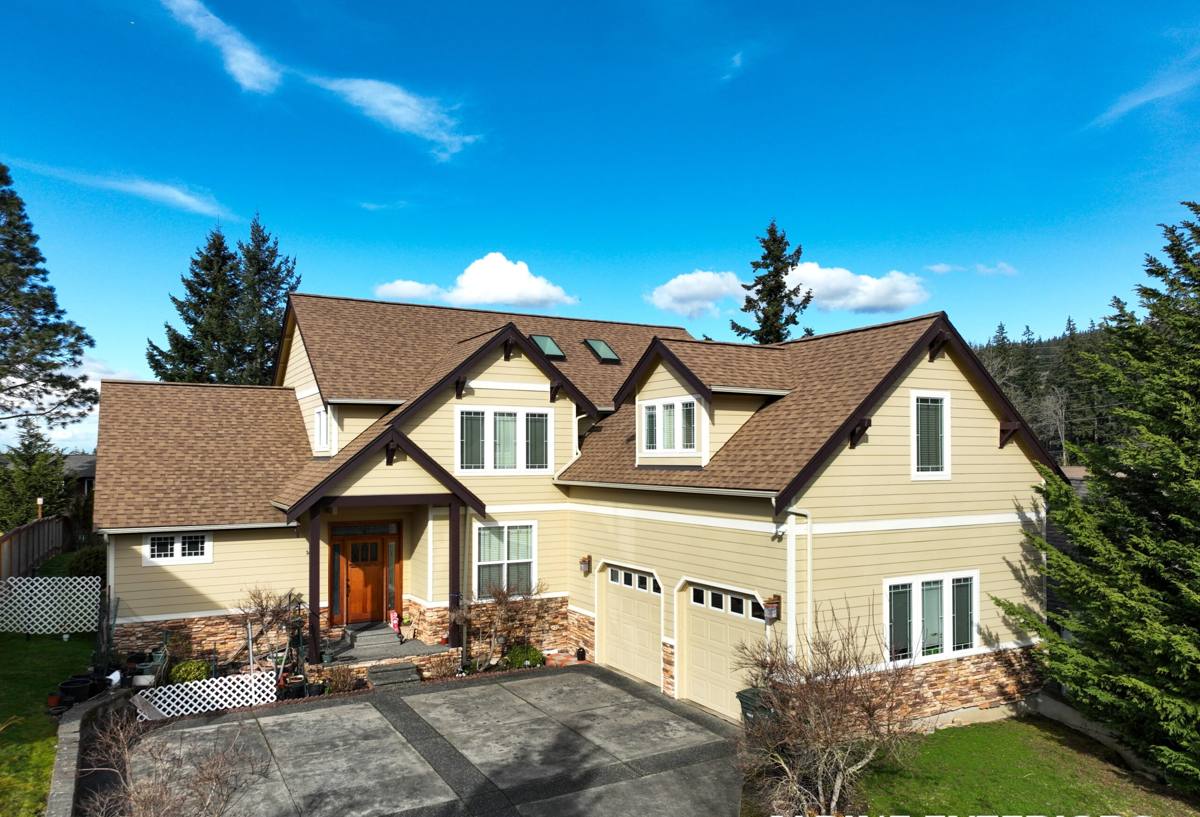
We standardized on James Hardie fiber cement siding for every home we work on, including here in Blaine, and we don't install vinyl, LP SmartSide, primed spruce, cedar, or other fiber cement brands. That's not a marketing position — it's a decision built around what actually holds up in this specific climate over the long run.
James Hardie's HardiePlank and related products are non-combustible fiber cement, engineered specifically for moisture exposure rather than treated as an afterthought. The company makes climate-specific formulations — its HZ5 product line is engineered for cold, wet, freeze-prone regions like the Pacific Northwest — and the ColorPlus finish is baked on at the factory under controlled conditions, not brushed on in the field where humidity and temperature swings affect how well paint bonds and cures. That factory finish matters directly in a place like Blaine: less reliance on a perfect on-site paint job means less risk of premature peeling or fading from salt air and UV exposure.
Fiber cement also doesn't feed moss and mildew growth the way wood-based siding can, and it holds its shape and fastener grip in wet conditions far better than materials prone to swelling. Paired with a transferable warranty backing the product itself, it's the siding we're willing to put our name behind on every job.
What This Means Day to Day
For a homeowner, the practical upside is fewer surprises. You're not repainting every few years to keep water out, you're not chasing soft spots where moisture got behind a seam, and you're not watching moss creep across a shaded wall and slowly hold water against the substrate. The material is doing the climate-resistant work up front, so the maintenance burden on your end is genuinely lower.
What a Correct James Hardie Installation Involves
Fiber cement siding is only as good as the installation behind it. Most of the failures we see on older homes aren't a materials problem — they're a workmanship problem, usually around water management details that get rushed or skipped. In a wind-driven-rain environment like Blaine, these details aren't optional extras; they're the difference between siding that lasts decades and siding that fails at the seams within a few years.
- Weather-resistant barrier and flashing first. A correctly lapped house wrap and properly integrated flashing at every window, door, and penetration go on before a single piece of siding, directing water down and out rather than letting it track behind the cladding.
- Proper fastener spacing and type. Hardie specifies fastener placement, type, and embedment depth for a reason — under-driven or over-driven nails, or the wrong fastener for the exposure, create weak points that loosen over time in wind.
- Correct clearances. Siding needs a minimum gap from grade, roofing, decks, and other abutting surfaces so water has somewhere to go instead of wicking up into the board.
- Field-cut edge sealing. Any cut edge exposes raw fiber cement that needs to be sealed per manufacturer spec — skipping this is one of the most common corner-cutting mistakes we see.
- Caulking only where it belongs. Hardie's lap siding is designed to shed water through overlap, not through caulk. Over-caulking seams that should be left to drain is a common installation error that traps moisture instead of releasing it.
James Hardie Product Lines for Blaine Homes
Not every Hardie product fits every house, and part of our job is matching the right line to your home's exposure and architectural style. Here's a general comparison of the products we work with most often on homes in this area.
| Product | Best For | Notes for Blaine's Climate |
|---|---|---|
| HardiePlank Lap Siding | Most single-family homes, classic horizontal look | Most common choice; available in smooth or cedar-textured finishes with ColorPlus coating |
| HardiePanel Vertical Siding | Modern builds, accent walls, gable ends | Works well combined with lap siding for architectural contrast |
| HardieShingle | Craftsman or cottage-style homes | Gives a shingle look without the moisture and moss vulnerability of real wood shakes |
| HardieTrim | Corners, window and door surrounds, fascia | Matched fiber cement trim avoids the mismatched durability of wood trim on a fiber cement wall |
Our Process for a Blaine Siding Project
Assessment and Planning
We start by walking the exterior with you, checking existing siding condition, moisture entry points, trim and flashing condition, and any areas — north-facing walls, spots near mature trees, low clearance areas near grade or decking — that are seeing more moss or wear than the rest of the house. That inspection drives the product selection and any prep work the job needs.
Removal and Wall Prep
Old siding comes off, and we check the sheathing and weather-resistant barrier underneath before anything new goes on. Any rot, soft sheathing, or damaged flashing gets addressed at this stage — covering over an existing moisture problem with new siding just hides it, it doesn't fix it.
Installation to Spec
Siding, trim, and flashing go in following Hardie's fastening and clearance specifications, not shortcuts. This is where the wind-driven rain resistance actually gets built into the wall.
Final Walkthrough
We walk the finished job with you, check seams, trim lines, and caulking placement, and go over basic care so you know what routine maintenance (if any) to expect going forward.
Signs Your Current Siding Is Already Struggling
If you're not sure whether it's time to look at replacement, a few signs are common on Blaine homes exposed to marine air and moss:
- Persistent moss or algae staining on north- or shade-facing walls that comes back shortly after cleaning
- Paint that's peeling, bubbling, or chalking faster than it should, especially on sides exposed to prevailing wind
- Soft or spongy spots when you press on siding near the bottom courses or around window trim
- Visible gaps, warping, or separation at seams and corners
- Rusting or staining around fastener heads
Any one of these on its own might just need a repair. Several at once, especially on an older wood or composite installation, usually means the underlying material is reaching the end of what it can handle in this climate.
Why It Matters That Your Crew Already Works This Area
Whatcom County's coastal exposure isn't uniform — a home right on the water in Blaine deals with more direct salt and wind exposure than one set back and sheltered by trees a few miles inland, and that affects product selection, flashing detail, and even which walls need the most attention. A crew that installs Hardie siding regularly across this area already knows which exposure patterns cause problems and builds the install around them, rather than treating every house the same way a generic installer might.
Local permitting and inspection expectations are also easier to navigate when the crew already has a working relationship with them, and knowing how Whatcom County's wet-season weather affects install scheduling helps avoid work getting rushed or done in conditions that compromise the result.
Ready to Talk About Your Home
If your siding is showing wear, or you're planning ahead for a home you want to stop maintaining every year, we're happy to take a look and walk you through what James Hardie siding would involve for your specific house. Reach out for a free, no-pressure estimate — there's no obligation, just a straight assessment of where your home stands.