 Bellingham
 Why Birch Bay Asks More of a Siding Job Than Most of Whatcom County
Birch Bay sits right on the water, and that changes what a home's exterior has to survive year-round. Homes a few miles inland in Bellingham deal with plenty of rain, but Birch Bay properties add salt-laden air off the water, wind-driven rain that hits siding at an angle instead of falling straight down, and a moss and algae season that can stretch for most of the year in the shaded, damp spots around a house. Any siding material can look fine in a showroom. What matters is how it performs after a decade of that combination, and that's the question we start with on every Birch Bay estimate.
We install James Hardie fiber cement siding exclusively. We don't carry vinyl, LP SmartSide, Cemplank, Allura, primed spruce, or cedar. That's not a marketing line — it's a standard we hold because we've seen how each of those products actually behaves under this exact coastal exposure, and we'd rather turn down a job than install something we don't think will hold up on a Birch Bay home.
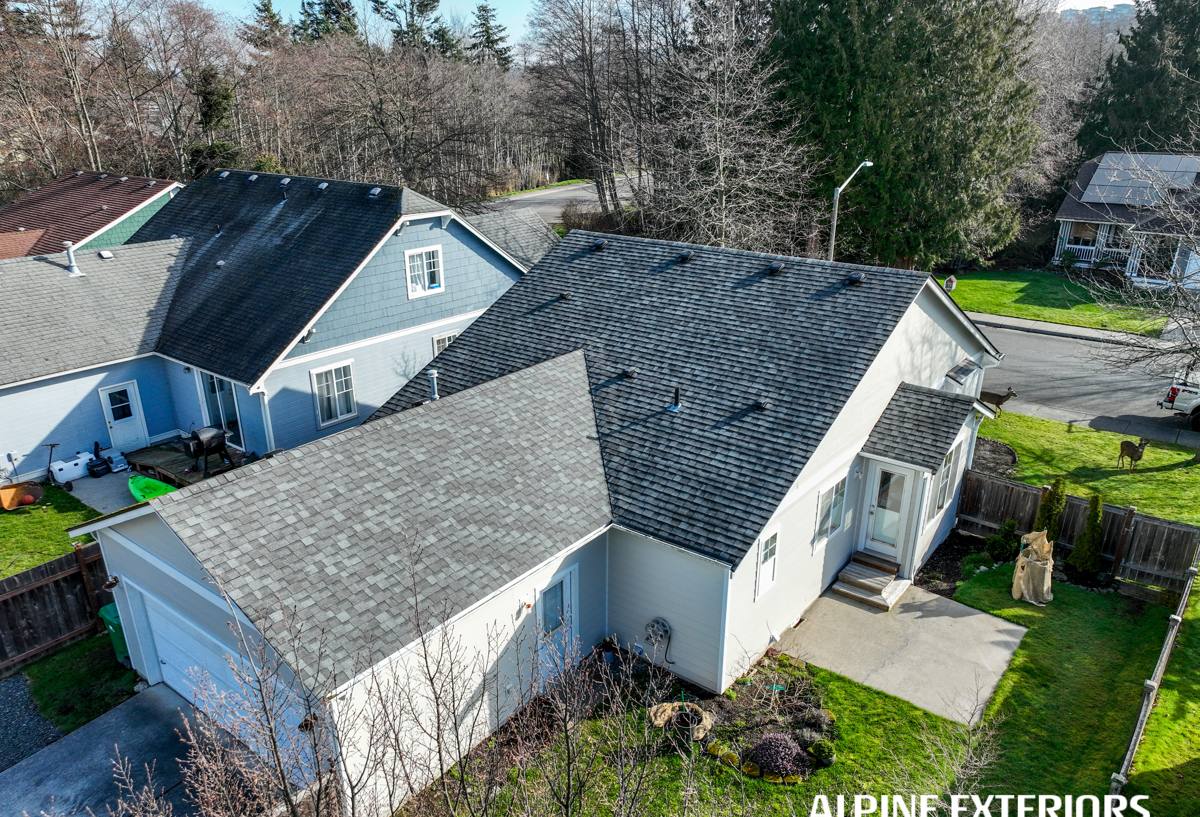
What Salt Air, Driving Rain, and Moss Actually Do to a House
Salt air
Airborne salt is corrosive and it doesn't stay near the beach — wind carries it inland and deposits it on every exterior surface, including siding, trim, and fasteners. On materials with exposed metal components or poor factory coatings, salt exposure accelerates corrosion and finish breakdown. Fiber cement itself isn't affected by salt the way metal is, but the fasteners, flashing, and finish system used with it absolutely matter in a salt environment, which is part of why installation quality is as important as the siding material itself.
Driving rain
Rain that comes in sideways off the water pushes moisture into laps, seams, and penetrations that a straight-down rain would never reach. This is where poor installation shows up first — gaps at butt joints, under-flashed windows, or caulk used as a substitute for proper flashing will let water behind the siding long before the face material itself fails. Wind-driven rain is a installation-quality problem as much as a material problem.
Moss and algae
The Pacific Northwest's damp, mild climate is ideal for moss and algae growth, and waterfront lots with more shade and airflow off the water tend to see it worse and earlier than drier inland sites. Moss holds moisture against a surface for extended periods, which is exactly the condition that causes rot in wood-based products and accelerates finish failure on lower-grade siding. A material's real-world moss resistance — and how easy it is to clean without damaging the surface — is a legitimate performance factor here, not a cosmetic afterthought.
Why We Standardized on James Hardie for Homes Like These
James Hardie fiber cement is engineered from cement, sand, and cellulose fibers — there's no wood content to rot, swell, or feed moss the way organic material does. It's non-combustible, which matters for insurance and peace of mind regardless of coastal exposure. For this climate specifically, we install Hardie's HZ5 product line, engineered for wetter, harsher weather zones, which is the right specification for a Whatcom County coastline home.
The factory-applied ColorPlus finish is baked on under controlled conditions and backed by its own finish warranty, which is a meaningful difference from field-applied paint. In a salt-air, high-moisture environment, a factory finish that's cured properly and bonded correctly to the substrate resists fading, chipping, and peeling far better than paint applied on-site after installation. Hardie backs the product with a strong transferable limited warranty, which matters if you ever sell the home — buyers and their inspectors on the water in Birch Bay know what they're looking at.
What we tell homeowners about the alternatives
Vinyl can crack in cold snaps and fade unevenly under UV and salt exposure over time, and it doesn't offer the impact resistance or fire rating fiber cement does. LP SmartSide and other engineered wood products use wood strand technology that performs reasonably in drier climates but is more sensitive to sustained moisture exposure than fiber cement — and sustained moisture is exactly what a waterfront lot delivers. Primed spruce or cedar require an ongoing paint and maintenance commitment that's tougher to keep up with in a climate where mildew and moss pressure never really lets up. None of these are "bad" products in every setting. We just don't think they're the right call for the environment Birch Bay homes actually sit in, which is why we don't install them.
What a Correct James Hardie Installation Involves Here
The material is only half the equation. A Hardie install done to spec in a high-exposure coastal location includes:
- A properly lapped weather-resistive barrier behind the siding, with all seams taped and integrated with window and door flashing so water is directed out, not trapped in
- Correct fastener type, length, and spacing per Hardie's engineering specs — under-fastening or using the wrong fastener is a common cause of early failure in high-wind coastal areas
- Proper clearance between the siding's bottom edge and grade, decks, or roof lines so water doesn't wick up into the board
- Factory-mitered or properly caulked joints at corners and butt seams, sealed with a product rated for the exposure rather than generic caulk
- Correct nailing at studs with the right gap tolerances so the panels can handle thermal movement without stressing the joints
- Rainscreen or vented gap detailing where the site conditions call for it, giving any moisture that does get behind the siding a path to dry out
Skip any one of these steps and you can end up with a house wearing an excellent material that still fails early — usually at the seams, corners, and penetrations first, exactly where wind-driven rain hits hardest.
Material Comparison for a Waterfront Whatcom County Home
| Factor | James Hardie Fiber Cement | Vinyl | Wood / Engineered Wood |
|---|---|---|---|
| Moisture behavior | Does not rot or swell; engineered moisture management with HZ5 | Won't rot, but seams and J-channels can trap water | Absorbs moisture; prone to swelling and rot if finish fails |
| Salt air exposure | Face material unaffected; finish system holds up well | Can fade and become brittle faster near salt air | Finish breaks down faster; exposes wood to salt-driven decay |
| Moss/algae resistance | Dense, hard surface resists staining and is easy to clean | Resists moss but scratches and stains show | Textured surface holds moss and moisture longer |
| Fire rating | Non-combustible | Combustible, can melt/warp near heat sources | Combustible |
| Finish longevity | Factory ColorPlus finish, separately warranted | Color molded in but fades; can't be easily refinished | Requires repainting/staining on a recurring cycle |
| Typical maintenance | Occasional rinse; no repainting needed | Occasional rinse; brittle panels crack and need replacement | Repainting/staining every few years, crack and rot repair |
Our Process for a Birch Bay Job
We start with an on-site walkthrough of the specific exposure your home faces — which sides catch the worst of the wind-driven rain off the water, where moss tends to build up, and where the existing siding or sheathing shows signs of past moisture problems. From there we check the condition of the sheathing underneath (this matters more on older Whatcom County homes than most people expect), plan the weather barrier and flashing details around every window, door, and penetration, and confirm the right HZ5 product and ColorPlus color for the home before ordering material. Installation follows Hardie's fastening and clearance specs to the letter, and we walk the finished job with you before calling it done, including a look at the details that matter most in this location — corners, butt joints, and the bottom clearance along grade.
Why a Crew That Already Works Birch Bay Matters
A lot of siding problems on the water aren't material failures — they're installation shortcuts that a crew from a drier, calmer area might not think twice about because they've never had to. A crew that regularly works Birch Bay and the surrounding Whatcom County coastline knows which elevations of a house typically take the worst wind-driven rain, where moss tends to build up fastest based on shade and airflow, and how to detail flashing and clearances for a site that's exposed to salt air on a daily basis rather than occasionally. That local pattern recognition is the difference between a job that looks right at completion and one that's actually built to hold up through a decade of Birch Bay winters.
Signs your current siding is losing the battle with the local climate
- Visible moss or dark streaking that returns quickly after cleaning
- Soft or spongy spots, especially near the bottom courses or around window trim
- Paint that's peeling, chalking, or fading unevenly, particularly on water-facing walls
- Gaps opening up at butt joints, corners, or around window and door trim
- Visible corrosion streaking from fasteners or metal flashing
- A musty smell or moisture staining on interior walls that back up to exterior siding
What Homeowners Should Budget For
Cost on any Birch Bay siding job depends on the size and complexity of the home, how much of the existing wall assembly needs repair before new siding goes on, trim and detail work, and the specific Hardie product and finish chosen. Homes with extensive moisture damage behind the old siding, or with a lot of corners, dormers, and window trim, will run higher than a simple, straightforward elevation. We give a firm, itemized quote after the on-site walkthrough rather than a ballpark over the phone, because guessing at sheathing condition or flashing scope from a photo isn't something we're willing to do — it's exactly the kind of shortcut that causes problems down the road on a coastal lot.
Maintenance That Keeps Hardie Siding Performing Long-Term
- Rinse the exterior periodically, focusing on shaded or north-facing walls where moss builds up fastest
- Keep gutters clear so overflow doesn't run down the siding face repeatedly in one spot
- Trim back vegetation and landscaping that keeps siding shaded and damp
- Inspect caulking at joints, corners, and trim annually and have any gaps re-sealed promptly
- Address any soft spots, staining, or fastener corrosion early rather than waiting for it to spread
None of this is heavy maintenance — that's the point of choosing a material engineered for this exposure in the first place. It's a fraction of what a wood or engineered-wood exterior demands on the same lot.
If you own a home in Birch Bay and want a straight answer on what your siding actually needs, we'll come take a look and give you a free, no-pressure estimate — no obligation, just an honest read on your home's exposure and what a correct James Hardie installation would involve.