 Bellingham
 Why Lynden's Climate Punishes the Wrong Siding Choice
Lynden sits in the Nooksack River valley in Whatcom County, close enough to the Salish Sea that salt-laden air moves inland on a regular basis, and far enough into the agricultural flatlands that fog and standing damp linger longer than they do on higher ground. That combination — salt air, driving rain off the water, and a moss season that can stretch from October into May — is a tough environment for exterior materials. Wood-based siding absorbs moisture and starts to swell, cup, or rot from the inside out. Vinyl gets brittle in cold snaps and doesn't hold up to sustained wind-driven rain at seams and corners. Anything with a paint film instead of a factory-cured finish will need repainting on a shorter cycle than most homeowners expect, especially on north- and west-facing walls that stay shaded and wet longer after a storm.
Fiber cement doesn't solve every problem in this climate automatically — installation quality matters as much as the material — but it starts from a fundamentally better position. It's dimensionally stable, it doesn't feed moss and mildew the way bare wood does, and a factory finish holds its color and seal far longer than field-applied paint. That's the baseline this page is built around: what fiber cement siding needs to do right in Lynden, and what a correct installation looks like here specifically.
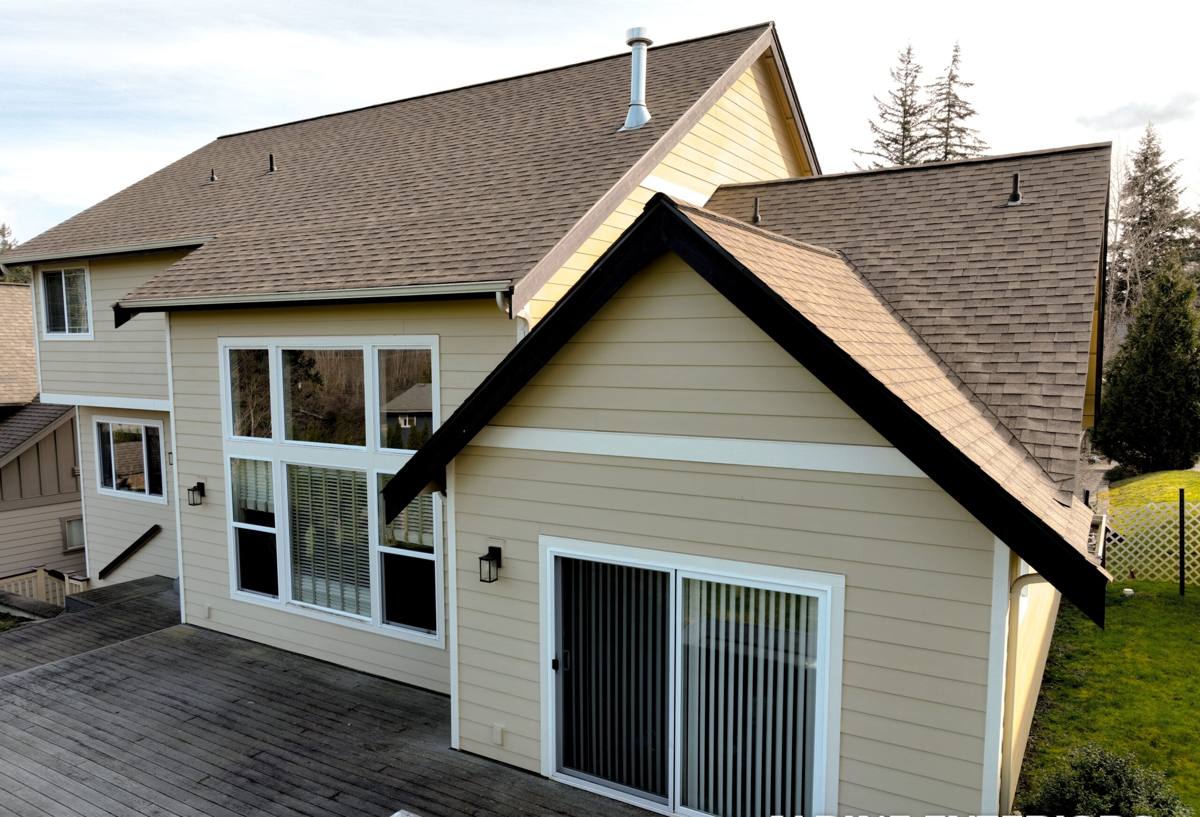
What Lynden Homes Actually Need From Their Siding
Moisture Management First
More siding failures in Whatcom County trace back to trapped moisture than to the siding material itself. A wall assembly needs a way for incidental water — the water that gets past the siding in any wind-driven rain event — to drain back out. That means a proper weather-resistive barrier behind the siding, correctly lapped flashing at every window, door, and penetration, and a rainscreen gap or drainable house wrap so water doesn't sit against the sheathing. Fiber cement is far more forgiving of moisture than wood, but it's not immune to problems caused by bad flashing detail or siding installed tight to a wet substrate.
Standing Up to Moss and Algae
The long damp season in this part of Whatcom County means anything with texture or a porous surface is going to grow moss and algae faster than it would in a drier climate. James Hardie's factory-applied ColorPlus finish is baked on and cured, not brushed on, which gives it a smoother, denser surface that sheds spores better than site-painted products and holds up to occasional gentle cleaning without the finish lifting.
Handling Salt Air Without Corroding
Proximity to Bellingham Bay and the greater Salish Sea means fasteners, trim, and flashing all need to be rated for a marine-influenced environment. Fiber cement itself doesn't corrode, but every metal component tied into the assembly — nails, screws, flashing, and any exposed trim fasteners — needs to be corrosion-resistant or the siding will outlast the hardware holding it up.
What a Correct Fiber Cement Installation Involves
Fiber cement is an unforgiving material to install wrong. It's heavy, it has to be cut and fastened to spec, and the manufacturer's warranty is conditioned on installation matching their published instructions — not general industry habit. A correct job includes:
- A drainable weather-resistive barrier installed shingle-fashion, with all seams taped or lapped correctly
- Proper flashing at every window, door, deck ledger, and roof-to-wall transition, integrated with the barrier — not just caulked over
- Minimum clearances maintained: siding held up off roof lines, decks, and grade per Hardie's published specs, not tight to the surface below
- Corrosion-resistant fasteners, driven correctly — not overdriven, not underdriven, and never through both boards in a lap
- Correct fastener spacing and blind-nailing pattern per the exposure and wind zone the home is in
- Butt joints and corners caulked with a high-quality, paintable-grade sealant rated for the product, or factory joiners used where specified
- Field-cut edges sealed per Hardie's instructions so the cut edge isn't left exposed to moisture
Skipping any one of these doesn't usually cause an obvious problem in year one. It shows up two, five, or ten years later as a stained wall, a soft spot at a window corner, or a warranty claim that gets denied because the installation didn't match the manufacturer's requirements. This is the core reason installation crew matters as much as the siding brand.
Why We Only Install James Hardie
We install James Hardie fiber cement exclusively. We don't install LP SmartSide, vinyl, Cemplank, Allura, or bare wood siding, and that's a deliberate standard, not a sales pitch. Hardie's HardiePlank and HardieShingle lines are engineered in climate-specific formulations — the HZ5 product line is built for the wetter, colder regions like ours in the Pacific Northwest — and the ColorPlus finish system gives a longer, more consistent color life than field-applied paint on any competing product. Hardie also backs its product with one of the stronger transferable non-prorated warranties in the category, which only holds up if the installation itself was done to their spec. Standardizing on one product line lets our crew get genuinely fast and consistent at installing it correctly, rather than splitting attention across several systems with different flashing details, fastening rules, and failure points.
Our Process for a Lynden Job
1. Assessment and Measure
We walk the exterior, check the condition of the existing sheathing and trim, note problem areas — anything showing past moisture intrusion, soft spots, or existing moss buildup — and take accurate measurements for material ordering.
2. Tear-Off and Sheathing Check
Old siding comes off down to the sheathing so we can actually see what's underneath. Any rotted or compromised sheathing gets repaired before anything else happens — covering a bad substrate with new siding just hides the problem.
3. Weather Barrier and Flashing
This is the step that determines how the wall performs for the next 30-plus years. We install a drainable weather-resistive barrier and integrate flashing at every window, door, and penetration before a single piece of siding goes up.
4. Siding Installation
HardiePlank, shingle, or panel product is installed per Hardie's published fastening schedule for our wind exposure, with correct clearances at rooflines, decks, and grade.
5. Trim, Caulking, and Final Detail
Corners, trim boards, and joints get sealed with the correct sealant, and every cut edge is treated so it isn't left exposed.
6. Walkthrough
We walk the finished job with the homeowner, point out what was done and why, and cover basic care going forward.
Maintenance in a Moss-Prone Climate
Fiber cement cuts maintenance significantly compared to wood, but "low-maintenance" doesn't mean "no-maintenance" in this part of Whatcom County. A simple annual routine goes a long way:
- Rinse the exterior once a year, focusing on shaded north and west walls where moss and algae take hold first
- Keep gutters clear so overflow doesn't run down the siding face and feed growth in one concentrated area
- Trim back vegetation and landscaping that keeps a wall section shaded and damp longer than the rest of the house
- Check caulking at trim joints and penetrations every couple of years and re-caulk anything that's cracked or pulled away
- Address any moss with a gentle wash rather than pressure-washing directly at the siding, which can force water behind laps
Cost Factors for a Lynden Project
Every home is different, and we won't quote a number without seeing the job, but these are the factors that actually move the price on a fiber cement re-side in this area:
| Factor | Why It Matters |
|---|---|
| Tear-off scope | Full removal to bare sheathing costs more than siding over sound existing sheathing, but it's the only way to catch hidden moisture damage |
| Sheathing repair | Rot found during tear-off adds cost but is far cheaper to fix now than after new siding is up |
| Siding profile | Lap siding, shingle-style, and panel systems have different material and labor costs |
| Trim and detail work | Homes with more windows, corners, and architectural detail take more time to flash and trim correctly |
| Home height and access | Multi-story sections and difficult access add labor time for scaffolding or lift equipment |
| Finish selection | ColorPlus factory finishes cost more upfront than primed product but eliminate a future paint job |
Why It Matters That We Already Work in Lynden
A crew that's already worked jobs around Lynden and the rest of Whatcom County has a practical read on this specific climate — how much clearance to leave at grade given the wet winters, which wall orientations need extra attention for moss, and how the local wind and rain patterns off the valley and the bay actually load a wall. That's different from general fiber cement experience picked up in a drier or milder region. It also means straightforward logistics: material staging, scheduling around the wetter months, and being reachable if a question comes up after the job is done, without a long drive being part of the equation.
Questions to Ask Any Contractor Before You Hire
- Are you installing to the manufacturer's published fastening and flashing specifications, or general industry practice?
- Who handles the tear-off, and will sheathing be inspected and repaired before new siding goes up?
- What weather-resistive barrier and flashing details will be used at windows, doors, and penetrations?
- Is the warranty from the manufacturer, the installer, or both, and what voids it?
- Can you walk me through your fastener spacing and clearance plan for this specific home?
If you're weighing a re-side in Lynden and want a straight answer on what your home actually needs, we're happy to take a look and walk the property with you. There's no obligation and no pressure — just an honest assessment and a written estimate, using the form below.