 Bellingham
 Why Fairhaven's Climate Is Hard on Siding
Fairhaven sits close enough to the water that homes here take on a different kind of weathering than siding a few miles inland. Salt-laden air off the bay works on fasteners, trim, and paint film year-round, not just during storms. Layer on Bellingham's long wet season — driving rain that comes in sideways off Puget Sound, months of low sun angle, and a moss season that can stretch from fall through spring — and you get an exterior environment that punishes any siding product with weak points in its finish, its fastening, or its water management.
Most siding failures we see in this neighborhood aren't dramatic. They're slow: a corner board that stays damp two extra days after every rain, a caulk joint that hardens and cracks a season early because it never fully dries between storms, moss holding moisture against a north-facing wall until the substrate underneath starts to soften. None of that is unique to Fairhaven, but the combination — salt air plus sustained moisture plus shade-driven moss growth — shows up here more consistently than in drier parts of Whatcom County.
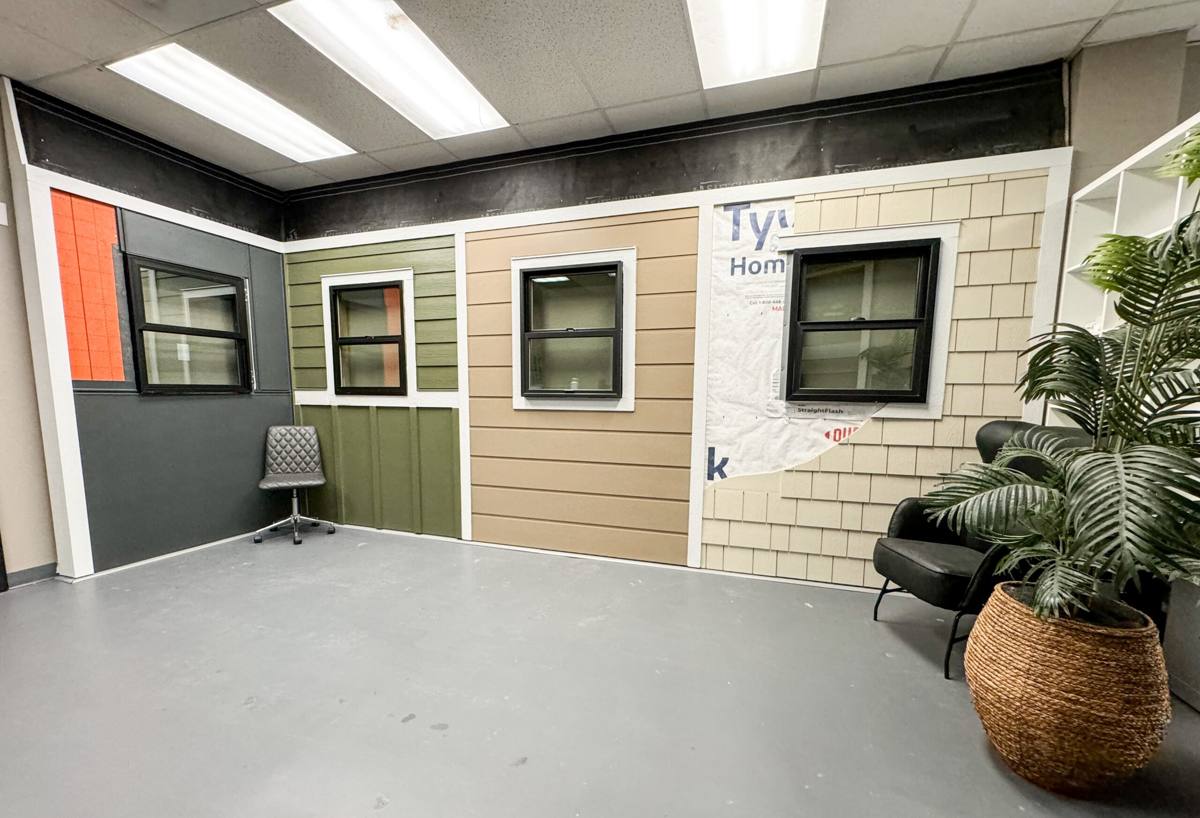
What James Hardie Siding Brings to a Home in This Environment
James Hardie fiber cement is cement, sand, and cellulose fiber — not wood, not vinyl, not a wood byproduct. That matters in a marine climate for a few concrete reasons:
- It doesn't rot, swell, or delaminate the way wood-based products can when moisture gets in and stays in.
- It holds paint and factory finish far longer than wood substrates, because it isn't expanding and contracting with every wet-dry cycle the way wood fiber does.
- It's dimensionally stable, so seams, caulk lines, and butt joints stay tight instead of opening up as the material moves.
- It's non-combustible, which is a separate benefit from moisture performance but one homeowners increasingly ask about.
None of that makes Hardie maintenance-free. It still needs correct flashing, correct clearances, and a finish that's actually rated for the exposure. But it starts from a substrate that doesn't rot, and in a neighborhood dealing with salt air and near-constant dampness half the year, that's the foundation everything else is built on.
Where Fiber Cement Still Needs Help From the Installer
Fiber cement is not magic. It's a water-resistant material, not a waterproof one, and it depends entirely on the installer to keep bulk water out from behind it. Every window, door, deck ledger, and roof-to-wall intersection is a place water wants to get behind the siding, and Hardie's own installation instructions are specific about flashing, gaps, and fastening for exactly this reason. A product installed to spec in Fairhaven performs completely differently than the same product installed to a lower standard.
The Right HZ Product Line for a Marine Climate
James Hardie engineers its lap and panel products in regional formulations called HZ5 and HZ10, tuned to the climate zone they're sold into. Western Washington, including Bellingham and the rest of Whatcom County, falls into the wetter HZ5 climate zone designation, which is engineered with moisture and freeze-thaw cycling in mind rather than the drier-climate formulation sold in the Southwest. Using the correct HZ-rated product for this region isn't a marketing detail — it affects how the material handles the specific moisture load a Fairhaven wall assembly is going to see.
This is one of the reasons we don't treat "Hardie siding" as a single generic product. The lap profile, the panel thickness, and the climate engineering all get selected for the actual exposure of the wall — full weather side facing the water, partially sheltered side yard, or a shaded north wall where moss and moisture linger longest.
What a Correct Installation Actually Involves
The difference between siding that looks fine for two years and siding that performs for decades comes down to a handful of details that are invisible once the job is done. Here's what we hold as non-negotiable on every Fairhaven install:
| Detail | Done Correctly | Common Shortcut We Won't Take |
|---|---|---|
| Water-resistive barrier | Continuous weather barrier lapped correctly, integrated with flashing at every penetration | Barrier stapled up quickly with gaps or reverse laps at windows |
| Starter strip & clearance | Proper starter strip, 1-2" clearance off decks, patios, and grade | Bottom course run tight to grade or hardscape, wicking moisture up |
| Fasteners | Corrosion-resistant fasteners per Hardie spec, set to the correct depth | Standard fasteners overdriven, cracking the board's face |
| Butt joints & caulking | Joints backed and sealed with a sealant rated for the exposure, or shadow-gapped with trim | Caulk alone bridging a gap with no backing |
| Cut edges | Factory-primed cut edges sealed before installation | Raw cut edges left exposed to weather |
Every one of those shortcuts is invisible on install day. They only show up two, five, or ten years later — usually as paint failure, a stain line, or soft trim right where the mistake was made. In a climate that stays wet as long as Fairhaven's does, a shortcut has more time to do damage before anyone notices.
ColorPlus Factory Finish vs. Field Painting
James Hardie's ColorPlus finish is baked on at the factory under controlled conditions, with a finish system built specifically to resist UV fading and moisture intrusion at the cut and fastener points once installed correctly. That's a meaningfully different proposition than field-applied paint, which has to cure on-site in whatever weather window is available — not ideal in a region where a dry 48-hour stretch isn't guaranteed for a good chunk of the year.
For a marine-influenced neighborhood like Fairhaven, that factory cure matters more than it might inland. Field-applied finishes are more exposed to salt air interaction and to the risk of curing improperly if the weather turns mid-job. ColorPlus removes that variable and comes with its own finish warranty, which is one of the concrete reasons we standardized on Hardie rather than a comparable fiber cement product finished on-site.
Our Process on a Fairhaven Job
The steps are the same on every home, but the decisions inside each step change based on the specific lot — how close to the water, how much shade, how exposed to prevailing wind and rain.
- Walk and assess — we look at existing siding condition, trim, flashing, and any moisture or moss patterns already visible on the walls.
- Tear-off and sheathing check — old siding comes off and we inspect the sheathing underneath for soft spots or existing rot before anything new goes up.
- Weather barrier and flashing — a continuous, correctly lapped barrier goes on, with flashing integrated at every window, door, and penetration before siding starts.
- Product selection — lap profile, exposure, and HZ formulation are matched to each wall's actual exposure, not a single spec for the whole house.
- Installation to spec — correct clearances, fastener placement, and sealed joints, following Hardie's published installation requirements rather than a faster approximation.
- Final detail and walkthrough — trim, caulking, and touch-up finished, then a walkthrough so you know what maintenance, if any, this specific siding will need going forward.
Maintenance in a Salt Air, Moss-Prone Neighborhood
Correctly installed Hardie siding is low-maintenance, not zero-maintenance. In Fairhaven's specific conditions, a short annual routine keeps it performing the way it's supposed to:
- Rinse siding once or twice a year to clear salt residue and organic buildup, especially on walls facing the water or prevailing wind.
- Keep gutters clear so overflow doesn't run down the face of the siding and feed moss growth at the wall.
- Trim back vegetation and tree cover that keeps a wall shaded and damp longer than the rest of the house.
- Check caulk joints at trim and penetrations every year or two — caulk is the one component with a shorter service life than the siding itself.
- Address any moss or dark staining on siding promptly rather than letting it hold moisture against the surface all winter.
Cost Factors for a Fairhaven Home
Pricing depends on the house, but the variables that move the number the most are consistent from job to job:
| Factor | Why It Changes the Price |
|---|---|
| Tear-off scope | Full removal of old siding vs. installing over existing sheathing that needs repair first |
| Sheathing condition | Rot or soft spots found after tear-off require repair before new siding goes on |
| Home size and stories | More wall area and taller walls both add material and labor time |
| Trim and detail work | Corner boards, window trim, and architectural detail add labor beyond flat wall runs |
| Product line and profile | Different lap widths, textures, and panel styles carry different material costs |
We won't quote a number before seeing the house — anyone who does hasn't actually looked at your sheathing yet, and sheathing condition is usually the single biggest swing factor once tear-off starts.
Why Local Fairhaven Experience Matters
A crew that already works this neighborhood knows which walls take the worst of the weather off the water, how much moss pressure to expect on shaded north sides, and how the mix of older character homes and newer construction in the area changes what's underneath the existing siding. That's not something you get from a general specification sheet — it's pattern recognition built from doing the work here repeatedly. It shows up in small decisions: which walls get extra attention at flashing details, which trim gets a slightly heavier sealant, which starter course gets extra clearance because of how the grade sits.
If you're weighing James Hardie siding for a home in Fairhaven, we're happy to walk the property, look at what's on the walls now, and give you a straight assessment of what a correct installation would involve for your specific house. There's no cost and no pressure to move forward — just fill out the form below to get a free estimate.