 Bellingham
 Building a Deck That Actually Holds Up in Edgemoor
Edgemoor sits close to Bellingham Bay under a heavy canopy of mature trees, and that combination creates a specific set of problems for outdoor structures that a lot of standard deck-building advice doesn't account for. Salt-laced air off the bay accelerates corrosion on hardware. Tree cover keeps shaded sections of decking damp long after the rain stops. And Whatcom County's wet season stretches on for months, which means any weak point in a deck's drainage or flashing gets tested over and over, not just once or twice a year. A deck built the same way you'd build one in a dry inland climate will show problems here faster — soft ledger boards, rusted fasteners, slick green surfaces — often within the first two or three winters.
None of that means a deck can't last decades in this neighborhood. It means the details that get skipped in a generic build can't be skipped here. This page covers what actually matters for a deck built to hold up in Edgemoor's conditions, and how we approach the job differently because of it.
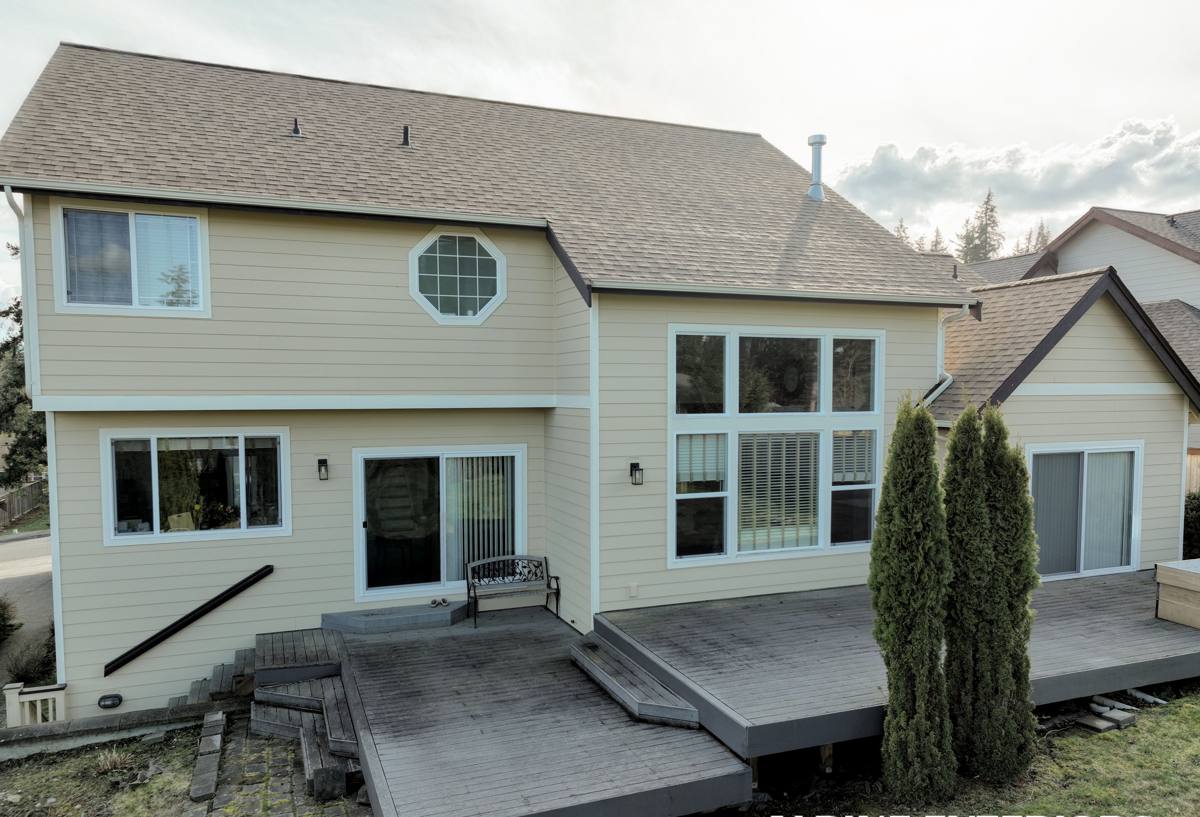
What Edgemoor's Microclimate Does to a Deck
Salt Air and Metal
Proximity to the bay means airborne salt settles on exposed metal — screws, joist hangers, railing brackets, post bases — and speeds up corrosion compared to homes further inland in Whatcom County. Standard electro-galvanized fasteners that might be fine elsewhere can start showing rust streaks and pitting on an Edgemoor deck well before their expected lifespan, especially on the side of the house facing the water or open air.
Driving Rain
Bellingham's rain doesn't always fall straight down. Wind off the bay pushes it sideways into ledger connections, under railing posts, and into any gap where flashing was cut short or caulk was used as a substitute for proper detailing. Water that gets behind a ledger board and can't get back out is one of the most common causes of deck failure we see, and it's almost always preventable with the right flashing at the time of the build.
Shade and Moss
The mature tree cover that makes Edgemoor attractive also means many decks sit in partial or full shade for large parts of the day, especially in fall and winter when the sun angle is low. Shaded, damp wood is exactly what moss and algae need to take hold, and once established they hold moisture against the decking surface, accelerate rot, and turn boards slick underfoot.
Choosing the Right Decking Material for This Neighborhood
There's no single "best" decking material — the right choice depends on how much shade the deck gets, how much maintenance the homeowner wants to do, and budget. Here's how the common options actually perform under Edgemoor's specific conditions:
| Material | Performance in Shade/Moss | Maintenance | Typical Lifespan Here |
|---|---|---|---|
| Pressure-treated lumber | Prone to moss and mildew staining in shaded areas without regular cleaning | Needs periodic cleaning and re-sealing | 15-20 years with upkeep |
| Cedar | Naturally more rot- and insect-resistant, but still needs care in damp shade | Regular oiling/staining to prevent graying and moss | 15-25 years with upkeep |
| Composite decking | Won't rot, but can still grow surface algae/moss film in deep shade if not cleaned | Occasional washing; no sealing/staining | 25-30+ years |
| Tropical hardwoods (e.g. ipe) | Very dense and rot-resistant, holds up well in wet shade | Periodic oiling to maintain color; low rot maintenance | 30+ years |
For heavily shaded lots — which describes a fair number of Edgemoor properties — we usually steer homeowners away from bare pressure-treated lumber as a finished surface, not because it's a bad product, but because it needs consistent upkeep to resist moss in low-sun conditions, and it's the option most likely to get neglected once the deck is a few years old. Composite or a well-maintained hardwood tends to be the better trade-off for a shaded, bay-adjacent lot, even at a higher upfront cost.
The Structural Details That Matter Most Here
Ledger Board Flashing
The ledger board — where the deck attaches to the house — is the single most common failure point on any deck, and it's the detail most likely to be under-built in a rushed job. In Edgemoor's rain and shade, we flash the ledger with a full metal drip cap and waterproof membrane behind the band board, not caulk alone. Caulk fails; proper flashing sheds water the way it's supposed to for the life of the deck.
Fasteners and Hardware
Given the salt air, we use stainless steel or heavy hot-dip galvanized fasteners and connectors rated for coastal exposure, not the standard-grade hardware that's fine further inland. This is a small cost difference at build time and a significant difference in how the deck looks and performs ten years out.
Footings for Local Soil
Whatcom County soils vary block to block, and Edgemoor's mix of clay and organic topsoil under tree cover can hold moisture longer than well-drained sites. We size and depth footings to local frost and soil-bearing conditions and pull the required permit rather than guessing — undersized or shallow footings are a slow-motion problem that shows up as a bouncy or settling deck years later.
Airflow Underneath
Decks built low to the ground or over poorly graded soil trap moisture underneath, which speeds up rot in joists and beams even if the visible decking looks fine. We grade and vent the substructure so air actually moves under the deck instead of sitting stagnant in a shaded, damp pocket.
Railings, Stairs, and Code Requirements
Any deck built or substantially replaced in Bellingham needs to meet current building code and typically requires a permit through the City of Bellingham (or Whatcom County if the property falls outside city limits). Key requirements we build to as a baseline:
- Guardrails required on any deck surface more than 30 inches above grade, minimum 36-42" height depending on code cycle
- Baluster spacing that won't allow a 4-inch sphere to pass through, for child safety
- Stair rise/run consistency and handrail requirements on any stairway with four or more risers
- Graspable handrail profile on stairs, not just a flat cap rail
- Ledger attachment and footing depth documented and inspected, not just built to "look right"
Skipping the permit might save a little time up front, but it leaves the homeowner exposed at resale, on insurance claims, and if there's ever a structural question down the line. We pull permits as a standard part of the job.
Moss, Algae, and Slip Safety
Because so much of Edgemoor sits under tree canopy, moss and algae control has to be part of the design, not just an afterthought for the homeowner to manage later. A few things we build in specifically for this:
- Proper board spacing so water drains through rather than pooling on the surface
- Decking profiles (grooved composite, certain wood patterns) that shed water and debris rather than trapping it
- Avoiding low, tight-to-grade sections in the shadiest parts of the lot where moss establishes fastest
- A realistic conversation up front about which areas of the deck will need seasonal cleaning regardless of material
No decking material is completely moss-proof in a shaded bay-adjacent lot. The goal is a deck that's easy to clean and doesn't trap water where moss can get a foothold, so a simple annual wash keeps it safe underfoot through the wet months.
Our Process for an Edgemoor Deck Build
We keep the process straightforward and specific to the site:
- Site walk: We look at sun/shade exposure, existing drainage, soil condition, and how close the deck will sit to the bay-facing side of the house.
- Design and material selection: Based on shade level, budget, and maintenance preference, we recommend the decking and railing system that fits the specific lot — not a one-size-fits-all package.
- Permit and engineering: We handle the permit application and any required structural details with the City of Bellingham or Whatcom County.
- Build: Flashing, footings, framing, decking, and railings installed to code with corrosion-resistant hardware throughout.
- Final walkthrough: We go over maintenance expectations specific to the material chosen and the shade conditions on your lot.
Deck Maintenance Checklist for Edgemoor Homes
- Sweep debris (leaves, needles, seed pods) off the deck surface regularly, especially in fall
- Wash the deck surface at least once a year to clear moss and algae film before it takes hold
- Check ledger flashing and caulking annually for gaps or cracking
- Inspect fasteners and hardware yearly for rust or corrosion, particularly on the bay-facing side
- Reseal or re-stain wood decking on the schedule recommended for the species used
- Confirm gaps between boards stay clear so water keeps draining through, not pooling
Why Hire a Crew That Already Works in Edgemoor
A deck built with generic assumptions about weather and soil is a deck that's going to need early repairs in a neighborhood like this. Crews unfamiliar with the bay-air corrosion issue, the shade-driven moss problem, or the amount of driving rain a ledger board actually takes here tend to underbuild the details that don't show up as a problem until year two or three. We've built and repaired decks across Bellingham and Whatcom County long enough to know which shortcuts fail first in this specific climate, and we build accordingly from day one — right hardware, right flashing, right material for the amount of shade on your particular lot.
If you're planning a new deck or replacing one that's showing its age, we're happy to come take a look and talk through what makes sense for your property. Fill out the form below for a free, no-pressure estimate.