 Bellingham
 Fairhaven's Location Puts Extra Demands on a Deck
Fairhaven sits close to Bellingham Bay, which means homes here get a version of Whatcom County's marine climate that's a notch more aggressive than what you'd find a few miles inland. Salt-laden air moves in off the water, driving rain comes at decks sideways instead of just falling straight down, and the shaded, damp stretches of the year give moss and algae a long runway to take hold on any horizontal wood surface. A deck built with the same specs you'd use in a drier inland town will show its age faster here — fasteners corrode sooner, end grain wicks moisture longer, and anything without real airflow underneath stays wet for days after a storm passes.
None of that means a deck in Fairhaven is a bad investment. It means the build has to account for those conditions from the footings up, not just at the surface finish. That's the difference between a deck that looks fine for two summers and one that's still tight, dry, and safe fifteen years in.
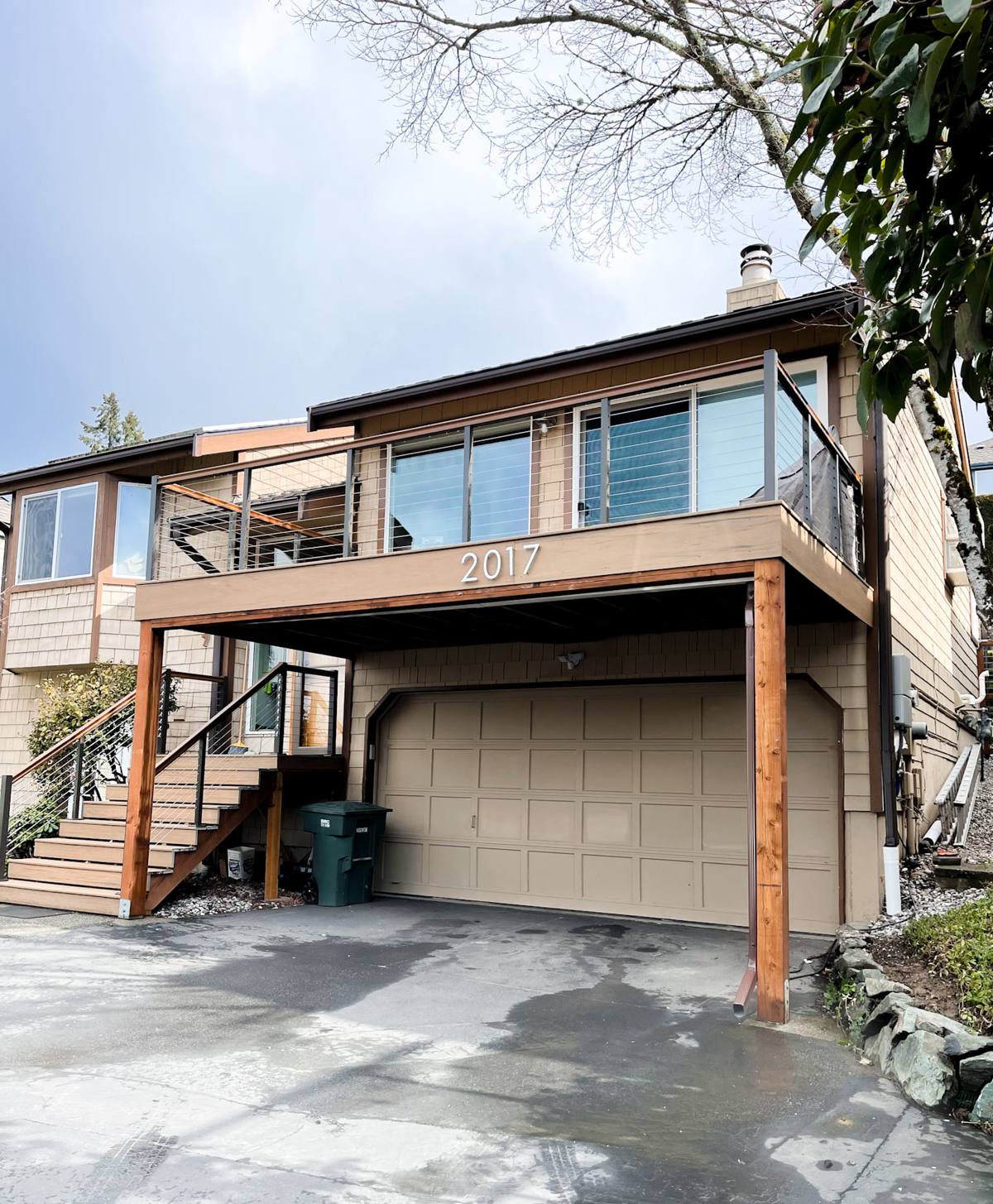
What Fairhaven's Climate Actually Does to a Deck Over Time
Salt Air and Metal
Proximity to the water accelerates corrosion on anything metal — fasteners, joist hangers, post bases, and railing hardware. Standard galvanized coatings that hold up fine inland can start showing rust streaks and pitting years earlier this close to the bay. This is a fastener and hardware spec issue more than a decking issue, and it's one of the most common corners cut on decks built by crews unfamiliar with coastal-adjacent sites.
Driving Rain and Wind-Blown Moisture
Rain here doesn't always fall straight down. Wind off the bay pushes it at angles that get moisture into joints, ledger connections, and railing post bases that a purely vertical rain assumption would miss. Flashing details at the house connection and around post penetrations matter more here than they would in a sheltered inland yard.
Moss, Algae, and Shade
Whatcom County's long wet season, combined with tree cover and shaded exposures common on Fairhaven lots, gives moss and algae plenty of time to establish on deck boards before a dry stretch ever fully dries them out. Moss holds moisture against the wood surface and makes boards slicker and more slippery underfoot — a real safety issue on stairs and ramps, not just a cosmetic one.
Cycling Between Wet and Dry
Even in a mild coastal climate, decks go through repeated wet-dry cycles across the year. Wood that isn't properly gapped, sealed, or ventilated underneath swells and shrinks with each cycle, which loosens fasteners and eventually opens gaps for water to get into end grain and framing connections.
Decking Material Options, Compared for This Climate
There's no single "right" material for every Fairhaven project — it depends on budget, how much upkeep you want to take on, and how the deck sits relative to shade and water exposure. Here's how the common options actually perform under local conditions:
| Material | How It Handles Salt Air & Moisture | Moss/Algae Resistance | Maintenance Load |
|---|---|---|---|
| Pressure-treated fir/hem-fir | Good if fasteners and hardware are corrosion-rated; wood itself handles moisture cycling reasonably well | Needs regular cleaning and periodic sealing to resist buildup | Moderate to high — refinish every 2-3 years |
| Cedar | Naturally moisture- and insect-resistant; still needs sealing near the water | Better natural resistance than fir, but still grows moss if shaded and neglected | Moderate — periodic oil/sealer treatment |
| Composite decking | Excellent — doesn't absorb moisture into the board core, fasteners are the main concern | Surface can still host algae/moss film in deep shade; cleans off easily and doesn't rot underneath it | Low — occasional washing, no refinishing |
| PVC decking | Excellent — fully closed-cell, minimal water absorption | Similar to composite; cleans off without surface damage | Low |
In our experience, homes closer to the water and in heavier shade get the most out of composite or PVC decking simply because the maintenance interval to stay ahead of moss and moisture is longer. Wood decks are absolutely still a good choice — they just ask more of the owner in terms of cleaning and refinishing on schedule.
Where Deck Failures Actually Start: The Substructure
Most deck problems we get called out to fix in this area aren't decking board problems — they're framing, fastener, or drainage problems that took a few years to show up on the surface. A correct build addresses these from the start:
- Corrosion-rated fasteners and joist hangers rated for treated lumber contact and coastal-adjacent exposure, not generic galvanized hardware
- Proper flashing at the ledger board where the deck meets the house, so wind-driven rain can't track behind the siding
- Adequate gap spacing between boards for drainage and airflow, sized correctly for the decking material used
- Post bases set above grade with proper drainage so posts aren't sitting in standing water after storms
- Footings sized and set to current frost and load requirements for the site conditions
- Enough clearance and airflow underneath the deck to let the framing dry out between rain events
Skimping on any of these doesn't usually show up in year one. It shows up in year five or six as soft spots, rust stains bleeding through decking, or a railing post that's gone spongy at the base — expensive problems that a slightly different build sequence up front would have avoided entirely.
Designing for Fairhaven's Lots and Homes
Fairhaven has a mix of older homes on established, often tree-shaded lots and newer construction closer to the water. Both present design considerations worth thinking through before the build starts:
Shade and Orientation
Mature tree cover is common on older lots and keeps decks shaded and slower to dry — a factor worth weighing when choosing decking material and planning gap spacing and airflow underneath.
Grade and Elevation Changes
Sloped lots are common in this part of Bellingham, and a deck design that works with the existing grade — rather than forcing a flat pad against a slope — usually means better drainage away from the house and a more stable long-term structure.
View and Wind Exposure
Homes with a water-facing orientation get the benefit of a view but also take the brunt of wind-driven rain. Railing design, board orientation, and surface texture (for slip resistance when wet) all matter more on an exposed deck than a sheltered one.
Our Process for a Fairhaven Deck Project
We approach every deck build here the same structured way, adjusted for the specific site:
- On-site assessment — we look at grade, shade, wind exposure, and how close the site is to the water to inform material and hardware recommendations, not just measure the footprint.
- Design and material selection — we walk through decking options, railing styles, and layout with honest trade-offs on maintenance and cost, so the choice fits your budget and how much upkeep you actually want to do.
- Permitting — decks over a certain height or attached to the home typically require a permit through the City of Bellingham; we handle that process as part of the project.
- Framing and structural work — footings, posts, ledger flashing, and joist framing built to the standard described above, with corrosion-rated hardware throughout.
- Decking and railing installation — proper gap spacing, fastening method suited to the material, and railing installed to current code for height and baluster spacing.
- Final walkthrough — we go over the finished deck with you, including what maintenance schedule fits the material you chose.
Maintenance: What to Actually Expect
How much work a deck asks of you depends heavily on the material decision made up front. Wood decks in this climate genuinely need a real maintenance rhythm — cleaning off moss and debris before it sits and traps moisture, and resealing or refinishing on a regular cycle rather than waiting until boards look gray and worn. Composite and PVC decking cut that burden significantly but aren't fully maintenance-free — periodic washing to keep algae film from building up in shaded spots is still worth doing, especially heading into the wetter months.
Either way, a quick seasonal check — clearing debris from between boards, checking railing hardware for looseness, and confirming drainage underneath isn't blocked — catches small issues before they become structural ones.
What a Fairhaven Deck Project Typically Involves, Cost-Wise
Pricing on a custom deck varies a lot based on size, material, elevation changes, and railing style, so we won't put a number on it without seeing the site. What we can tell you is what tends to move the number:
| Factor | Why It Affects Cost |
|---|---|
| Decking material (wood vs. composite/PVC) | Composite and PVC cost more upfront but less over the deck's lifespan in maintenance |
| Height and footing complexity | Sloped or elevated sites need more substantial framing and footings |
| Railing style | Cable, glass, and custom metal railings cost more than standard baluster railing |
| Size and shape | Multi-level decks or non-rectangular layouts add framing and labor |
| Site access | Tighter lots or limited equipment access can add labor time |
Why Local Experience in Fairhaven Matters
A crew that builds decks across Whatcom County's varied microclimates knows the difference between a deck spec that's fine in a sheltered inland yard and one that needs to hold up against salt air and driving rain near the water. That shows up in hardware choices, flashing details, and material recommendations that aren't guesswork — they're based on what actually holds up here, not a generic national spec sheet. It also means faster, more accurate permitting familiarity with Bellingham's requirements and a crew that isn't learning the local conditions on your project.
If you're planning a new deck or replacing one that's showing its age, we're happy to come take a look, walk the site with you, and put together a straightforward, no-pressure estimate — no hard sell, just an honest read on what your home and lot actually need.