 Bellingham
 Cordata's Climate Is Harder on Siding Than It Looks
Cordata sits in north Bellingham, close enough to Bellingham Bay and the Salish Sea that homes here deal with a combination most siding products were never engineered for: salt-laden air, wind-driven rain that hits walls at an angle instead of falling straight down, and a moss season that can stretch from fall through spring in Whatcom County's marine climate. None of these factors is dramatic on its own. Together, over years, they're what separates a siding job that still looks sharp at year fifteen from one that's cupping, staining, and rotting at the seams by year eight.
Salt air is the one homeowners underestimate most. It doesn't just come from storms off the water — it's a low-grade, constant presence that accelerates corrosion on anything metal: fasteners, flashing, trim screws. Combine that with rain that gets pushed sideways into wall assemblies by wind off the Sound, and you have a climate that punishes any siding installation with weak moisture management. Add shaded lots and tree cover common in this part of Bellingham, and you get long stretches where siding simply doesn't dry out between rain events — which is exactly the environment moss and algae need to take hold.
What "Correct" Siding Installation Actually Means Here
Siding installation isn't really about the panels — it's about everything behind them. In a climate like Cordata's, the water-resistive barrier, flashing details, and fastening choices matter more than the finish color. A crew that skips or rushes these steps can put up siding that looks fine on install day and fails quietly, behind the wall, for years before anyone notices.
Weather-Resistive Barrier and Flashing
Every wall needs a continuous weather-resistive barrier underneath the siding, with flashing integrated at every penetration — windows, doors, hose bibs, light fixtures, deck ledgers. In a driving-rain climate, water will find any gap in this layer. The barrier's job isn't to keep water out entirely; it's to manage the water that does get past the siding and direct it back out before it reaches the sheathing or framing. Rushed or out-of-sequence flashing work is one of the most common causes of hidden rot behind otherwise good-looking siding.
Fasteners and Clearances
Salt air corrodes exposed or poorly coated fasteners faster than homeowners expect, which is why fastener selection and placement matter as much as the siding material itself. Correct installation also means proper clearance between the bottom edge of the siding and the ground, decks, patios, and roof lines — typically several inches — so moisture and debris don't wick up into the material or trap moss-friendly shade against it. Skipping these clearances is a shortcut that shows up as damage years later, not on install day.
Why This Company Installs Only James Hardie Fiber Cement
We don't install vinyl, LP SmartSide, primed spruce, cedar, or off-brand fiber cement products. That's a deliberate standard, not a sales pitch. Vinyl expands and contracts with temperature swings and can warp or crack in high wind exposure; engineered wood products like LP SmartSide depend on an intact factory coating to resist moisture, and that coating is only as good as the caulking and touch-up maintenance behind it over time; and cedar, however good it looks, is a wood product that needs ongoing staining or sealing to hold up against a wet, moss-prone climate — and it's combustible, which matters more every wildfire season.
James Hardie fiber cement is non-combustible, doesn't rot, and holds its factory ColorPlus finish without the repeated painting cycle wood and some engineered wood products need. It's also dense and dimensionally stable, which means it doesn't move the way vinyl does with temperature and moisture changes — a real advantage in a climate with the kind of freeze-thaw and rain-to-dry swings Whatcom County sees.
How Hardie's HZ Product Line Fits Whatcom County
James Hardie engineers its HZ5 product line specifically for climates with more moisture exposure and freeze-thaw cycling, which is the category the Pacific Northwest falls into. That means the product itself — not just the installation — is matched to what a Cordata wall actually experiences over a year. Paired with a factory-applied ColorPlus finish, it also means the color coat isn't relying on job-site paint application to hold up against UV and salt air; it's baked on before the material ever reaches the house, backed by Hardie's finish warranty.
Comparing Siding Materials for a Cordata Home
| Material | Moss & Moisture Behavior | Salt-Air / Fastener Corrosion | Ongoing Maintenance | Typical Lifespan |
|---|---|---|---|---|
| James Hardie fiber cement | Doesn't rot; sheds moisture well when installed with proper clearance | Non-combustible, dimensionally stable; corrosion risk isolated to fastener quality | Occasional wash; no repainting cycle with ColorPlus finish | Decades, with strong transferable warranty |
| Vinyl siding | Won't rot itself, but seams and J-channels trap moisture and moss buildup | Fasteners often exposed at nail hem; can loosen or corrode over time | Low, but color fades and panels can warp in sun/wind exposure | Variable; performance drops if panels distort |
| LP SmartSide | Engineered wood core; moisture resistance depends entirely on intact coating and sealed cut edges | Standard fastener sensitivity; coating failure accelerates rot | Regular caulk and touch-up inspection required | Shorter than fiber cement if maintenance lapses |
| Cedar | Natural material; absorbs moisture, prone to moss and rot without diligent upkeep | Combustible; fastener corrosion less relevant than wood decay | High — periodic staining or sealing required | Shortest of the group without strict maintenance |
Our Installation Process
- Site and wall assessment. We look at existing siding, sheathing condition, flashing at windows and doors, and any signs of past moisture intrusion before quoting anything.
- Removal and sheathing check. Old siding comes off and we inspect the sheathing underneath — this is where hidden rot or past flashing failures show up, and it needs to be addressed before anything new goes on.
- Weather-resistive barrier and flashing. A continuous barrier goes up first, with flashing integrated at every penetration and properly lapped for drainage.
- Starter strip and layout. We establish level, square starting points so the whole installation reads straight, including around corners and openings.
- Hardie panel or lap installation. Panels are fastened per James Hardie's published specifications — fastener type, spacing, and clearance are not optional details.
- Trim, caulking, and touch-up. Joints, trim, and any field-cut edges are sealed and touched up to match the ColorPlus finish where required.
- Final walkthrough. We walk the exterior with the homeowner before calling the job done.
Signs Your Siding Is Already Losing the Fight
- Dark green or black streaking, especially on north- or shade-facing walls
- Soft or spongy spots when you press on siding near the base of the wall
- Paint that's peeling or bubbling in patches rather than fading evenly
- Visible gaps, warping, or bowing in panels, especially after temperature swings
- Rust streaks below fastener heads or trim screws
- Higher heating bills that coincide with visible siding damage or gaps
- Cracking at panel seams or corners that keeps reopening after caulking
Cost Factors for a Cordata Siding Job
| Factor | Why It Moves the Price |
|---|---|
| Existing sheathing condition | Rot or damage found during tear-off adds repair work before new siding can go on |
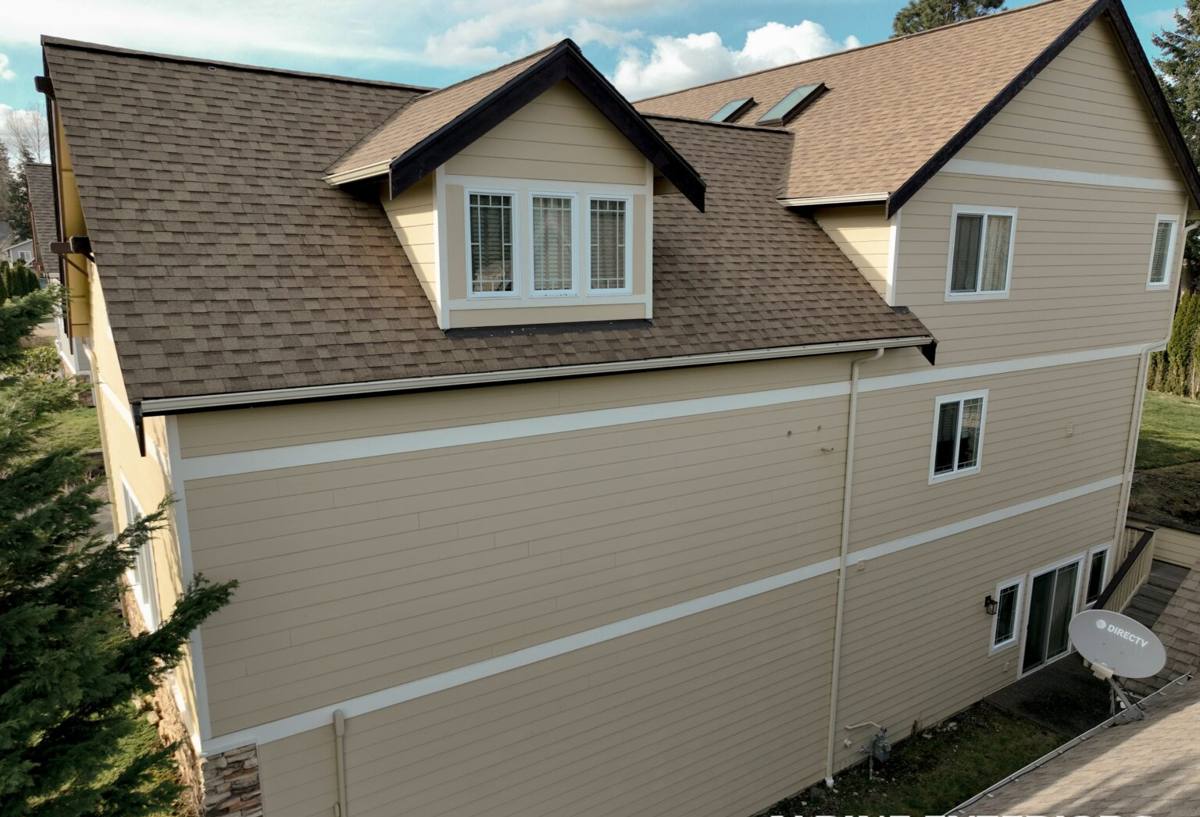
| Home size and wall complexity | Dormers, multiple gables, and cut-in windows add labor and material waste |
| Siding profile chosen | Lap, panel, and shingle-style Hardie products differ in material and labor cost |
| Trim and accessory work | Corner boards, window trim, and fascia detailing add scope beyond flat wall square footage |
| Access and site conditions | Steep lots, tight setbacks, or limited staging area affect crew efficiency |
We give real numbers after we've actually looked at the house — broad online estimates rarely hold up once sheathing condition and wall complexity are factored in.
Why a Crew That Already Works Cordata Matters
A crew that regularly works this part of Bellingham already knows what north-facing, shaded walls in this neighborhood do to a siding job, and they don't have to relearn local conditions on your house. That familiarity shows up in small decisions — how much clearance to leave near a patio, which walls need extra attention to drying and airflow, how to sequence work around Whatcom County's wetter months — that add up to a longer-lasting result. It also means a company with a physical, ongoing presence in the area rather than a crew passing through for one job and gone.
Get a Free, No-Pressure Estimate
If your Cordata home's siding is showing streaking, soft spots, or you're just planning ahead for a replacement, we're happy to take a look and give you a straight answer — no pressure, no inflated online guess. Use the form below to request a free estimate.