 Bellingham
 Board & Batten Siding in Columbia: What Local Homes Actually Need
Board and batten has a long history in the Pacific Northwest for a reason — the vertical lines read as clean and traditional on a bungalow, and equally at home on a newer build. In Columbia, we see it requested most often on homes looking to add texture to a plain elevation, define a gable end, or set an addition apart from the original structure without clashing with it. That's the easy part. The harder part is making sure a pattern built from dozens of extra vertical seams actually holds up to a Whatcom County winter.
Board and batten isn't just an aesthetic choice — it's a different water-management problem than lap siding. Every batten strip creates a joint, and every joint is a place water can find its way behind the cladding if the assembly underneath isn't built correctly. That's true everywhere, but it matters more here than in drier climates, because Bellingham doesn't give damaged siding much chance to dry out between storms.
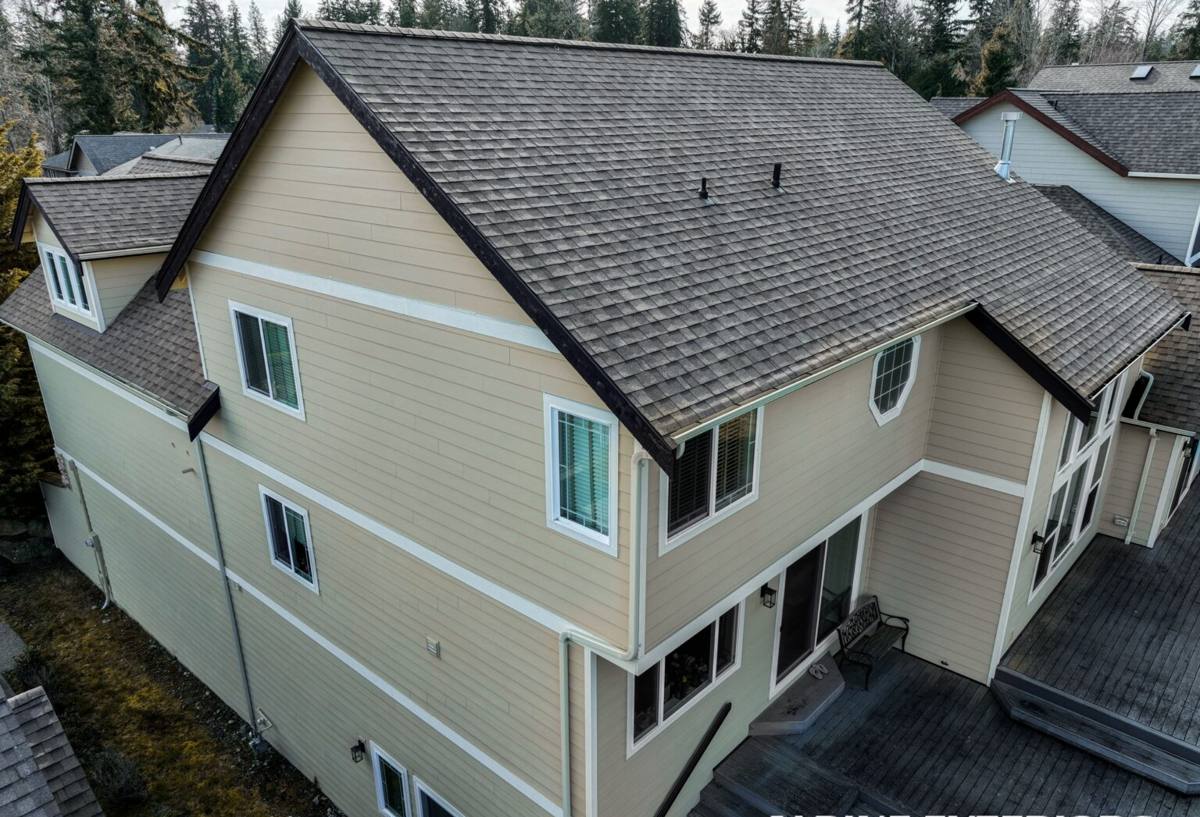
Why Columbia's Climate Is Tougher on Vertical Siding Than It Looks
Columbia sits close enough to Bellingham Bay to catch the salt-laden air that moves in off the water, and close enough to the hills and tree cover common through the neighborhood to hold onto shade and dampness longer than more open parts of town. That combination — salt air plus persistent moisture — is exactly what shortens the life of siding that isn't built for it.
- Salt air: accelerates corrosion on fasteners, flashing, and any exposed metal trim. Cheap or mismatched hardware fails years before the siding around it would otherwise need replacing.
- Driving rain: Whatcom County storms frequently come in sideways off the Sound. Vertical board and batten has more seams facing that wind-driven rain than horizontal lap siding, so the drainage plane behind it has to work harder.
- Long moss season: shaded, damp elevations in Columbia can stay wet for months at a stretch. Moss and algae don't just look bad — they hold moisture against the siding surface, which is a problem for any material that isn't dimensionally stable when wet.
None of this means board and batten is a bad choice for a Columbia home. It means the assembly behind the boards — not just the boards themselves — is what determines whether the siding lasts 10 years or 40.
What a Correctly Built Board & Batten Assembly Looks Like
A board and batten system is really three layers working together: the weather-resistive barrier, a drainage gap, and the cladding itself. Skipping or shortcutting any one of them is where most of the board and batten failures we get called out to look at actually started.
The drainage plane and rainscreen gap
Behind the vertical boards, we install a code-compliant water-resistive barrier and a true drainage gap — not just furring strips nailed flat against the sheathing. That gap lets any moisture that does get past the battens drain and evaporate instead of sitting against the wall assembly. On a home in a shaded, damp part of Columbia, this gap is arguably more important than the siding brand on the outside of it.
Flashing at every transition
Windows, doors, roof lines, and the bottom termination of the siding all need proper flashing and kick-out details. Board and batten's vertical joints put more seams near these transitions than lap siding does, so flashing mistakes show up as leaks sooner rather than later.
Fastening and hardware
Given the salt air in this part of Whatcom County, we use corrosion-resistant fasteners rated for the exposure, not whatever is cheapest at the yard. This is a small line item on an estimate and one of the biggest factors in how the job looks in year fifteen.
Why We Only Install James Hardie for Board & Batten
Board and batten amplifies whatever weaknesses a material already has, because the battens themselves are narrow, vertically oriented, and exposed on both faces to weather. That's exactly where wood-based products struggle most in a climate like Bellingham's.
| Material | How it behaves as board and batten in this climate |
|---|---|
| Primed wood / cedar battens | Absorbs water at end grain and joints; cups, splits, or pulls away from fasteners with repeated wet-dry cycles through a Whatcom County winter. Needs regular repainting and caulk maintenance to hold up. |
| Vinyl board and batten panels | Can't hold a crisp, flat board profile the way fiber cement can; expands and contracts with temperature swings, and impact damage (branches, hail, ladders) means a full panel replacement, not a spot repair. |
| LP SmartSide / engineered wood | Better moisture resistance than raw wood, but it's still a wood-based substrate — edge sealing and caulking have to stay intact indefinitely, which is a lot to ask on a shaded, damp elevation. |
| James Hardie fiber cement | Non-combustible, dimensionally stable when wet, and doesn't cup or split at the batten edges the way wood-based products can. Factory-applied ColorPlus finish resists the fading and moss-staining that shows fastest on painted vertical siding. |
We standardized on James Hardie years ago and haven't installed anything else since. For board and batten specifically, the deciding factor is how the material behaves at the edges and joints — that's where narrow vertical boards take the most punishment, and it's where fiber cement holds its shape while wood-based alternatives are the ones we'd be back out repairing.
Hardie systems that work for a board & batten look
Depending on the home, we typically build this look with Hardie panel products and vertical battens, or with Hardie's engineered board and batten collections designed specifically for this profile. Either way, the boards carry a factory finish rather than a field-applied paint job, which matters a great deal on an elevation that spends half the year damp.
Our Process for a Columbia Board & Batten Project
- On-site assessment: we look at sun and shade exposure, existing moisture or moss staining, and how the current wall assembly is draining — or not draining — before we talk about materials.
- Scope and design: board width, batten spacing, and reveal all change the look of the finished elevation. We walk through options that fit the home rather than defaulting to one standard layout.
- Tear-off and inspection: once the old siding is off, we check the sheathing for hidden rot or moisture damage — common on older homes where a prior installation skipped a drainage plane.
- Weather barrier and rainscreen install: this is the layer that actually protects the wall long-term, and it's not visible once the job is done — which is exactly why it can't be shortcut.
- Hardie board and batten installation: installed to manufacturer spec for fastener placement, gapping, and flashing, with corrosion-resistant hardware appropriate to this area's salt air.
- Final detailing and walkthrough: trim, caulking philosophy, and a review of what maintenance (if any) the finished siding will actually need.
What Board & Batten Costs to Do Right
Board and batten generally costs somewhat more than lap siding on the same wall, mainly because of the extra material for battens and the added labor for more fastening and flashing detail work. The factors below move the number more than the siding brand does.
| Factor | Why it affects the price |
|---|---|
| Existing wall condition | Rot or moisture damage found under old siding adds repair scope before new siding can go on. |
| Batten spacing and reveal | Tighter spacing means more boards, more fasteners, and more labor hours per square foot. |
| Trim and transition detail | Homes with more windows, dormers, or roof transitions need more flashing and cut work. |
| Height and access | Two-story gables and steep-sloped lots around Columbia can require additional staging. |
| Color and finish | Factory ColorPlus finishes cost more upfront than field-primed boards but remove repainting from the maintenance picture entirely. |
Maintaining Board & Batten Through a Bellingham Winter
Fiber cement board and batten is low-maintenance, not zero-maintenance. A short seasonal routine keeps it performing the way it's supposed to.
- Rinse moss and algae off shaded elevations before it builds up a thick mat — a soft wash, not a pressure washer aimed directly at seams and caulk lines.
- Walk the exterior each fall and check caulking at trim, window returns, and butt joints for cracking or separation.
- Keep gutters and downspouts clear so runoff isn't sheeting down a wall during driving rain events.
- Trim back vegetation that's shading a wall and keeping it damp longer than it needs to be.
- Have any impact damage (ladders, branches, equipment) looked at promptly rather than left to sit through a wet season.
Why Hire a Crew That Already Works in Columbia
Board and batten forgives fewer mistakes than lap siding, because there are more seams, more fastener locations, and more places for a rushed installer to skip the drainage detailing that doesn't show up until years later. A crew that already works Whatcom County homes has seen how this neighborhood's shade patterns, salt exposure, and rainfall actually play out over a full winter — not just how a spec sheet describes it. That's the difference between board and batten that still looks sharp in year twenty and board and batten that's already showing streaking, cupping, or seam failure by year five.
If you're weighing board and batten for a home in Columbia, we're happy to walk the exterior with you, talk through layout options, and give you a straight answer on what your specific walls need. Reach out for a free, no-pressure estimate — there's a form below.