 Bellingham
 Board & Batten in a Place Like Birch Bay
Board and batten has become one of the most requested siding styles along the Whatcom County coastline, and it's easy to see why. The vertical lines read as clean and modern on newer builds, but the same profile also suits the cottages and beach homes that make up a lot of Birch Bay. It's a look that fits the setting. The catch is that Birch Bay's setting is also one of the tougher places on the Salish Sea coast to keep siding looking good and performing well, because the same waterfront exposure that makes the style desirable is what puts real stress on the material underneath it.
This page is specifically about board and batten siding for homes in and around Birch Bay — what the local climate does to this style of siding over time, what a correctly built system actually involves, and how we approach these jobs differently than a crew that doesn't regularly work this stretch of coastline.
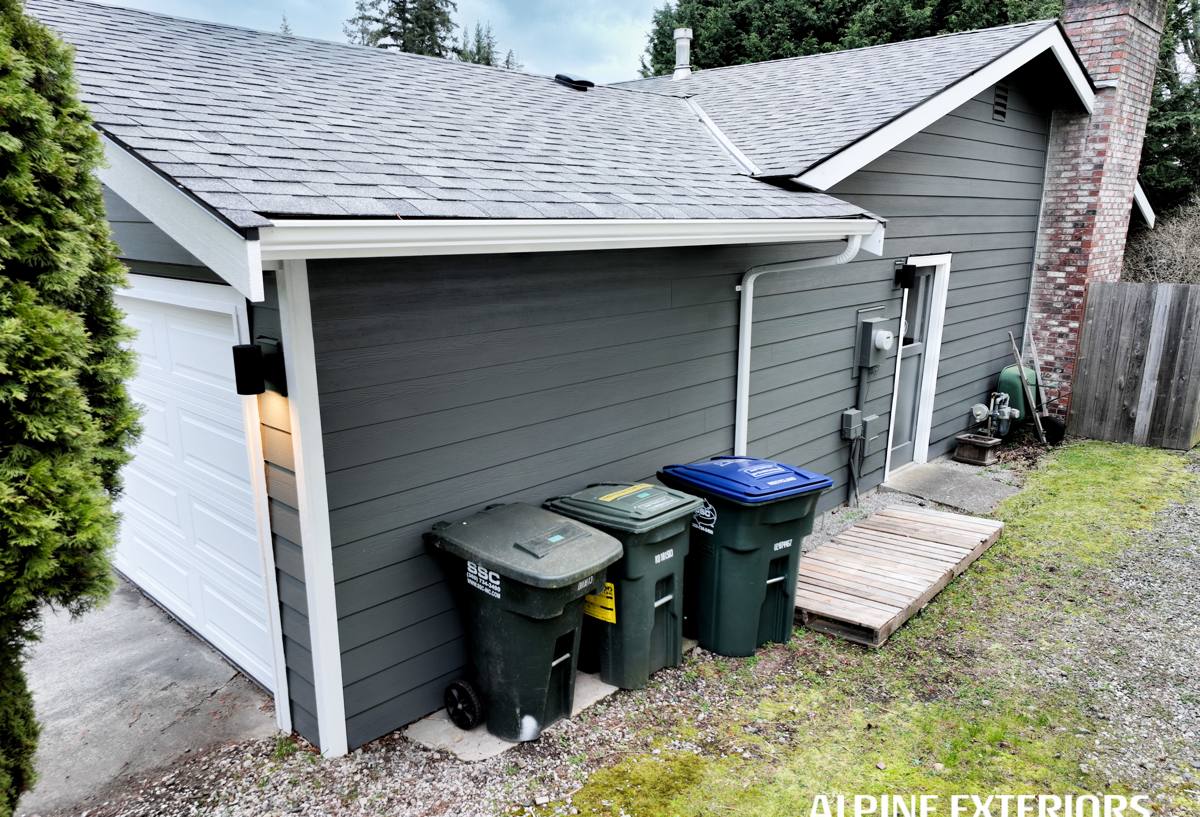
What Birch Bay's Climate Does to Board & Batten Siding
Board and batten has more seams than a standard lap siding job — every batten strip is a fastening point and a joint line — which means the details matter more here than they would on a simpler profile. In a marine environment like Birch Bay, three conditions do most of the damage when those details are cut short.
Salt Air
Waterfront and near-waterfront properties in Birch Bay sit in a steady drift of salt-laden air coming off the bay. Salt is corrosive to metal, which matters a lot on a siding style that depends on hundreds of fastener heads and trim connections. Standard fasteners can start showing rust streaks and weakening well before the siding itself is due for attention, and once a fastener corrodes, the board around it is the next thing to suffer.
Driving Rain
Storms off the water don't just fall straight down — wind-driven rain gets pushed sideways into vertical siding joints, batten seams, and anywhere the water-resistive barrier and flashing weren't detailed correctly. Board and batten is more vulnerable to this than lap siding because of the sheer number of vertical seams running down the wall, each one a potential entry point if it isn't lapped, taped, or flashed properly.
Moss and Algae Season
Whatcom County's damp season runs long, and Birch Bay's tree cover and shaded north walls hold moisture even longer. Any siding surface that stays damp for extended stretches becomes a candidate for moss, algae, and mildew growth — especially where a house sits close to vegetation or doesn't get much direct sun. A siding material without built-in resistance to this, or a finish that traps moisture at the surface, will show green and black staining years sooner than it should.
Why We Only Install James Hardie Board & Batten
We get asked fairly often about cedar board and batten, or engineered wood options like LP SmartSide, because both can be styled the same way. We don't install either, and it comes down to how each one behaves in exactly the conditions described above.
Cedar board and batten looks great new, but real wood absorbs moisture at cut ends and fastener penetrations, and in a climate that stays damp as long as ours does, that moisture cycling leads to cupping, splitting, and rot at the batten edges over time — no matter how well it's finished initially. It also needs a repaint or re-stain cycle to keep protecting the wood, which is a real ongoing cost most homeowners underestimate when they price the project.
Engineered wood products like LP SmartSide use a wood-strand core with a resin-treated surface. That's a genuine improvement over solid wood in some respects, but the core is still a wood product — if the factory-sealed edges get compromised at a cut, a fastener, or a damaged corner, moisture can wick into the strand core, and in a climate this wet that's a slower but real risk, not a hypothetical one.
James Hardie fiber cement doesn't have that failure path. It's cement, sand, and cellulose fiber — it doesn't rot, it isn't a wood host for insects, and it holds up to repeated wetting and drying without the material itself breaking down. That's why it's the only board and batten system we put on Birch Bay homes.
Board & Batten Material Comparison for Coastal Whatcom County Homes
| Factor | James Hardie Fiber Cement | Cedar | LP SmartSide | Vinyl |
|---|---|---|---|---|
| Moisture / salt-air behavior | Non-organic, doesn't rot or absorb like wood | Absorbs moisture at cuts and fasteners; prone to cupping near water | Wood-strand core; vulnerable if factory seal is breached | Doesn't rot, but seams and fasteners can loosen under wind load |
| Finish | Factory-applied ColorPlus finish, baked on | Field paint or stain, reapplied on a cycle | Field-applied paint typically required | Color molded through, fades with UV over years |
| Fire performance | Non-combustible | Combustible | Combustible | Combustible, can deform under heat |
| Long-term maintenance | Occasional wash, caulk checks | Repaint/re-stain cycle required | Repaint cycle, edge sealing | Low, but limited repair options if damaged |
| Typical warranty structure | Long, transferable manufacturer warranty on the product | No manufacturer warranty on the material itself | Manufacturer warranty exists, terms vary | Manufacturer warranty exists, terms vary |
None of these products are "bad" in the abstract — each has a place. But given what Birch Bay's exposure does to a wall over the years, fiber cement is the one we're willing to stand behind here.
What a Correctly Installed Hardie Board & Batten System Involves
Board and batten isn't harder to install than lap siding, but it's less forgiving of shortcuts, because there are more seams and fastening points per square foot of wall. In a driving-rain, salt-air environment, the details below are what separate a system that lasts from one that fails early.
Rainscreen Drainage Gap
We install with a drainage gap behind the siding rather than nailing directly to the wall. This lets any moisture that does get past the outer surface drain and dry out instead of sitting against the sheathing — which matters a lot more in a climate with a long wet season than it does somewhere dry.
Corrosion-Resistant Fasteners
Given the salt content in the air this close to the water, we use fasteners rated for the exposure rather than standard-grade hardware. This is one of the cheapest details to get right and one of the most commonly skipped, because it doesn't show up as a problem until years later.
Flashing and Seam Detailing
Every window head, door head, and horizontal transition gets flashed to shed water outward, not just caulked and hoped for. Caulk is a backup, not a primary water management strategy — it degrades faster than the siding around it, especially with this much sun and salt exposure cycling on it.
Batten Spacing and Reveal
Batten spacing affects both the look and the performance of the wall. We follow Hardie's engineered spacing and fastening specifications rather than eyeballing a "close enough" reveal, because the manufacturer's installation instructions are also what keeps the product warranty intact.
Our Process for Birch Bay Board & Batten Projects
- On-site assessment. We look at wall orientation, tree cover, water exposure, and the condition of the existing siding and sheathing before quoting anything.
- Sheathing check. Board and batten only performs as well as what's underneath it — we check for hidden moisture damage before closing the wall back up.
- Weather-resistive barrier and flashing. This layer goes on correctly before a single piece of siding is installed, since it's the part you can't inspect once the job is finished.
- Board and batten installation. Installed to Hardie's fastening and spacing specifications, with corrosion-resistant hardware throughout.
- Final walkthrough. We go over the finished exterior with you and address anything before calling the job complete.
Maintenance Checklist for Board & Batten Homes Near the Water
- Rinse the siding down once or twice a year to clear off salt residue, especially on walls facing the water
- Check shaded, north-facing walls and areas near trees for early moss or algae growth
- Inspect caulking at window and door trim for cracking or separation
- Look at fastener heads and metal trim for rust staining
- Keep gutters and downspouts clear so runoff isn't sheeting down the wall
- Trim back vegetation that keeps a wall section shaded and damp longer than the rest of the house
Why a Crew That Already Works Birch Bay Matters
A siding crew that mostly works inland jobs isn't necessarily used to detailing for salt exposure or building in the extra margin that driving rain off the bay demands. Crews that regularly work Birch Bay and the surrounding Whatcom County waterfront know which walls take the worst of the weather, which fastener and flashing choices actually hold up here, and where the previous generation of siding on a given street tends to fail first. That local pattern recognition is worth more than it sounds like on paper — it's the difference between a wall that's built to a spec sheet and one that's built for this specific coastline.
Get a Straightforward Estimate
If you're weighing board and batten siding for a home in Birch Bay, we're glad to come take a look, walk the exterior with you, and give you a straightforward, no-pressure estimate based on your home's actual exposure and condition. Use the form below to get started.