 Bellingham
 Why Birchwood Windows Take More Abuse Than the Brochure Admits
Window manufacturers write their installation instructions and warranty terms for a generic climate. Birchwood isn't generic. Homes in this part of Bellingham deal with driving, wind-pushed rain for months at a stretch, salt-laden air drifting up from Bellingham Bay, and a moss season that can run from October well into spring. None of that shows up in a glossy brochure, but all of it shows up at the window over time.
Wind-driven rain is the big one. A window doesn't have to leak in a downpour to fail — it has to leak in a sideways rain with gusts pushing water sideways and upward against the frame. That's the condition that finds a bad seal, a missing sill pan, or flashing that was never lapped correctly in the first place. West- and south-facing walls in Whatcom County take the brunt of it, and those are usually the first windows to show staining, soft trim, or fogged glass.
Salt air adds a slower, quieter problem. It accelerates corrosion on hardware, screws, and unprotected metal flashing, and it degrades some sealants faster than the manufacturer's stated service life would suggest. And moss — while it doesn't grow on the glass itself — grows on roofs, gutters, and siding above and around window openings, holding moisture against the wall assembly and feeding water toward exactly the gaps a poorly installed window leaves behind.
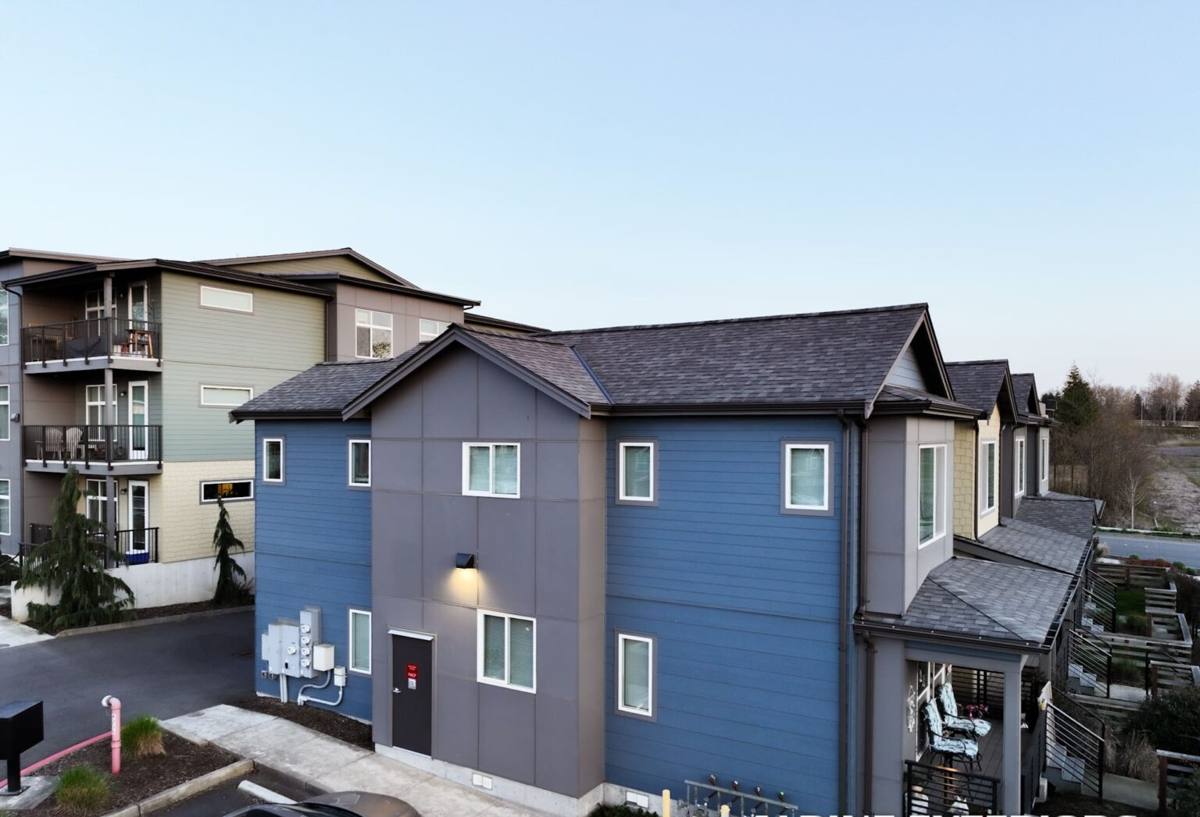
Signs Your Current Windows Are Losing the Battle
Most window failures in this climate are slow. By the time you notice a problem at the surface, moisture has usually been working on the framing behind it for a while. Worth checking for:
- Fogging or a milky haze between the panes of a double-pane window (the seal has failed and the gas fill is gone)
- Soft, discolored, or spongy wood trim or sill at the base of the window
- Paint that's bubbling or peeling specifically around the window opening and nowhere else on the wall
- Drafts you can feel with your hand held near the frame on a windy day
- Visible daylight or a gap where the sash meets the frame when the window is closed and locked
- Difficulty opening, closing, or latching a window that used to operate smoothly
- A musty smell in the room only during or after heavy rain
- Moss or dark streaking on the siding directly above a window, which often means water is being channeled down onto that opening
One or two of these on an older window is normal wear. Several at once, or any sign of soft wood, usually means the installation — not just the window — needs attention.
What a Correct Window Installation Actually Involves
The window itself is only part of the job. In our experience, most leaks and rot problems we get called out to repair trace back to installation shortcuts, not a bad product. A correct install has a few non-negotiable steps.
Sill Pan and Flashing
The rough opening needs a sloped sill pan so any water that does get past the window drains back outside instead of pooling on the framing. Flashing tape and building paper or house wrap need to be layered so each piece overlaps the one below it — water always sheds downward and outward, never the other way. This is the step that's easiest to rush and hardest to inspect once the trim is back on, which is exactly why it matters most.
Insulation and Air Sealing
The gap between the window frame and the rough opening needs to be filled with a low-expansion foam or backer rod and sealant — not stuffed with fiberglass, which does little to stop air movement and nothing to stop bulk water. Over-filling with high-expansion foam can bow the frame and cause the window to bind or fail to seal properly, so this step takes some judgment, not just a full can of foam.
Sealants and Trim
Exterior sealant around the trim has to be compatible with the cladding material and applied in the right conditions — cold, wet sealant application is a common reason caulk fails within a year or two here. Trim gets primed and painted on all cut edges, not just the face, since an unsealed cut edge is an open door for moisture.
Choosing a Window Built for Whatcom County Weather
Frame material matters more here than in a drier climate, because the frame is what's exposed to rain and salt air year-round. There's no single "best" choice for every home — it depends on your budget, your home's style, and how much upkeep you want to take on.
| Frame Material | Moisture Tolerance | Maintenance | Typical Lifespan |
|---|---|---|---|
| Vinyl | Very good — won't rot, low corrosion risk | Low — occasional cleaning | 20–30+ years |
| Fiberglass | Excellent — dimensionally stable in wet/dry cycles | Low | 30+ years |
| Wood-clad | Good if cladding and flashing are intact; vulnerable where cladding is breached | Higher — watch joints and cut edges | 20–30 years with upkeep |
| Aluminum | Fair — prone to condensation and salt-air corrosion without a thermal break | Moderate | 20–25 years |
For most Birchwood homes, we lean toward vinyl or fiberglass for their resistance to moisture and corrosion with minimal upkeep. Wood-clad windows can look great and suit some architectural styles, but we're upfront with clients that they demand more attention to caulking and paint over time in a climate this wet — that's a maintenance trade-off, not a defect, and it's worth knowing before you buy.
Our Window Installation Process
The steps below don't change from job to job — consistency is what keeps a window from becoming a callback.
- On-site assessment of existing windows, framing condition, and any signs of water intrusion or rot
- Precise measurement of each opening — replacement windows are built to the actual opening, not a standard size
- Careful removal of the old window and inspection of the rough opening and sheathing underneath
- Repair of any soft or damaged framing found once the old window is out (this is common on older Bellingham homes and gets flagged before we proceed)
- Installation of a sloped sill pan and properly lapped flashing
- Setting the new window level, plumb, and square, then securing it per manufacturer specifications
- Low-expansion foam or backer rod and sealant in the perimeter gap
- Exterior trim, caulking, and paint-ready or paint-matched finish work
- Interior trim and final adjustment so the window operates smoothly and locks tight
- Walkthrough with the homeowner and cleanup of the work area
What Affects the Cost of Window Installation in Birchwood
Every home is different, so we quote after seeing the actual openings, but the factors below are what typically move the number up or down.
| Factor | Why It Affects Cost |
|---|---|
| Number of windows | Per-window cost usually drops as the job size grows |
| Frame material | Vinyl is generally the most affordable; fiberglass and wood-clad cost more upfront |
| Size and configuration | Large picture windows, bays, and custom shapes cost more than standard double-hungs |
| Condition of the rough opening | Rot or water damage found during removal adds repair time before the new window can go in |
| Removal and disposal | Old window and packaging haul-away is typically included but varies by job size |
| Trim and finish work | Matching existing exterior trim profiles or repainting takes more labor than a straight swap |
Why Hiring a Crew That Already Works Birchwood Matters
A window installer who's worked other homes in this neighborhood has already seen how the local weather patterns interact with the housing stock here — which wall orientations take the worst wind-driven rain, what kind of framing and cladding are common on homes of a given age, and where rot tends to show up first. That's not something you can fully substitute with a generic checklist, and it means fewer surprises once the old window comes off the wall.
It also matters for follow-through. If a question comes up after the install — a drafty spot, a sticking sash, a warranty item — a local crew can get back out to the property quickly instead of you waiting on a company that's an hour or more away and only in the area occasionally. In a climate where small gaps turn into bigger moisture problems if they sit unaddressed through a wet season, that response time is worth something real.
Living With Your New Windows Through Moss Season
A correctly installed window is largely maintenance-free, but a little seasonal attention goes a long way in Whatcom County's wet stretch:
- Keep gutters and downspouts clear above and near windows — overflow water is a common source of staining and long-term moisture at the frame
- Rinse accumulated moss, dirt, and debris off nearby siding and trim so it doesn't hold moisture against the wall assembly
- Check exterior caulking once a year for cracking or separation, especially on south- and west-facing walls
- Operate each window a few times through the fall and winter so weatherstripping doesn't set in one position and seals stay flexible
- Watch for condensation between panes as an early sign a seal has failed, and address it before it leads to fogged glass or drafts
None of this is heavy upkeep — it's the kind of five-minute check that catches a small problem before a wet Bellingham winter turns it into a bigger one.
If your windows are drafty, fogged, hard to operate, or you're just planning ahead for a home in Birchwood, we're happy to take a look and give you a straightforward, no-pressure estimate. Use the form below to get started.