 Bellingham
 Roofing Built for Birchwood's Coastal Climate
Homes in the Birchwood area sit close enough to Bellingham Bay and the surrounding waterways that salt-laden air is a constant factor in how a roof ages. Combine that with Whatcom County's long wet season, driving rain off the Strait, and the deep shade many Birchwood lots get from mature evergreens, and you have a recipe for roofs that wear out faster than the manufacturer's brochure suggests. Moss doesn't take a season off here — it's active nearly year-round, working into shingle laps and granule surfaces whenever there's enough moisture and shade to sustain it.
A roof replacement in this neighborhood isn't just a matter of swapping old shingles for new ones. It's about choosing materials and installation details that specifically resist the moss, moisture, and salt exposure that define this part of Bellingham. We've replaced roofs throughout Birchwood and the surrounding streets long enough to know which failure patterns show up here again and again, and we build every new roof to address them from day one.
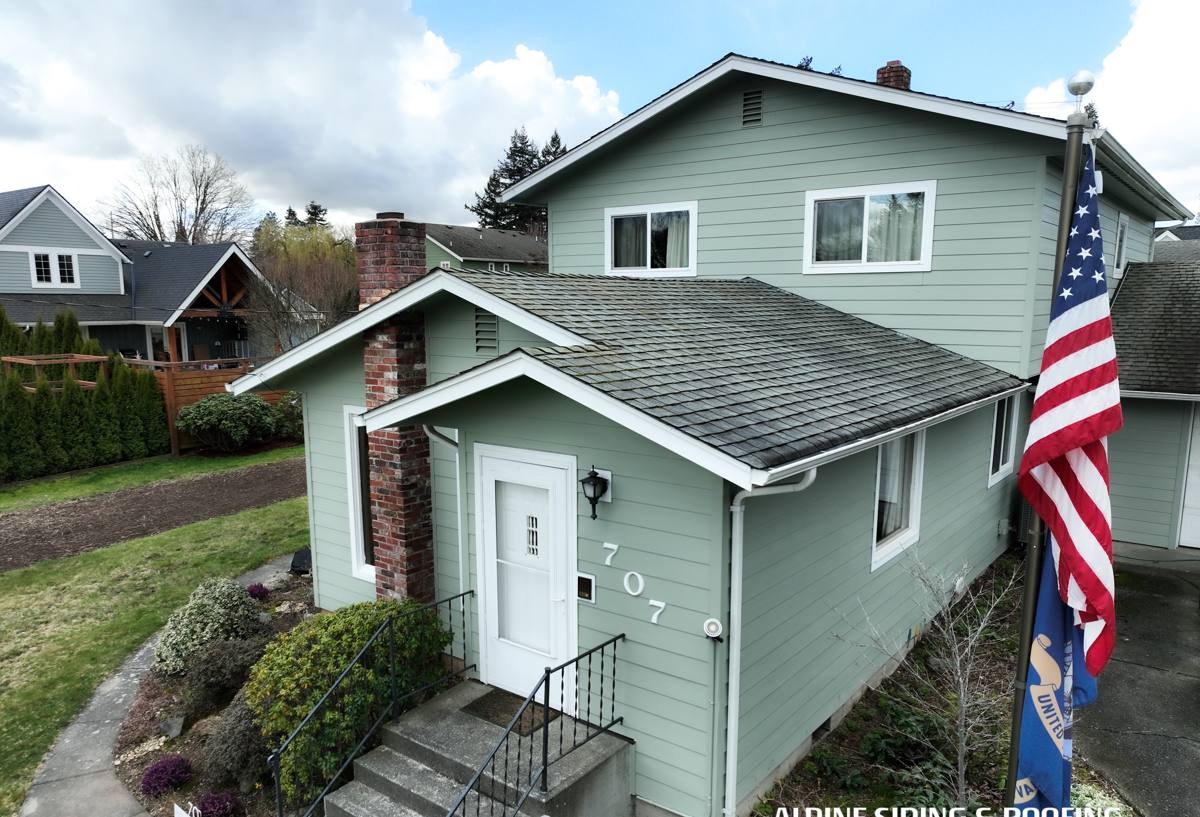
Why Birchwood Roofs Fail Early
Before we talk about replacement, it helps to understand what's actually shortening the life of roofs in this neighborhood. Most premature roof failures we find during inspections trace back to the same handful of causes.
Moss and Organic Growth
Moss holds moisture against the roof surface long after the rain has stopped. On shaded, north-facing slopes — common on lots with tall fir and cedar cover — moss can establish within a couple of years of a new roof going on if it wasn't installed with growth resistance in mind. Once moss gets a foothold, it lifts shingle edges, traps debris, and creates channels for water to work its way under the roofing material instead of over it.
Salt Air and Metal Corrosion
Proximity to the bay means airborne salt settles on roofing metal — flashing, fasteners, vent caps, and gutter hardware — at a faster rate than it would further inland. Standard galvanized fasteners and flashing can start showing rust streaks and pitting well before the shingles themselves are due for replacement. This is one of the most common "hidden" problems we find on roofs that look fine from the ground.
Driving Rain and Wind-Driven Water
Storms coming off the Strait of Georgia don't just drop rain straight down — they push it sideways under wind gusts, which means water finds its way into any gap, lap, or seam that isn't sealed and shingled correctly. Roofs installed with shortcuts on underlayment or flashing detail may hold up fine in calm weather and then leak the first time a real coastal storm rolls through.
What a Correct Roof Replacement Involves
A roof replacement done right in this climate goes well beyond removing old material and nailing down new shingles. Here's what we consider non-negotiable on every Birchwood project.
- Full tear-off to the deck — never a layover — so we can inspect and repair the sheathing underneath
- Deck inspection and replacement of any soft, delaminated, or water-stained sheathing before new material goes down
- Ice-and-water shield or high-quality synthetic underlayment at eaves, valleys, and around every penetration
- Corrosion-resistant flashing and fasteners suited to salt-air exposure, not just the cheapest code-minimum hardware
- Proper ventilation balance between intake and exhaust, which reduces the trapped moisture that feeds moss and mildew
- Shingle or material selection with algae and moss resistance built in, where the homeowner's budget allows
- Careful valley, chimney, and skylight flashing work, since these are the most common leak points in wind-driven rain
- A clean, code-compliant tie-in at all edges, ridges, and transitions so nothing is left to "settle in" over time
Skipping any one of these steps is usually where premature leaks and moss regrowth start. It's cheaper to do it right the first time than to chase leaks two or three years into a new roof's life.
Choosing Materials for This Neighborhood
There's no single "best" roofing material for every home, but there are trade-offs worth understanding before you decide. We walk every Birchwood homeowner through these honestly, including where a lower-cost option makes sense and where it doesn't.
| Material | Moss/Moisture Behavior | Salt Air Durability | Typical Lifespan Here |
|---|---|---|---|
| Standard asphalt shingle | Needs algae-resistant granules or regular cleaning to slow moss | Fasteners and flashing are the weak point, not the shingle itself | 15-20 years with maintenance |
| Algae-resistant architectural shingle | Copper or zinc granules actively resist moss and algae growth | Performs well when paired with corrosion-resistant hardware | 20-30 years |
| Metal roofing | Sheds water fast, very little surface for moss to grip | Requires marine-grade coatings or finishes near the bay | 40-50+ years |
| Cedar shake | High maintenance burden — needs regular treatment to resist moss and rot | Salt air accelerates weathering without diligent upkeep | 20-30 years with active maintenance |
For most Birchwood homes, we lean toward algae-resistant architectural shingles as the practical middle ground — they handle the moss pressure well, install cleanly on the roof pitches common in the neighborhood, and don't demand the ongoing maintenance that cedar shake requires to perform. Metal is worth serious consideration for homeowners planning to stay long-term, since the upfront cost is offset by decades of reduced maintenance and moss resistance. We're honest that cedar shake, while attractive, asks a lot of a homeowner in terms of upkeep in a climate this wet — that's a maintenance conversation we have up front, not a mark against the product itself.
Our Roof Replacement Process
Homeowners want to know what's actually going to happen to their house, and for how long. Here's the sequence we follow on every project.
- On-site inspection and estimate — we walk the roof, check the attic for ventilation and moisture issues, and give you a straightforward written estimate with no pressure to decide on the spot.
- Material selection — we go over the trade-offs for your specific roof pitch, shade exposure, and budget so you're choosing with full information.
- Scheduling around weather — we plan the tear-off and dry-in around the forecast, since an open roof deck and a Whatcom County rain system don't mix.
- Full tear-off and deck inspection — old material comes off completely, and any damaged sheathing gets replaced before anything new goes down.
- Underlayment, flashing, and shingle installation — installed in the sequence and overlap pattern that actually sheds wind-driven rain, not just vertical rainfall.
- Ventilation check — intake and exhaust venting are verified or corrected as part of the job, not treated as an afterthought.
- Final walkthrough and cleanup — magnetic sweep for debris, gutter check, and a walkthrough so you know exactly what was done and what to expect going forward.
What Homeowners Can Do Between Roof Replacements
A well-installed roof still benefits from basic upkeep, especially in a neighborhood with this much moss pressure. A few habits go a long way:
- Keep gutters clear so water doesn't back up under the shingle edge during heavy rain
- Trim back overhanging branches where reasonable, to reduce shade and debris buildup on the roof
- Have moss growth treated or gently removed before it spreads, rather than waiting until it's established
- Schedule a roof check after major windstorms to catch lifted shingles or damaged flashing early
Why Local Experience Matters for This Job
Roof replacement is one of those projects where the difference between "adequate" and "correct" doesn't show up until year two or three, when a poorly flashed valley starts leaking or moss takes over a shaded slope that was never treated for it. A crew that hasn't worked this specific stretch of Whatcom County doesn't always know to plan for salt-air corrosion on fasteners, or to size ventilation for a house tucked under heavy tree cover. Those are details you learn by doing this work here, on these homes, in this weather — not by following a generic install checklist written for a drier climate.
We also know the practical side of working in Birchwood: which permitting steps apply, what tear-off timing avoids the worst of a wet week, and how to sequence a job so your home isn't exposed to open weather any longer than necessary. That local knowledge translates directly into a roof that performs the way it's supposed to, for as long as it's supposed to.
Signs Your Birchwood Roof May Need Replacing
Not every roofing problem calls for full replacement, but certain signs mean it's time for a serious evaluation rather than another round of patch repairs.
- Granule loss heavy enough that shingles look bald or patchy, especially on south- and west-facing slopes
- Moss coverage that returns quickly after cleaning, or has visibly lifted shingle edges
- Rusted or deteriorating flashing around chimneys, vents, or skylights
- Daylight visible through the roof deck from inside the attic
- Interior water stains that appear or worsen during wind-driven storms specifically
- A roof approaching or past 20 years old, particularly if it's never had a full tear-off
If you're seeing one or two of these, a repair might still be enough. If you're seeing several at once, replacement is usually the more cost-effective path, since repeated patch repairs on an aging roof rarely add up to good value.
Get a Straightforward Estimate
If your Birchwood home is due for a new roof, or you're just not sure whether repair or replacement makes more sense, we're happy to take a look and give you an honest answer either way. Use the form below to request a free, no-pressure estimate, and we'll walk your roof with the local climate — salt air, moss, and driving rain included — in mind from the start.