 Bellingham
 New Construction Is a Different Job Than Window Replacement
When a home is going up from the studs out, windows aren't dropped into an existing rough opening that's already survived a few winters — they're set into framing that has never been tested by weather. That's an advantage if it's done right, because you get to build the water management system into the wall from day one instead of working around whatever's already there. It's a liability if it's done wrong, because any mistake gets sealed behind siding and trim before anyone notices, and in Birchwood's stretch of Bellingham that mistake usually shows up as a stain, soft trim, or a drafty room within a few winters, not right away.
New-construction window work means integrating the window with the weather-resistive barrier (WRB), flashing, and sill pan as one continuous drainage plane — not just screwing a window into an opening and calling it done. That distinction matters more here than in drier parts of the country, and it's the whole reason this page exists as its own service rather than a generic "we install windows" pitch.
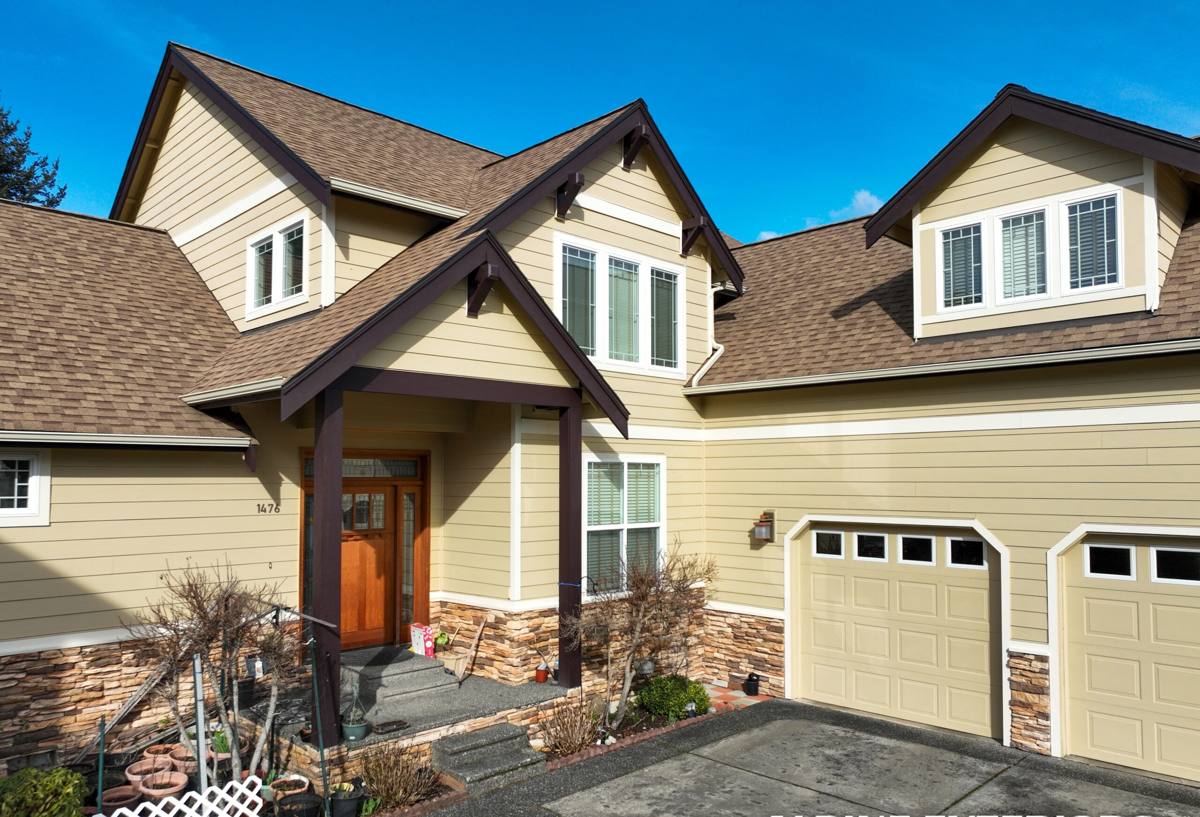
Why Birchwood's Climate Changes What "Correct" Looks Like
Birchwood sits inside Bellingham's marine climate, and that comes with a specific set of stresses on new-construction window openings:
- Salt air off Bellingham Bay accelerates corrosion on the wrong fastener or flashing metal, which is why we're picky about what hardware and flashing tape actually goes against the wood and metal components near a window opening.
- Driving rain off Puget Sound doesn't just fall — it gets pushed sideways into wall assemblies during winter storms, which means a window's weakest point (usually the sill and the corners) has to shed water outward, not just rely on caulk to keep it out.
- A long moss season in Whatcom County keeps north- and shade-facing exterior surfaces damp for months at a time, which is less about the window itself and more about making sure sills, trim, and the surrounding cladding are detailed to dry out instead of holding moisture against the frame.
None of this means Birchwood needs exotic products. It means the installation details — flashing sequence, sealant choice, sill pan design — have to account for sustained wet weather rather than the occasional storm.
Choosing the Right Window for a New Build Here
Frame material matters less than correct installation, but it's still worth getting right up front, because you're not going to want to swap it out in five years. Here's how the common options stack up for Whatcom County's climate:
| Frame Material | How It Handles Our Climate | Trade-Offs to Know |
|---|---|---|
| Vinyl | Good moisture resistance, low maintenance, widely available | Can expand/contract with temperature swings; quality varies a lot by manufacturer tier |
| Fiberglass | Very stable in wet/cold cycling, holds paint well, low expansion | Higher upfront cost than vinyl |
| Wood-clad | Strong look, good insulating properties | Cladding seams need careful sealing or moisture can work into the wood core over time — more of a maintenance commitment in a wet climate |
| Aluminum | Durable, slim sightlines | Poor thermal performance unless thermally broken; can be prone to condensation in our humidity without the right glazing package |
We'll also talk through U-factor and Solar Heat Gain Coefficient (SHGC) ratings for your specific elevations — a south-facing living room window and a north-facing bedroom window in the same Birchwood home don't necessarily want the same glass package.
What We Won't Install and Why
We steer builders and homeowners away from bargain-tier window lines with thin frame profiles and unproven weatherstripping, not because a brand is "bad," but because the failure mode in our climate is slow and expensive: minor air and water infiltration that doesn't show up until the warranty window has closed. Our standard is picking products with a track record in Pacific Northwest marine climates and warranty structures that actually cover moisture-related failures, not just glass defects.
The Installation Sequence That Actually Keeps Water Out
This is the part that separates a window that performs for decades from one that starts leaking in year three. On a new build, the sequence has to happen in order, every time:
- WRB (housewrap) is lapped correctly around the rough opening before the window ever shows up on site.
- A sloped sill pan goes in first, so any water that gets past the window has a built-in path back outside instead of sitting on the framing.
- The window is set, leveled, and shimmed to the manufacturer's tolerances — not just "close enough."
- Flashing tape goes on the sides and then the head, in that order, so each layer sheds onto the one below it like shingles.
- Sealant is applied at the specific points the manufacturer calls for — and just as important, left out where it shouldn't be, so trapped moisture has somewhere to escape.
- Exterior trim and cladding are tied back into that same drainage plane, not just butted up against the window frame.
A few things we check before calling any new-construction window install finished:
- Sill pan slopes outward with no dams or reverse-lap seams
- Flashing tape is fully adhered with no fishmouths or gaps at corners
- Window operates smoothly and locks flush without racking
- Weep holes (if applicable) are clear and functional
- Interior and exterior sealant lines are continuous with no skips
- Nailing fin or flange is fully fastened per the manufacturer's schedule
Coordinating with Your Builder or General Contractor
Most of our new-construction work in the Bellingham area happens as a scheduled trade on someone else's job site, not as a standalone project we run start to finish. That means timing matters: we need the rough openings framed to spec and the WRB installed before we show up, and we need to get windows in and flashed before the siding crew closes up the wall. We're used to working inside a GC's schedule, showing up when the job is actually ready for us, and flagging framing issues (out-of-square openings, missing blocking) before they become our problem to solve after the fact.
If you're an owner-builder managing your own trades in Birchwood, we can also walk you through what needs to happen before and after our part of the job so nothing gets missed in the handoff between framing, windows, and siding.
How We Handle a Birchwood New-Construction Window Job
1. Plans and Product Selection
We review the window schedule from your plans, talk through frame material and glass package options for each elevation, and confirm quantities and sizes before ordering.
2. Site Coordination
We check in with the builder or GC on timing, confirm the WRB and rough openings are ready, and schedule the install to fit the broader build sequence.
3. Installation
Sill pans, flashing, and window setting happen in the sequence above, with attention to the details that matter most for driving rain and long-term moisture exposure.
4. Walk-Through
Before we leave, we operate every window, check seals and flashing laps, and go over anything the homeowner or GC should know for the siding and trim crews coming in next.
Common Mistakes We See on New Builds in This Area
A lot of the water problems that show up in Whatcom County homes years after they're built trace back to a handful of repeatable mistakes: flashing installed in the wrong order (head before sides), sealant used as a substitute for proper flashing instead of a backup to it, sill pans that are flat instead of sloped, and window openings framed slightly out of square that get forced to fit instead of corrected. None of these are expensive to avoid during construction — they get expensive later, once siding, trim, and interior finishes are covering them up.
Why a Crew That Already Works Birchwood Matters
Window performance in a marine climate isn't just about the product — it's about installers who've already dealt with this specific combination of salt air, sideways rain, and a moss season that keeps things damp for months. A crew that's worked other new builds in Bellingham and around Whatcom County isn't guessing at how to detail a sill pan for our weather; they've already seen what happens when it's done wrong on a different job and adjusted. That local track record is worth more than a lower bid from a crew that's mostly worked drier climates and is learning our weather on your house.
If you're planning a new build in Birchwood and want windows installed the right way the first time, we're happy to walk the plans with you or your builder and give you a straightforward, no-pressure estimate — just fill out the form below.