 Bellingham
 The Climate Barkley Siding Actually Has to Survive
Barkley sits close enough to the water and the surrounding tree cover that its homes deal with a specific combination of stresses most siding products were never designed for: salt-laden air drifting in off Bellingham Bay, driving rain that comes in sideways during fall and winter storms, and a moss season that can stretch from October well into spring. None of these alone is unusual for Whatcom County. Together, over years, they're what separates siding that still looks sharp at year fifteen from siding that's cupping, staining, and rotting at the seams by year eight.
Salt air is corrosive to exposed fasteners and hard on any finish that isn't fully cured and sealed at the factory. Driving rain finds every gap in flashing, caulking, and butt joints, and pushes water sideways into places gravity alone would never take it. And moss doesn't just sit on the surface — it holds moisture against the siding face for months at a time, which is exactly the condition that rots wood-based products and softens paint film on lesser materials. A siding system for a Barkley home has to be evaluated against all three, not just "does it look good going up."
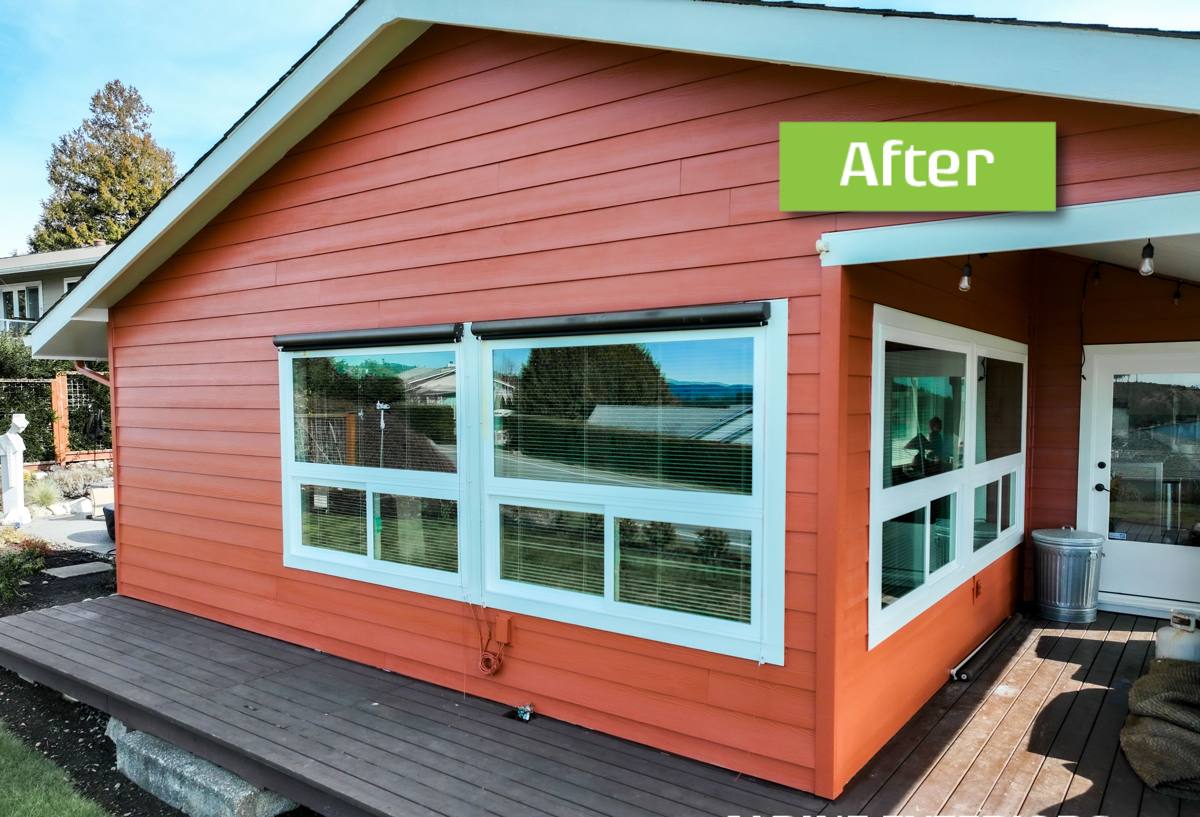
The James Hardie System We Install Here
We install James Hardie fiber cement siding exclusively — no vinyl, no LP SmartSide, no Cemplank or Allura, no primed spruce or cedar. That's not a marketing position, it's a decision based on what actually holds up in this climate over decades rather than years. Hardie's fiber cement core is non-combustible and doesn't rot, delaminate, or feed moss the way wood-based products can. On top of that, Hardie engineers its siding by climate zone, and the Pacific Northwest falls into the HZ5 formulation — built to perform in a region defined by sustained moisture rather than extreme heat or hard freeze-thaw cycles.
The other piece is ColorPlus Technology, Hardie's factory-applied finish. It's baked on in a controlled environment rather than field-painted, which means better adhesion and a finish that resists fading and cracking far longer than a job-site paint job. For Barkley specifically, that matters because a field-applied finish is only as good as the weather conditions on the day it was sprayed — and reliable dry, low-humidity stretches aren't something you can count on here for long.
Product Lines We Use Most in This Neighborhood
- HardiePlank lap siding — the standard for most Barkley homes, available in several exposure widths and textures
- HardieShingle — for homes with shingle-style accents or full shingle facades
- HardiePanel — vertical panel applications, often paired with board-and-batten detailing
- HardieTrim and HardieSoffit — matched trim and soffit systems so the whole envelope moves and weathers together
What a Correct Installation Involves
Fiber cement siding is only as good as the installation underneath it. Most of the siding failures we get called out to inspect in this area aren't product failures at all — they're installation shortcuts that let water get behind the siding and stay there. A correct James Hardie install on a Barkley home includes:
- A weather-resistive barrier installed correctly, with proper overlaps and no punctures left unsealed
- Flashing at every window, door, and roofline intersection — the single most common place we find water damage on older installs
- Proper fastener placement and type, driven to the manufacturer's specified depth (not too shallow, not overdriven, which crushes the material and voids protection at that point)
- Correct clearance at the bottom of the siding — from grade, from decks, from roof lines — so water has somewhere to go instead of wicking upward
- Caulking only where Hardie's install specs call for it, not as a substitute for proper flashing and gapping
Every one of those items is inspectable, and every one of them is where an underqualified crew cuts corners to move faster. It's also exactly why Hardie's product warranty is tied to installation according to their published specifications — get the install wrong and you can void the coverage on a product that would otherwise last decades.
Signs Your Current Siding Is Already Losing the Battle
If your Barkley home has older siding — original wood, vinyl, or an aging fiber cement product installed without proper flashing — there are specific signs worth watching for before a small problem becomes a sheathing repair:
| What You See | What It Usually Means |
|---|---|
| Persistent moss or dark streaking on north- and west-facing walls | Moisture is sitting against the siding longer than it should; check drainage and gutter overflow points |
| Soft spots or slight give when you press on the siding | Water has likely reached the substrate; this needs inspection before it spreads |
| Paint that's peeling in sheets rather than fading evenly | Moisture is pushing out from behind the siding, not just weathering the surface |
| Visible gaps or cracking at butt joints and corners | Failed caulking or original installation gaps — a direct path for driving rain |
| Warping or cupping panels | Common on wood-based or lower-grade products after repeated wet-dry cycles |
Our Process, Start to Finish
We keep the process straightforward because homeowners in this neighborhood are usually juggling a lot else. It looks like this:
- On-site assessment — we look at your current siding, sheathing condition where visible, trim, flashing, and any problem areas you've already noticed
- Written estimate — a clear scope covering product line, color, trim details, and what's included, with no vague allowances
- Prep and tear-off — removal of existing siding, inspection of the sheathing underneath, and repair of any rot or damage found before anything new goes up
- Weather barrier and flashing — the layer that actually determines whether the job lasts, done to spec before a single piece of Hardie siding is hung
- Installation — siding, trim, and soffit installed to manufacturer fastening and clearance specifications
- Final walkthrough — we go over the finished work with you directly before calling the job done
What a Barkley Hardie Project Typically Involves
Every home is different, but the factors that move a project's scope and cost are consistent. This isn't a price list — it's what to expect a contractor to actually walk through with you:
| Factor | Why It Matters |
|---|---|
| Home size and wall complexity | More corners, gables, and dormers mean more cutting, trim work, and labor time |
| Condition of existing sheathing | Rot found during tear-off has to be repaired before new siding goes up — this is common on older homes here |
| Siding profile and texture chosen | Lap widths, shingle accents, and panel details all price differently in labor and material |
| Trim and soffit scope | Full trim replacement adds cost but keeps the whole system matched and warrantied together |
| Access and site conditions | Grade, landscaping, and setback from neighboring structures affect staging and labor time |
Why a Crew That Already Works This Neighborhood Matters
Barkley isn't a generic subdivision — it's a mix of newer construction and established homes, with landscaping and tree cover that varies block to block, all sitting under the same Whatcom County weather. A crew that's already worked houses in this area knows where moss tends to build up fastest, which orientations catch the worst of the driving rain, and how the local moisture pattern behaves differently than it does ten miles inland. That local knowledge shows up in small decisions during the job — flashing details, drainage planning, product spacing — that a crew unfamiliar with this specific microclimate might not think to double-check.
It also matters for accountability. A local crew is easy to reach if a question comes up two years down the road, and has a reputation in the neighborhood worth protecting.
Living With Hardie Siding After Installation
One of the real advantages of fiber cement over wood or vinyl is how little ongoing maintenance it needs — but "little" isn't "none." A simple annual routine keeps a correctly installed system performing the way it's designed to:
- Rinse the siding down once or twice a year, especially north- and west-facing walls where moss and grime build up fastest
- Keep gutters clear so overflow isn't running down the wall face during heavy rain
- Trim back landscaping and tree limbs that keep siding shaded and damp longer than it should be
- Check caulking at trim joints and penetrations every couple of years and touch up as needed
- Address any impact damage (a stray branch, equipment bump) promptly rather than letting it sit exposed
That's meaningfully less than what wood siding demands, and it avoids the long-term issues — cracking, warping, color fade — that come with vinyl and lower-grade fiber cement products over a fifteen- to twenty-year span in this climate.
The Warranty and What It Actually Covers
James Hardie backs its siding with a non-prorated, transferable limited warranty, and ColorPlus finishes carry their own separate coverage for the factory finish itself. The transferability matters if you sell the home — it's a real asset in a listing, not just a maintenance-avoidance feature. The coverage is meaningful specifically because it's tied to correct installation per Hardie's published specs, which is the same reason we're careful about every flashing detail and fastener spec on every job: an install done right is what makes that warranty worth something instead of a document with an asterisk.
If you're weighing a siding replacement on a Barkley home, we're glad to come take a look and talk through what your specific house needs — no pressure, no obligation. A free estimate gets you a clear, honest read on condition and options before you decide anything.